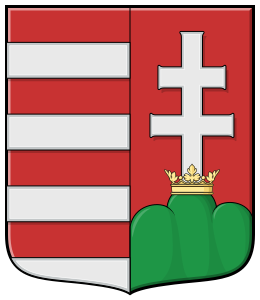
Coat of arms of the Kingdom of Hungary
Location:
Type:
The Origin and Elements of the Coat of Arms of the Kingdom of Hungary
The Hungarian state coat of arms, as known today, evolved from the combination of two foundational heraldic motifs: the so-called Árpád stripes and the double cross. Initially, these motifs appeared separately on the seals and coins of the monarchs:
The Double Cross: First appeared during the reign of King Béla III (1172–1196) under Byzantine influence. Originally, it featured no triple mount, rising directly from the base of the shield.
The Árpád Stripes: First emerged on the golden seal (bulla) of King Emery in 1202. The red and silver stripes of the barry of eight shield initially contained walking lions reflecting Aragonese influence, which were later omitted.
The Triple Mount and Crown: The green triple mount beneath the double cross, along with the golden crown resting on its central peak, became established during the 14th century, during the Gothic period (primarily under the Anjou kings and King Wenceslaus).
The Unification of the Árpád Stripes and the Double Cross
The practice of depicting the two distinct shield fields together and organizing them into a single composition began at the end of the 14th century, under the reigns of King Louis I (Louis the Great) and Sigismund of Luxemburg, when the party per pale shield displayed the stripes on one side and the double cross on the other. However, this process was not exclusive for a long time, as reigning monarchs consistently combined national emblems with their own dynastic coats of arms (such as the Anjou fleurs-de-lis or the Jagiellonian eagle).
Until the late Middle Ages, the coat of arms primarily represented the person and dignity of the king. A turning point occurred in the 15th century when, driven by feudal estate development, the royal coat of arms began to be officially regarded as the coat of arms of the realm (arma regni), distinguishing it from the private family coat of arms of the monarch.
The composition of the emblems and the arrangement used to this day was finalized only during the reign of Emperor and King Rudolph (1576–1608). It was during this period that it became a fixed rule that the Árpád stripes occupy the heraldic dexter side (the viewer’s left), while the double cross standing on the triple mount occupies the sinister side (the viewer’s right).
The Appearance of the Holy Crown on the National Coat of Arms
The Holy Crown placed atop the shield is not merely a decorative element, but a legal expression of Hungarian statehood and the Doctrine of the Holy Crown. Although the crown had appeared in a smaller form beneath the double cross since the 14th century, the large-scale, realistically depicted Holy Crown first appeared above the shield in the second half of the 15th century, on the coins and seals of Matthias Corvinus and Vladislaus II.
The placement of the crown on top of the shield became permanent in the 16th century under the Habsburg monarchs, symbolizing the sovereignty of the Kingdom of Hungary and its distinct status within the empire.
Source: Wikipedia

The visual content of this website may be freely used under the terms of the Creative Commons 4.0 license, provided that the source is clearly indicated and the attribution includes a full, clickable link to https://cimerek.hu or to the exact web address of the specific content.
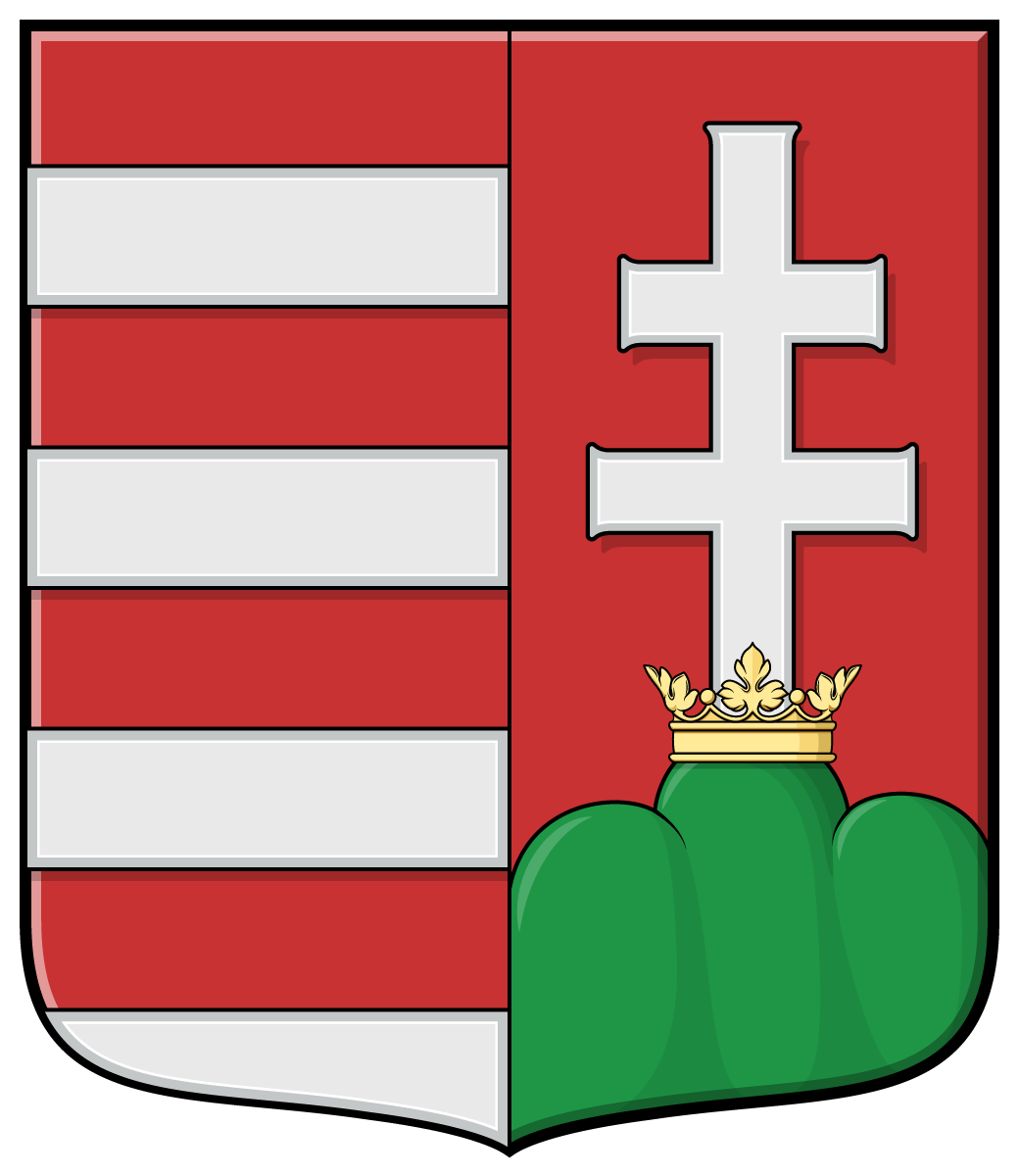
Coats of arms related to the Kingdom of Hungary on this page
Coats of arms of rulers (chronological order)
House of Árpád (1000–1301)
King Béla III of Hungary és Anna Châtillon
House of Přemysl (1301–1305)
House of Wittelsbach (1305–1307)
House of Anjou and House of Luxemburg (1308–1437)
Charles Martel titular King of Hungary
Country coats of arms
Hungary
Coat of arms of the Lands of the Holy Hungarian Crown (1867)
Seal of the Prime Minister (1848)
Lesser coat of arms of the Kingdom of Hungary (1916)
Transylvania
Municipal coats of arms
Counties
Historical coat of arms of Aranyos-Torda County
Historical coat of arms of Győr County
Historical coat of arms of Szeben County
Spiš Pledge (starostwo spiskie)
Family coats of arms
Hodossy Family of Felsődraskóc