Coat of Arms of Košice (1502) and the Present Coat of Arms
Location:
Type:
Status:
Grantor:
Year:
Košice (Hungarian: Kassa; German: Kaschau; Latin: Cassovia; Polish: Koszyce; Ukrainian: Кошиці / Košyci) is the second-largest city in Slovakia and was formerly the fifth-largest city of Czechoslovakia. It was once the seat of Abaúj-Torna County and today serves as the centre of the district and county bearing its name, as well as a Roman Catholic archiepiscopal and an Evangelical episcopal see.
Description of the Coat of Arms
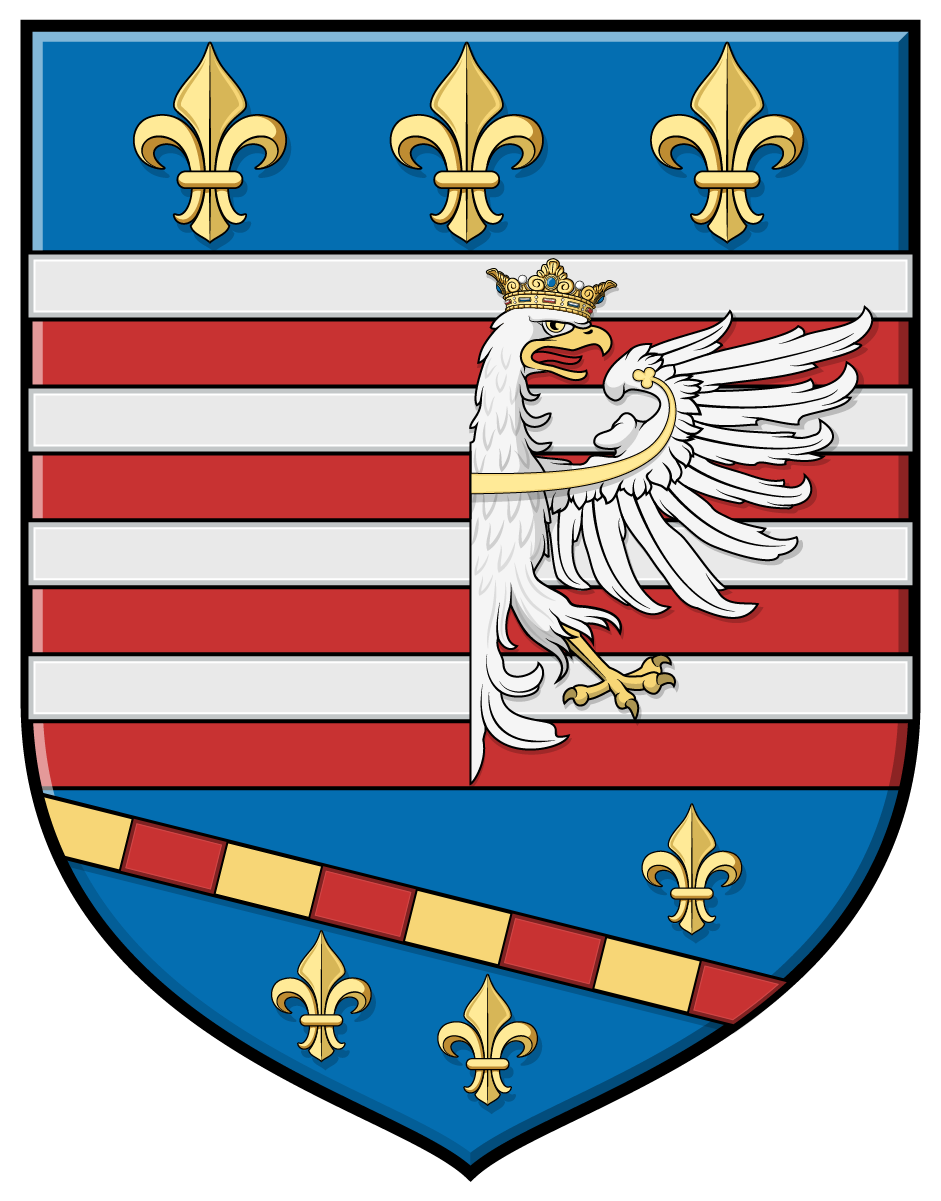
King Vladislaus II issued a new armorial charter for Košice in Buda on 8 December 1502. This was the first instance in Hungary where a municipal coat of arms included a helmet (in fact, two), crests, and mantling—that is, a complete achievement of arms. The original angelic supporter was also retained.
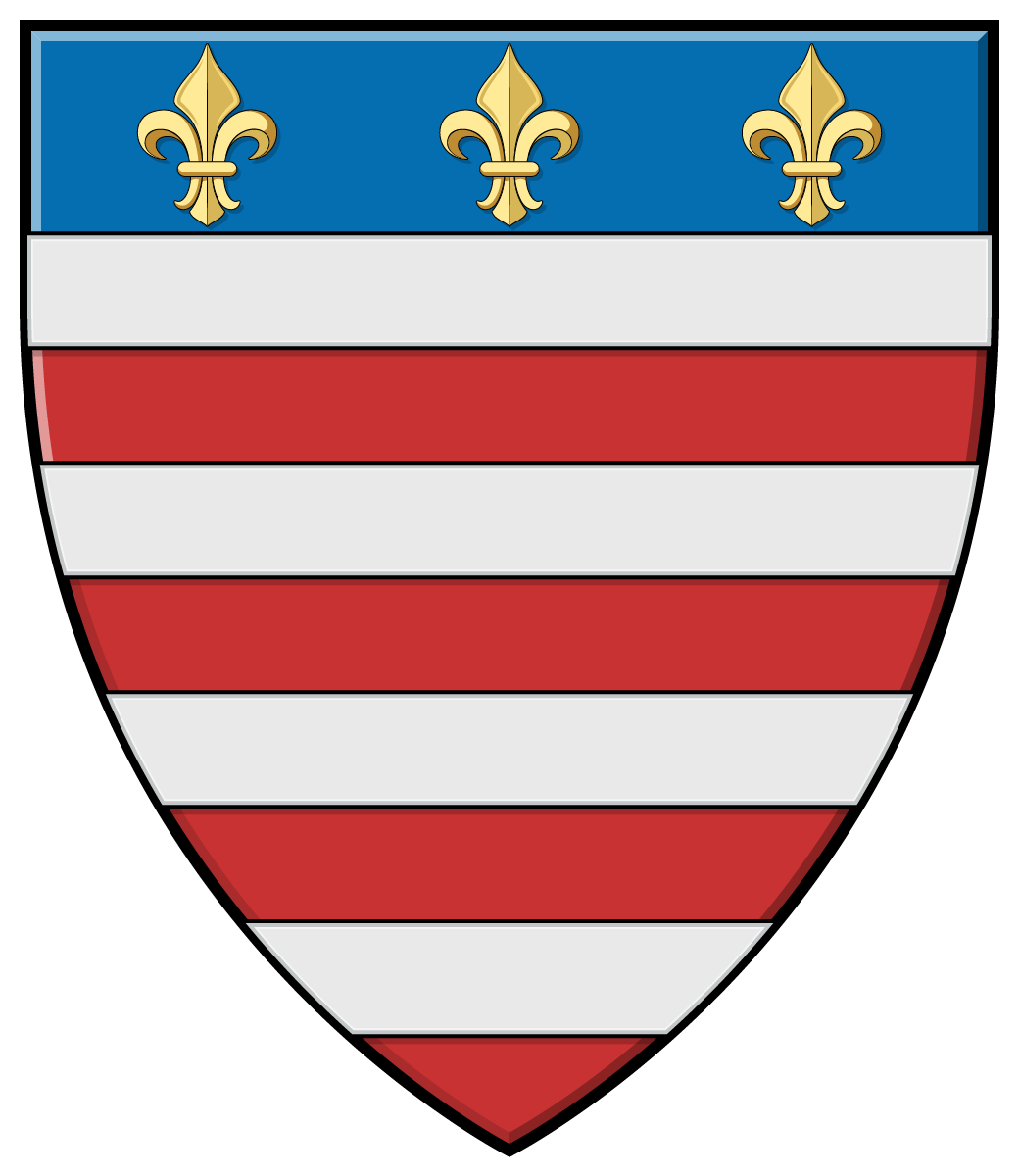
The shield field was significantly altered compared to the coat of arms of 1423. Beneath the chief decorated with three golden fleurs-de-lis, the field previously barry of seven pieces argent and gules became per pale. In the dexter field, a dimidiated (Polish) eagle from the king’s family arms was placed. In the base of the shield appears a part of the family arms of his wife, Queen Anne. The shield is pointed at the base.
The coat of arms was described in great detail in the charter, consistently observing heraldic courtesy and principles. This is especially evident in the description of the eagle: its golden beak and claws, crown, and trefoil-ended strap are all specified separately. Since the dimidiated eagle placed in the dexter field faces left—contrary to the original—and the complete eagle would otherwise be double-headed, the description explicitly states at the outset that it is a single-headed eagle. The angel is shown full-length, with a halo around its head.
Particularities of the Description
The description does not begin with the shield but with the supporter and the other heraldic elements. The angel’s garment is amethyst-coloured, woven with gold; its hair is fair and curly, bound with gemstones, and it wears a wreath adorned with a golden cross upon its head. Its wings are sky-blue, interwoven with small golden motifs. With its hands it holds the shield, which is pointed at the base.
Above the shield are two silver helmets crowned with gold, fitted with golden clasps. The crests consist of wings, yellow above and blue below, the latter dotted with gold, each bearing a golden fleur-de-lis at the centre. The mantling is described as “multicoloured, like falling flowers scattered by the wind.”
In Hungarian heraldry, this charter marks the first appearance of the interpretation of the silver bars as symbolising the country’s four principal rivers: the Danube, Tisza, Drava, and Sava.
The charter also provides a detailed account of the city’s merits that justified the grant, such as the campaign of King Vladislaus II’s brother, John Albert, as a pretender to the Hungarian throne following the coronation, and the month-long siege of Košice.
In 1504, based on the 1502 grant of arms, the city commissioned a new seal matrix, which is considered one of the finest examples of Renaissance municipal seals in Hungary. The silver seal matrix, bearing the legend SIGIL LUM CIVITA TIS. CASSA., was made by Antonius, a master of Košice. This served as a model for the city’s later seals as well, since the original armorial charter was kept in the city’s Secret Archives, inaccessible to the public.
Origin of the Name
The city’s name probably derives from the personal name Kasa or another name beginning with Ka-. The Slovak name Košice (“the people of Kosa”) is the result of a parallel Slovak naming tradition. In other languages, the city is known as: German Kaschau, Latin Cassovia or Cassoviae, Croatian Kašava, Polish Koszyce, and Russian Кошицы / Košicy.
Location
The city lies on the banks of the Hornád River, at the edge of the basin named after it, at the foot of the Kojsko Mountains, where the river emerging from the mountains slows down and deposits its sediment. As a result, its floodplain long remained a waterlogged area, and the silt deposited by regular flooding renewed the fertility of the soil. In the Árpádian period, a marsh called Blathan extended along the northern boundary of the then city.
The most important trade route connecting Hungary with Poland ran through this valley, and Košice quickly became one of its hubs because:
wagoners arriving from the Great Hungarian Plain did not venture further into the mountainous roads with their heavy vehicles, while
inhabitants of the highlands could most easily meet here the merchants coming from the Tisza region, bringing grain and wine.
A road toward Gömör County also led from here, as extensive marshes further south made travel impossible.
History of Košice
Medieval Urban Development
In the 13th century, hospes settlers established themselves here; the city is first mentioned in 1230. After the Mongol invasion of 1241, it began to develop, and in the 14th century it received the status of a free royal town. Its first church was built during this period, and guilds such as that of the furriers were established. In 1369, Košice became the first city in Europe to be granted a coat of arms.
Conflicts, Sieges, and Political Role
The city changed hands several times; between the 14th and 17th centuries it was besieged by royal, Transylvanian, and Ottoman forces alike. It became an important political and ecclesiastical centre: Stephen Bocskai died here, Gabriel Bethlen held his wedding here, and in 1644 George I Rákóczi was elected Prince of Hungary here.
Early Modern Changes
In the 18th and 19th centuries, Košice was a cultural and administrative centre. From 1802 it served as an episcopal seat; in 1849 it briefly came under Hungarian control before being occupied by Russian forces.
20th-Century History of Košice
After the First World War, the city became part of Czechoslovakia, then was re-annexed to Hungary in 1938. In 1941 it was bombed, providing the pretext for Hungary’s declaration of war against the Soviet Union. In 1944, several thousand Jews were deported from the city. In 1945, Soviet troops occupied Košice, and it once again became part of Czechoslovakia. The Košice Government Programme was proclaimed here.
Original image source: Wiki könyvek – Kassa címere
Text source: Wikipedia
The visual content of this website may be freely used under the terms of the Creative Commons 4.0 license, provided that the source is clearly indicated and the attribution includes a full, clickable link to https://cimerek.hu or to the exact web address of the specific content.
Version of the coat of arms from 1423