
Coat of arms of Master Demeter
Country:
Type:
Grantor:
Year:
Title:
Master Demeter, son of Nicholas
Life
Master Demeter, son of Nicholas, was one of the most prominent Hungarian magnates and military leaders at the turn of the 13th and 14th centuries. He came from a distinguished family: his grandfather, comes Detrik, was the first known ispán of Zólyom County, and several members of the family held ispánates in Zólyom, Szepes, Sáros and Bereg counties. As a youth, Demeter entered the royal court, probably as a page, and already distinguished himself through his military abilities during the reign of King Ladislaus IV (the Cuman).
In 1273, for his bravery during the recapture of Győr Castle, he was granted the ispánate of Sáros, later acquiring estates in Nógrád County. Between 1280 and 1286 he served as Queen’s Treasurer (tárnokmester), in 1281 became ispán of Pozsony, and from 1285 held the office of ispán of Zólyom. He took part in repelling Tatar incursions and played a major role in defending the northern regions of the kingdom, as well as in campaigns against the oligarchs.
During the reign of King Andrew III, Demeter became one of the monarch’s most reliable supporters, leading royal forces against the Kőszegi family and Matthew Csák. After Andrew’s death he supported King Wenceslaus of Bohemia, but in 1306 submitted to Charles I of Hungary. In his final years he again opposed the Angevins, and fell in the front ranks at the Battle of Rozgony in 1312.
Significance
Master Demeter was a key figure of the last generation of magnates of the Árpádian period. His military power and personal loyalty made him an indispensable supporter of successive kings, especially in the strategically important northern territories of the kingdom. Unlike many oligarchs of his age, he based his authority primarily on the lesser and middle nobility.
He raised in his household his nephew, Master Donch, as well as the sons of his brother-in-law, comes Pós. Through his offices and extensive estates, he enabled the rise of several later prominent noble families, including the Madách, Palugyay, Okolicsányi and Bobrovniczky families. In both political and military terms, he formed a link between the elite of the late Árpádian era and that of the early Angevin period.
Coat of arms of Master Demeter
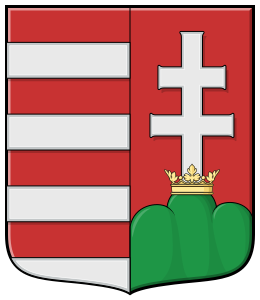
During his career, Demeter’s heraldic usage underwent a significant change. He abandoned his earlier ancestral coat of arms, featuring the bison’s head preserved throughout in the arms of the Balassa family; on his great seal of 1299, the shield already displays three fesses divided by an upward-pointing arrow. This new armorial design became the fundamental motif of later family heraldry and exerted a decisive influence on the coat of arms of his nephew, Master Donch.
Image source: Internet
Source: ChatGPT
The visual content of this website may be freely used under the terms of the Creative Commons 4.0 license, provided that the source is clearly indicated and the attribution includes a full, clickable link to https://cimerek.hu or to the exact web address of the specific content.
