
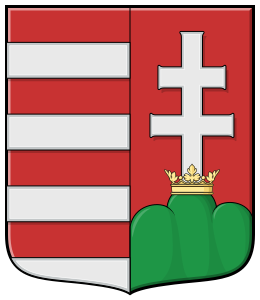
Coat of arms of Paul Kinizsi
Location:
Type:
Grantor:
Year:
Title:
The Kinizsi Family
According to Andor Puky (Turul IX, p. 88), the Kinizsy family is of very ancient origin. Members of the lineage living in the 13th century founded the two villages named Kinizs in Abaúj County, which still exist today. Another branch of the family, originating in Bihar County, split into two lines: one styled itself de Gurba, the other de Kynys. From this lineage descended the famous and exceptionally strong Pál Kinizsy, who was not of common birth but of noble origin. The family also owned a mill in the area, where he may have spent considerable time; from this circumstance Bonfini may have derived the legend that he had once been a simple miller’s apprentice.
Paul Kinizsi
(circa 1432, Kiskinizs/Nagykinizs – Szent-Kelemen, 24 November 1494) was országbíró (Chief Justice of the Kingdom of Hungary) and ispán (county head) of Zala County, and one of the most renowned military commanders in Hungarian history. He became a legendary figure thanks to his outstanding military skills, extraordinary physical strength, and a long series of victories. Remarkably, Kinizsi never lost a single battle during his lifetime—an extremely rare achievement worldwide. He was one of King Matthias Corvinus’s commanders in the Black Army.
Life
The name of Pál Kinizsi is first mentioned in 1467, in a footnote to one of King Matthias’s decrees. His exact date of birth is unknown. Earlier historians believed that he was of noble origin from birth, possibly descending from a minor noble family in Bihar County, although families bearing the name Kinizsi are also known from Székely Land and Abaúj-Torna County (Nagykinizs). More recent research has “rediscovered” sources from Abaúj County, and according to contemporary historians (Dr. László Fenyvesi, Jenő Aigner, Richárd Horváth), Pál Kinizsi most likely originated from Abaúj County, probably from the settlement of Kiskinizs or Nagykinizs.
In terms of ethnicity, he was most likely born into a Hungarian-speaking family, though German or Slavic ancestry among his forebears cannot be ruled out. His father is known to have fought against the Ottomans under János Hunyadi. According to legend, Kinizsi himself was a miller’s apprentice, but this is rejected with regard to his origins. Some theories suggest that the Kinizsi family, as a minor noble lineage, owned a mill along the Hernád River, and that due to the family’s impoverishment, Pál Kinizsi may have served in this mill.
Between 1467 and 1472, Kinizsi served as ispán of Máramaros County. In 1468 he appeared as one of the sub-commanders of Balázs Magyar during the Moravian campaign. In 1472, as a reward for his loyalty, he was granted Vázsony Castle—located along the route from Buda to Italy—together with its estates. He subsequently expanded the “Kinizsi Castle” with a palace and a barbican-like gate fortification. Around 1477, the king appointed him to lead Temesvár and the southern provinces. On 22 October 1479, he was granted the title “Captain-General of the Lower Regions,” placing fourteen counties under his administration along with their regular annual taxes. As ispán of Temes, he organized the southern defensive system, overseeing the frontier zone between the Croatian–Slavonian banate and Transylvania.
In 1478, he settled Pauline monks in Vázsony, which had been elevated to market-town status, and built a monastery and church for them. In 1480, he was also granted Somló Castle, and around the same time he married Benigna, the daughter of Balázs Magyar.
Kinizsi was ispán of Temes in 1479 when an Ottoman force led by Isa Bey Hasan-oğlu invaded Hungary and devastated Saxon Land. Contemporary sources speak of armies numbering 80,000 or 35–40,000 men, though the actual figure was likely smaller, perhaps 6,000 or 12–15,000. Together with Stephen Báthory, Voivode of Transylvania, Kinizsi won a decisive victory over the Ottoman army at the Battle of Breadfield (Kenyérmező) on 13 October 1479. Antonio Bonfini provided a vivid contemporary account of this feat:
“Pál Kinizsi grasps two swords in his hands and, like a roaring lion, wades everywhere through blood. Wherever he charges, he tramples down everything he encounters, unstoppable, carrying out great slaughter and massacre in broad ranks.”
King Matthias, who could also be ruthless, ordered Kinizsi during the war against the Czechs to devastate enemy villages with fire and sword:
“He secretly sent Imre Szapolyai and Pál Kinizsi into Poland… instructing them not to halt anywhere, not to engage in sieges, but to ride across Poland far and wide, ravaging, burning, and cruelly destroying everything with fire and steel.”
In 1481, King Matthias entrusted him with the defense of the southern borders, and in 1482 he defeated an enemy army at Szendrő.
During his lifetime, Kinizsi led numerous campaigns into Ottoman-occupied Serbia. As the population of the southern regions had been greatly reduced by Turkish incursions, he brought large numbers of Serbs to Hungary during these campaigns, settling them in these territories and employing them for military service.
After the death of Matthias Corvinus, Kinizsi turned against John Corvinus, defeated him at the Battle of Csontmező, and supported King Vladislaus II. In 1490, Holy Roman Emperor Maximilian I captured Nagyvázsony, but Kinizsi retook it the following year. In 1492, he destroyed the disintegrated Black Army. Toward the end of his life, he again fought against the Ottomans. In 1494, he saved Belgrade (Nándorfehérvár) from betrayal: the traitorous soldiers who intended to surrender the fortress for money were executed under horrific torture. He also led incursions into Serbia and Bulgaria.
He held numerous offices, including ispán of Temes (1484), ispán of Máramaros (1467), and Chief Justice of the Kingdom (országbíró, 1494). In 1494, he suffered a stroke, yet even afterward took part in the siege of Szendrő. He died on 24 November 1494. His body was transported to Nagyvázsony, where his funeral likely took place in early December 1494 at the Pauline monastery of Vázsonykő.
Legacy
In the chapel of Kinizsi Castle in Nagyvázsony stands the carved sarcophagus depicting him, in which his body was originally placed in the Pauline monastery he founded. In 1708, treasure hunters looted his grave, removing his chain mail, helmet, and double-edged greatsword, which later became the property of the Hungarian National Museum. The remains of Pál Kinizsi and Márk Horváth were reburied by an estate official of the Zichy family in the cemetery of St. Stephen’s Church in Nagyvázsony, in an unmarked grave.
On 22 August 2022, archaeological excavations began in Nagyvázsony in an effort to locate the remains of the undefeated commander. The excavation was launched under the auspices of the Black Army Youth Association, led by Ádám Sándor Pátkai and Zsombor Győrffy-Villám, with Dr. Csanád Kandikó serving as project leader.
A bronze equestrian statue of Kinizsi, created by Iván Szabó, stands in the square in front of the castle, and a commemorative plaque still marks his memory at the corner of Kinizsi Street and Castle Street. His tombstone is preserved in the Buda Castle Museum, and Somló also commemorates him with the so-called “Kinizsi Rock.” Hungary’s first long-distance hiking event, the Kinizsi Hundred, bears his name. Due to his association with Abony, a secondary school and a city gate there are named after him. His memory is also preserved by the Carpathian Basin Kinizsi Association, which unites nine Hungarian settlements and communities (two in Hungary proper, three in Transylvania, one in Upper Hungary, and three in the southern regions). The association was founded by Szabolcs Fábry, mayor of Nagyvázsony, and is supported by the Hazajáró Association and the St. Francis of Déva Foundation.
Image source: Internet
Text source: Wikipedia
The visual content of this website may be freely used under the terms of the Creative Commons 4.0 license, provided that the source is clearly indicated and the attribution includes a full, clickable link to https://cimerek.hu or to the exact web address of the specific content.
