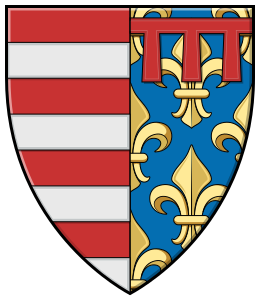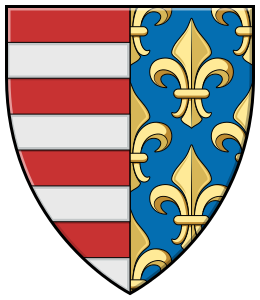
Coat of arms of King Charles I of Hungary
Name:
Epithet:
Country:
Title:
Dynasty:
Reign:
King Charles I of Hungary
Known commonly as Charles Robert (Hungarian: Károly Róbert), born Caroberto of Naples (1288 – Visegrád, 16 July 1342), he was an Angevin King of Hungary from 1308 until his death. Although he had been crowned as early as 1301, he was initially recognized as king only by the Angevin faction. His grandmother was Mary of the Árpád dynasty, Queen of Naples. His reign is considered fully legitimate from 1310, following his third and lawful coronation, and lasted until 1342. Modern historiography regards 1308—the year in which the Diet validly elected him king—as the true beginning of his reign.
He was the founder of the Hungarian branch of the House of Anjou, the firstborn son of Charles Martel of Anjou and Clemence of Habsburg, and the great-grandson of King Stephen V of Hungary. According to the Illuminated Chronicle, “at his birth he was first called at home Caroberto, that is, Charles Robert, but in Hungary the name Robert was dropped, and the Hungarians called him Charles.”
Through his western and northern policies, Charles I sought to establish an alliance system capable of counterbalancing the great power of the Holy Roman Empire, while also improving Hungary’s economic position. By developing the honor system and basing state finances on regalian revenues—income derived from royal rights—he carried out major financial reforms that significantly increased the revenues of the royal treasury.
In the second half of his reign, major Gothic construction projects were undertaken. These included the building of the royal palace at Visegrád, the chapter house of the Franciscan monastery in Sopron, the reconstruction of Diósgyőr Castle, and the Gothic expansion of the coronation basilica at Székesfehérvár. Thanks to his energetic rule, at his death in 1342 he was able to leave a strong and stable kingdom to his son, Louis.
Coat of arms of King Charles I of Hungary
Like other Angevin kings, Charles I retained and emphasized the fleur-de-lis of the Angevin family coat of arms in order to underline their hereditary claim to the throne. The fleur-de-lis was a characteristic symbol of the House of Anjou, serving as a visual expression of royal authority and dynastic inheritance. As a result, during the 15th century, rulers of mixed dynastic origin often incorporated the fleur-de-lis into their own family arms as well, thereby signaling their dynastic connection to the House of Anjou and to the Hungarian royal family. The coat of arms thus conveyed both family heritage and the political legitimacy that the ruler sought to assert.
However, the unification of the Hungarian and Angevin coats of arms did not originate with King Charles I. Even earlier, the heraldic symbols of the two houses had already been combined, as demonstrated by several historical examples. The kinship between the Hungarian royal house and the House of Anjou was established through Mary, daughter of King Stephen V of Hungary. In 1270, Mary was sent to Naples as the bride of Charles, heir to the Neapolitan throne, and in 1285 she and her husband were elevated to the throne of Naples.
Mary remained Queen of Naples until her husband’s death in 1309, and during her widowhood she did not leave Naples, residing there until her own death in 1323. Already during the lifetime of Queen Mary of Naples, the Hungarian-Angevin coat of arms was in use, as evidenced by the Hungarian-Angevin shield carvings found in the churches she commissioned for the Poor Clares in Naples.
Original image source: Internet
Text source: Wikipedia
The visual content of this website may be freely used under the terms of the Creative Commons 4.0 license, provided that the source is clearly indicated and the attribution includes a full, clickable link to https://cimerek.hu or to the exact web address of the specific content.
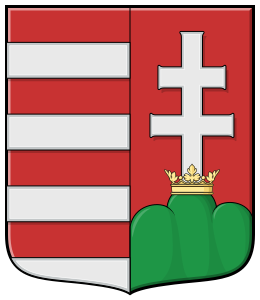
Other version of the coat of arms