
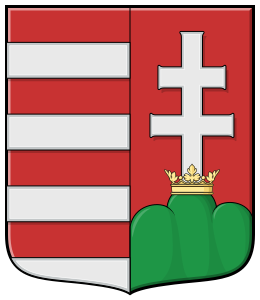
Old coat of arms of Cincu
Location:
Type:
State:
Cincu – A Historic Saxon Center of Transylvania
(Hungarian: Nagysink; German: Großschenk) is a small settlement in the western part of Brașov County, in the heart of Transylvania. Although today it is considered a simple village, its past is far more significant: from the Middle Ages until the 19th century it was a walled town and one of the important administrative centers of the Transylvanian Saxons. As the seat of the Nagysink Chair (Schenker Stuhl), it played a regional role for centuries, with market rights, a court of law, and a fortified church.
The settlement was founded in the mid-12th century by Transylvanian Saxon settlers who arrived from the Rhineland. They brought with them their urban culture, architectural traditions, and systems of self-government, which shaped the development of Nagysink for a long time.
Its name first appears in a charter in 1329 (sede Shenck), when a mill market belonging to the chair is mentioned. The oldest surviving seal of the chair dates from 1448.
Origin of the Name
The name of the settlement derives from the German word Schenke (“tavern” or “inn”). It is likely that an inn stood here at the end of the 12th century, during the early Saxon settlement period, and the surrounding area took its name from it. The prefix Groß (“great”) was added later to distinguish it from nearby Kleinschenk (Kissink).
In medieval sources the name appears in various forms: Chenk, Senk, Schenk, Sink, Schennckh, Synk, and later, in the 15th–16th centuries, Grossenschenk or Grosz Schenck. The Hungarian forms Nagy Senk and later Nagy Sink are documented from the 16th century onward, while the Romanian name Cincu became official only in the 19th century.
Interestingly, Romanian folklore connects the name to the Latin word quinque (“five”), suggesting that five native families lived here before the arrival of the Saxons.
Location and Surroundings
Nagysink lies in Brașov County, between the drainage basins of the Olt River and the Hortobágy. It is located about 15 km (as the crow flies) from Făgăraș and 68 km from Brașov. A hill rises in the center of the settlement, offering views over the surrounding valleys.
The elevation ranges between 400 and 425 meters above sea level, while the surrounding hills reach up to 650 meters. The climate is moderately continental, transitional between the harsher climate of the Olt Valley and the milder climate of the Târnava region.
History of Nagysink
The first written reference dates from 1329, when the name of the Nagysink Chair also appears. For centuries, the town competed with nearby Szentágota (Agnita) for economic and administrative prominence. Although Szentágota initially received market rights, Nagysink was granted the same privilege in 1474, and in 1494 King Vladislaus II ordered that the court of the chair and its administrative center be permanently located in Nagysink.
The fortified church was built in the early 13th century in Romanesque style and underwent Gothic reconstruction at the end of the 15th century. With its double defensive walls and bastions, it is one of the outstanding examples of Saxon fortified churches. From the 16th century onward, under the influence of the Reformation, the population converted to Lutheranism, and the church likewise became Evangelical.
The town’s history was frequently marked by disasters: it burned down in 1523, was devastated by the troops of Michael the Brave in 1600, by the Ottomans in 1658, and by the Kuruc forces in 1708. Several major fires swept through it in the 18th century as well. Despite this, the settlement was repeatedly rebuilt and retained its regional importance.
By the mid-19th century, however, Nagysink lost its former central role. In 1876 the Nagysink Chair was abolished, and the settlement became part of Nagy-Küküllő County. The railway line passed through Szentágota, causing Nagysink to gradually decline in importance. After the Treaty of Trianon, it remained part of Romania, and since 1968 it has belonged to Brașov County.
Source: ChatGPT

The visual content of this website may be freely used under the terms of the Creative Commons 4.0 license, provided that the source is clearly indicated and the attribution includes a full, clickable link to https://cimerek.hu or to the exact web address of the specific content.
