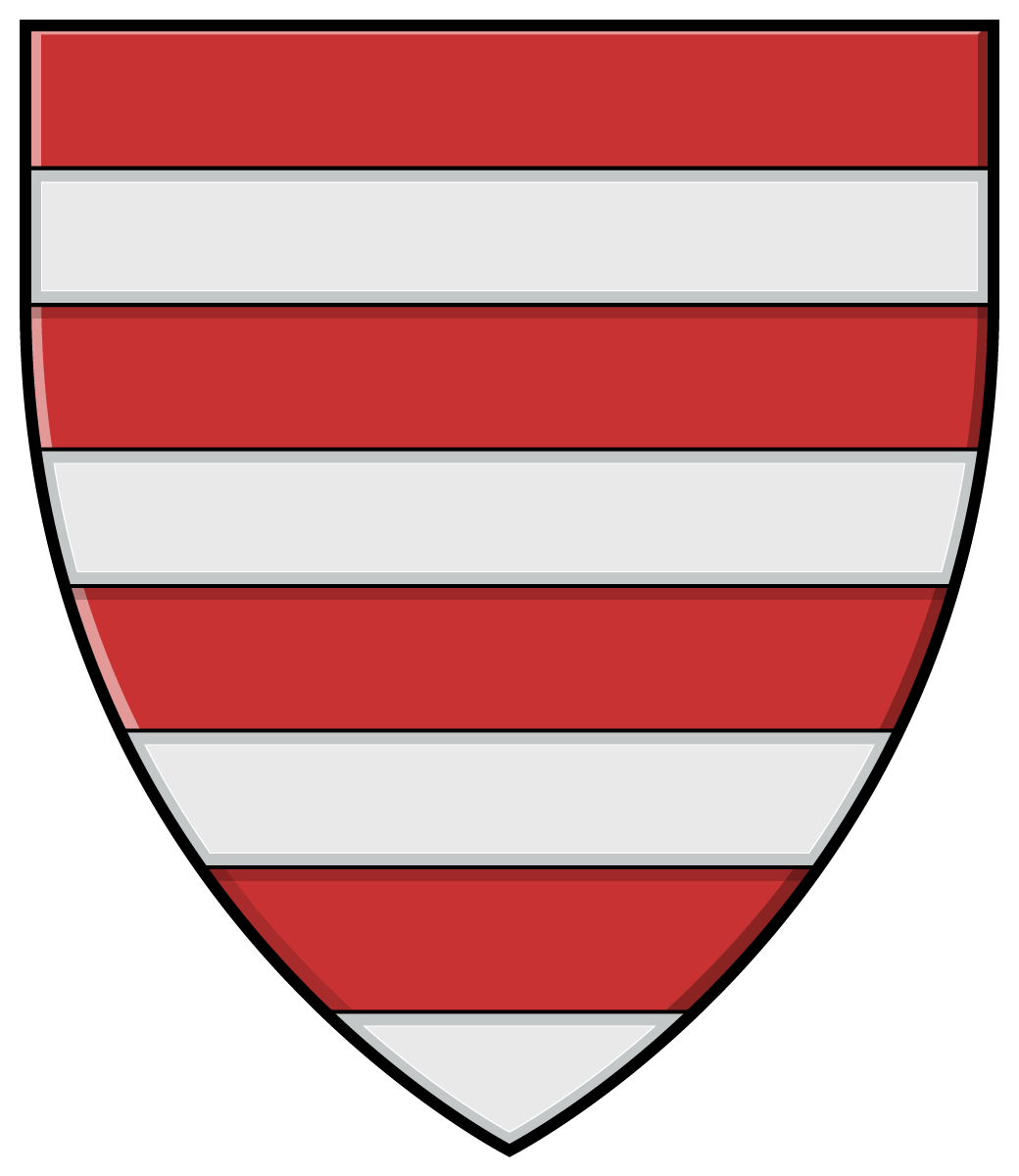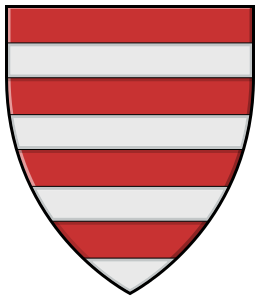
Coat of Arms of the House of Árpád
Name:
Epithet:
Country:
Dynasty:
Reign:
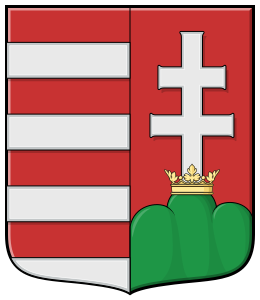
The family coat of arms of the House of Árpád was a shield barry of seven, gules and argent (seven horizontal stripes alternating red and silver). In the royal arms of Hungary this appeared in the dexter half of a per pale shield, while the sinister half bore the double cross symbolizing Hungary. In foreign heraldic literature, the barry shield is often called Hungary’s “old” coat of arms, while the double cross is referred to as Hungary’s “new” coat of arms.
The Origin of the Name “House of Árpád”
The members of the ruling dynasty now known as the House of Árpád never called themselves by this name. Although Prince Árpád, the leader of the Hungarian Conquest, was a highly significant figure, his name was rarely used in naming: only one prince named Árpád is known (a son of Géza II), while only two princes were named Álmos (sons of Géza I and Béla the Blind). In the latter case, it is not even certain that the name referred to the conquering Álmos.
Medieval sources used different terms. Simon of Kéza referred to the dynasty as de genere Turul, that is, the Turul kindred, a unique expression not found elsewhere. This interpretation probably reflected changes in the relationship between the king and the nobility. Contemporary usage more commonly preferred the expression “the kindred of the holy kings.”
The Árpád Stripes – The Origin of the Red and Silver Bars
The Árpád stripes are a heraldic motif used by the later Árpád rulers, consisting of a shield barry of seven (more rarely five or eight) in red and silver. The motif appeared in the second half of the 13th century. The earliest known banner depiction of the red-and-silver striped field dates from the 1270s. The design became widespread toward the end of the Árpád period and eventually developed into a permanent element of the Hungarian coat of arms.
Various versions of Árpád-striped flags, with differing numbers of stripes, also appear in the flags of Hungarian towns and cities. The symbol is likewise found in the coats of arms of many state, military, and law-enforcement institutions, for example in the emblem of the Constitution Protection Office. Striped banners are also part of the ceremonial historical flag series, including the vertical striped flags associated with the House of Árpád and with the cavalry of Francis II Rákóczi.
Princes and Kings of the House of Árpád
Grand Princes
- Álmos (c. 858–895)
- Árpád (895–907)
- Zolta (907–947)
- Fajsz (Falicsi) (947–955)
- Taksony (955–972)
- Géza (972–997)
- Vajk (the pagan name of King Stephen) (997–1000)
Kings
- Stephen I (Saint Stephen) (1000–1038)
- Peter of Hungary (1038–1041)
- Samuel Aba (1041–1044)
- Peter of Hungary (1044–1046), second reign
- Andrew I (1046–1060)
- Béla I (1060–1063)
- Solomon (1063–1074)
- Géza I (1074–1076)
- Ladislaus I (Saint Ladislaus) (1077–1095)
- Coloman the Learned (1095–1116)
- Stephen II (1116–1131)
- Béla II “the Blind” (1131–1141)
- Géza II (1141–1162)
- Stephen III (1162–1172)
- Béla III (1172–1196)
- Emeric (Imre) (1196–1204)
- Ladislaus III (1204–1205)
- Andrew II (1205–1235)
- Béla IV (1235–1270)
- Stephen V (1270–1272)
- Ladislaus IV “the Cuman” (1272–1290)
- Andrew III (1290–1301), the last golden branch
Source of the original image: Internet
Text sources: Wikipedia, ChatGPT
The visual content of this website may be freely used under the terms of the Creative Commons 4.0 license, provided that the source is clearly indicated and the attribution includes a full, clickable link to https://cimerek.hu or to the exact web address of the specific content.