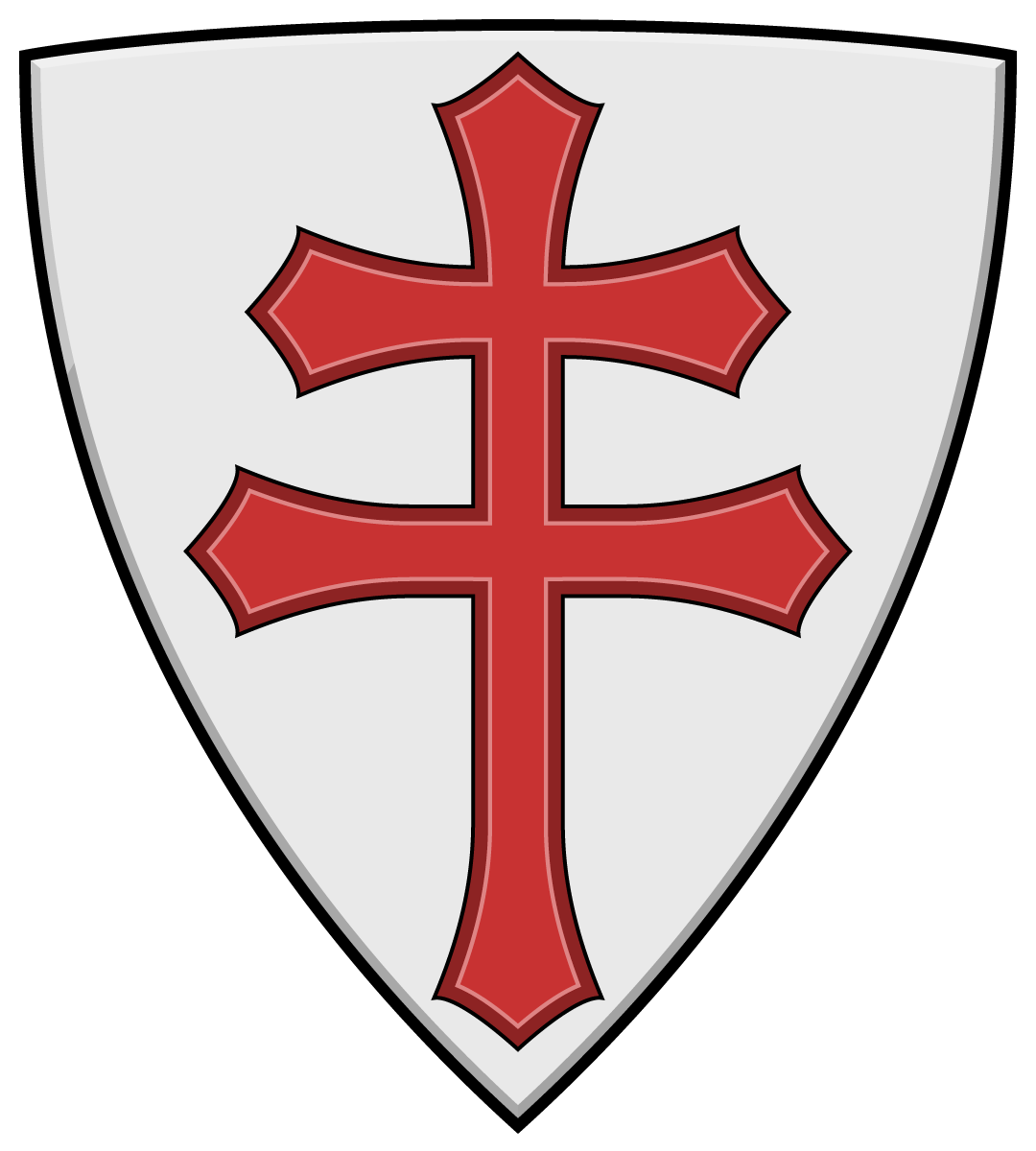
Fictional coat of arms of King Ladislaus I of Hungary
Name:
Epithet:
Country:
Title:
Dynasty:
Reign:
Coat of Arms
One of the fictional, imaginary coats of arms of Saint Ladislaus from the Ingeram Codex (1459)
Ladislaus I, also known as Saint Ladislaus
Ladislaus I, better known as Saint Ladislaus (in Poland: Władysław I Święty; in Croatia: Ladislav I; c. 1040 – 29 July 1095, Nitra), was one of the greatest rulers of the 11th-century Kingdom of Hungary and the embodiment of the ideal Christian knight-king. He was revered both by his contemporaries and by posterity as the most perfect representative of the Hungarian royal ideal. His father was King Béla I of Hungary, and his mother was the Polish-born Princess Richeza. From his father he inherited military strength, and from his mother deep religious devotion—traits that remained defining features of his character throughout his life.
Youth and Rise to Power
Ladislaus spent part of his childhood in exile in Poland, after his father and family were forced to leave Hungary due to internal dynastic conflicts. He later returned as a duke to support his brother Géza against King Solomon. Amid the dynastic struggles, he remained loyal to his brother, thereby securing for them the possession of the ducatus, the princely domain.
Even during Solomon’s reign, the young Ladislaus’s military talent stood out. He gained great renown at the Battle of Kerlés (1068), where he successfully repelled invading Cumans and earned lasting fame through his legendary deed of rescuing a Hungarian maiden from a fleeing Cuman leader—one of the most celebrated examples of the chivalric ideal. This heroic act brought him great glory during his lifetime and remained deeply rooted in popular memory.
During the factional struggles, Ladislaus repeatedly took up arms to help his brother secure the throne. Finally, after Géza’s short reign and subsequent death, the Hungarian nobility and high clergy elected Ladislaus king in 1077.
Reign and Military Campaigns
During his reign, Saint Ladislaus sought both to consolidate internal order and to expand the kingdom’s influence abroad. In the mid-11th century, the Kingdom of Hungary was frequently attacked by eastern nomadic peoples—the Pechenegs, Uzes, and Cumans—whom Ladislaus successfully repelled on several occasions. He often offered them the opportunity to adopt Christianity and settle within the kingdom, thereby strengthening Hungary’s Christian character.
In 1091, he took possession of Croatia, partly on dynastic grounds: his sister Ilona was the widow of the Croatian king, and he intervened at her request. As a result, the borders of the Kingdom of Hungary expanded significantly, and its political prestige increased. During his reign, Hungarian influence also extended over parts of former Moesia.
Due to his frequent military campaigns, numerous miracles became associated with his reign, further reinforcing his legendary image:
during his flight, a rock split open before him to provide refuge;
at his prayer, deer and fresh springs appeared to sustain his soldiers;
coins scattered before the enemy turned into stone.
These miracles became important elements of medieval hagiography and contributed to the process leading to his canonization.
Church and Cultural Policy
Saint Ladislaus devoted particular attention to strengthening and organizing the Hungarian Church. He founded several abbeys and bishoprics and supported existing ecclesiastical institutions with generous donations. During his reign, the chapter and archdeaconry system became more widespread, forming the foundation of Hungary’s later ecclesiastical structure.
In 1083, at Ladislaus’s initiative, the first saints of the Christian Hungarian state were canonized: King Stephen I, his son Prince Emeric, Bishop Gerard, and the hermits of Mount Zobor, Zoerard-Andrew and Benedict. This canonization not only reinforced the Christian faith but also enhanced the ecclesiastical prestige of the Hungarian Kingdom throughout Europe.
Saint Ladislaus and the Crusading Ideal
During his reign, the idea of crusading gained increasing strength across Europe. Ladislaus’s name was mentioned as a possible leader of the First Crusade, indicating the high esteem he enjoyed among Christian rulers of the continent. However, his death on 29 July 1095 prevented him from taking part in this role.
Death and Canonization of King Ladislaus I of Hungary
King Ladislaus I died in 1095 in Nitra and was buried in the cathedral of Várad (Oradea). His memory was preserved with exceptional reverence by the Hungarian people: his heroic figure, chivalric virtues, and the legends associated with him became one of the cornerstones of medieval Hungarian identity. In 1192, Pope Celestine III canonized him, officially enrolling him among the saints of the Catholic Church.
Legacy
The figure of Saint Ladislaus remains a defining presence in Hungarian history and culture to this day. He was regarded as the knight-king of medieval Hungary, embodying at once the roles of military leader, lawgiver, and devout Christian ruler. His veneration has remained unbroken since the Middle Ages, and numerous churches, frescoes, and manuscripts preserve his image. During the era of 19th-century national Romanticism, he once again became a model figure, remembered as one of the most illustrious heroes of the Hungarian past.
Az eredeti kép forrása: Internet
Szöveg forrása: ChatGPT
The visual content of this website may be freely used under the terms of the Creative Commons 4.0 license, provided that the source is clearly indicated and the attribution includes a full, clickable link to https://cimerek.hu or to the exact web address of the specific content.