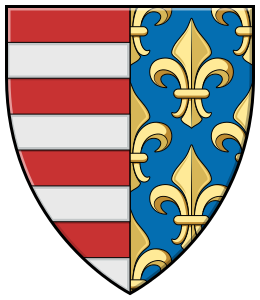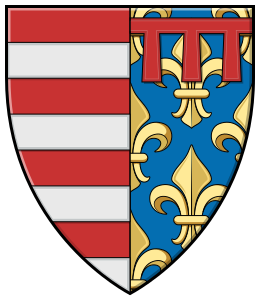
Coat of arms of Queen Mary of Hungary
Name:
Epithet:
Country:
Title:
Dynasty:
Reign:
Queen Mary of Hungary
(Mary of Anjou), the third surviving daughter of King Louis I (the Great) and Elizabeth of Bosnia (Elisabeth Kotromanić), was probably born in Buda in 1371. While still a child, her father granted her the rights of a male heir (“fiúsítás”), thereby ensuring succession through the female line in both Hungary and Poland.
Her coat of arms is that of Charles I, created by the union of the Hungarian and Anjou arms, supplemented with a label (tournament collar).
In heraldry, the label is a mark of cadency primarily used within ruling dynasties to indicate the order of birth—that is, the line of succession—of sons. Through this method of differencing, members of the royal family could be clearly identified, and dynastic relationships were made visible. The label was therefore not merely a decorative element, but an important heraldic feature indicating rank within the family and rights of inheritance.
Biography
After ascending the throne, Mary was crowned at the age of ten on 17 September 1382 in Székesfehérvár, as “king” (rex), becoming the first woman in Hungary to be crowned with the Holy Crown. Her mother, Queen Elizabeth, became the effective regent, and power was concentrated in the court center led by Palatine Nicholas Garai.
The group of magnates opposing female rule, led by the Horváti family, invited Charles of Durazzo to claim the throne in 1385. As a result, Mary abdicated, and Charles II received the crown at the end of December.
Civil War and Return
Charles’s reign lasted only 55 days; in February 1386 he was allegedly murdered at the instigation of the queen and her mother. In the ensuing political chaos, Mary and Elizabeth were captured near Đakovo (Diakovár). Eventually, with Venetian naval assistance, she was freed along with her co-ruler, Sigismund of Luxembourg, who was officially crowned co-ruler with her in the spring of 1387.
Co-rule and Marginalization (1387–1395)
Although at first she was formally equal to her husband, over time Sigismund increasingly took control of state affairs; in the eyes of both the public and the magnates, real power shifted into his hands. The chancellery issued decrees in Mary’s name only temporarily; by around 1388, governance had become entirely concentrated in Sigismund’s authority.
Fatal Hunting Accident
The queen met a tragic end: on 17 May 1395, she fell from her horse during a mounted hunt and was gravely injured. She was pregnant, and both her life and that of the unborn child were endangered—the child was lost, and Mary herself died of her injuries. She was buried in Várad (Oradea).
Legacy and Memory of Queen Mary of Hungary
As the first woman to occupy the Hungarian throne as “king,” her life was marked by political instability, aristocratic intrigue, and the constraints imposed by her gender. Although she initially held formal authority as co-ruler, she was gradually pushed into the background. After her death, the Hungarian throne remained in Sigismund’s hands. In popular memory, Diósgyőr Castle—one of her favored residences—and Novigrad, the site of her captivity, are particularly associated with her name.
Original image source: Internet
Text source: ChatGPT
The visual content of this website may be freely used under the terms of the Creative Commons 4.0 license, provided that the source is clearly indicated and the attribution includes a full, clickable link to https://cimerek.hu or to the exact web address of the specific content.
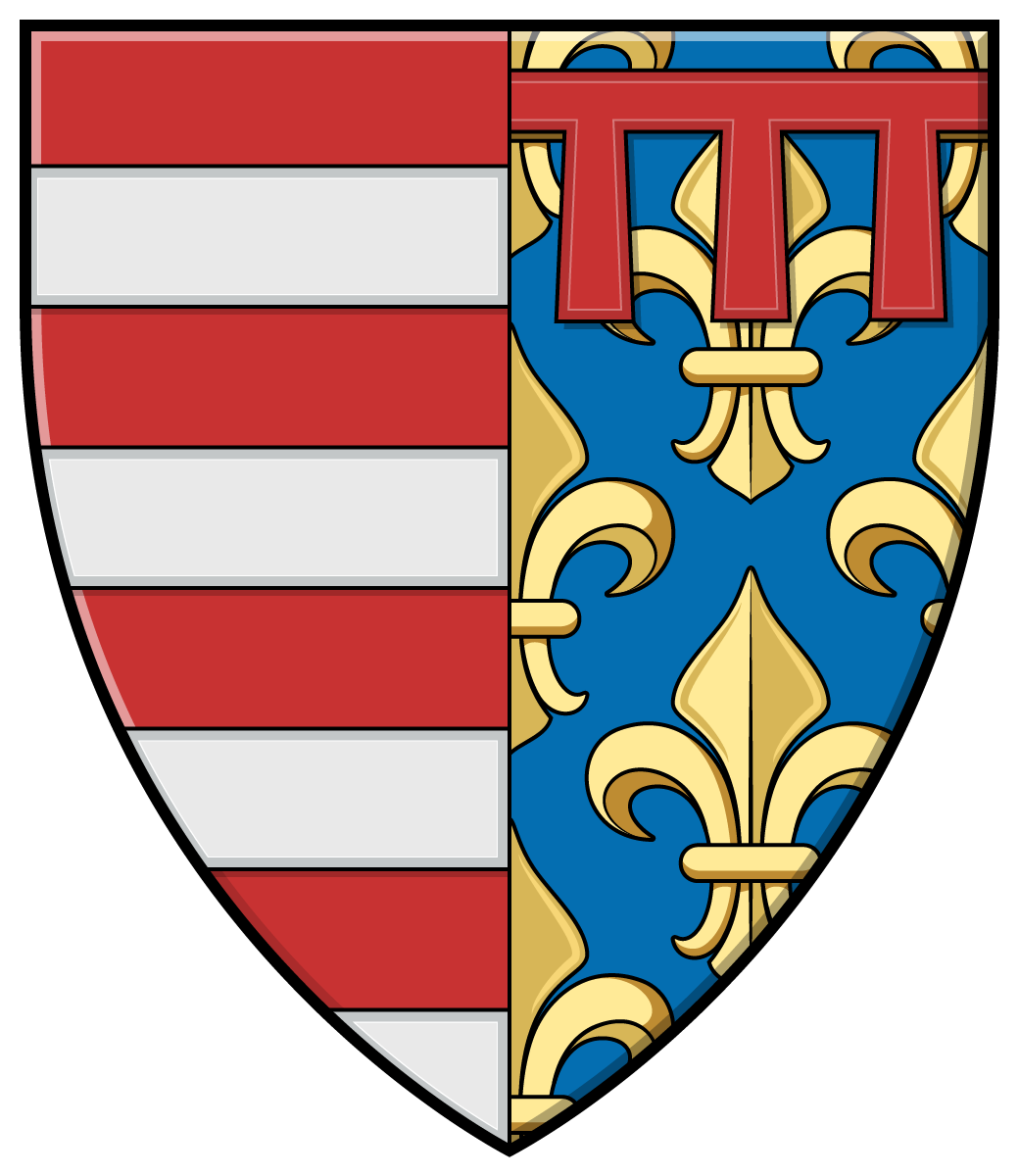
Another version of the coat of arms