
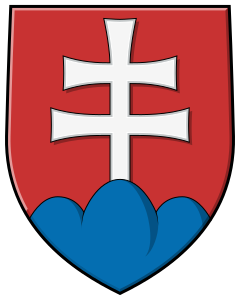
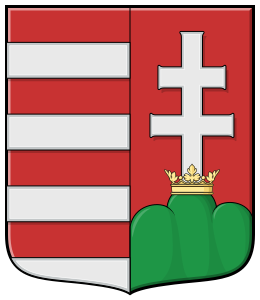
Coat of arms of Kremnica
Location:
Type:
Status:
Grantor:
Year:
Kremnica
(Hungarian: Körmöcbánya; German: Kremnitz; Latin: Cremnicium) is a town in Slovakia, located in the Žiar nad Hronom District of the Banská Bystrica Region. It was one of the most important mining towns and minting centers of the former Kingdom of Hungary, renowned especially for its gold mining.
Location
Kremnica lies approximately 40 km north of Banská Štiavnica (Selmecbánya), in the valleys of the Bystrica Stream and the Körmöc Stream.
History of Kremnica
The town was founded in the 12th century by German settlers from Silesia and Thuringia. In contemporary sources it appears under various name forms: Cremnychbana (1328), Cremnic (1332), Cremnech (1335), Cremnuch (1338), Crempnuch (1343), Chrempnichya (1389), Chrempnichya (1394), Cremnicia (1394), Krembnicia (1476), and Kremnica(1526).
On 17 November 1328, King Charles I of Hungary (Charles Robert of Anjou) granted the town the rights of a free royal mining town and founded its mint. From 1335 onward, the famous gold florin—also known as the Kremnica ducat—was minted here. Owing to its importance, the town consistently enjoyed royal favor. In 1390, its inhabitants were exempted from customs duties, and in 1425 it was granted the right to hold weekly markets.
The golden age of gold mining occurred during the 14th and 15th centuries. By the mid-15th century, the town consisted of nine quarters; about 3,000 inhabitants lived in 690 families occupying 250 houses. At that time, approximately 14,000 Kremnica ducats were minted annually.
In 1433, the town was occupied and plundered by the Hussites. In 1449, John Hunyadi unsuccessfully besieged it; by then the town was already protected by high stone walls and a moat. King Matthias Corvinus regained it through a peace treaty in 1462. Subsequent attacks were also successfully repelled, though in 1560 a major fire devastated the town, destroying about one-third of it.
During the 16th century, the Reformation spread in the town, while recatholicization began in 1653 through the efforts of the Jesuits. In 1604, Körmöcbánya initially refused to open its gates to the army of István Bocskai, but in 1605 it eventually submitted. It also admitted Prince Gabriel Bethlen within its walls.
In 1652, a paper mill was established in the town. Between 1696 and 1788, Körmöcbánya held the right to host national fairs. In 1715, the population included 474 tax-paying citizens and 193 cotter families; of these, 390 were miners, while most of the remainder were craftsmen. In 1767, a total of 1,299 miners worked in its mines. By 1787, the town had 509 houses, 1,152 families, and 5,147 inhabitants. In 1828, 4,944 residents lived in 538 houses.
In 1849, during the Winter Campaign of the Hungarian War of Independence, Artúr Görgei clashed with imperial forces near the town, then broke through toward Besztercebánya (Banská Bystrica) via a mine passage. Most of the town’s fortifications were demolished around 1872. The railway line leading to the town was constructed between 1869 and 1872. Toward the end of the 19th century, factories and industrial plants were established one after another.
From Borovszky’s Monograph on Bars County (Excerpts)
According to the Bars County volume of Borovszky’s monograph series:
“When Charles Robert leased the Kremnica chamber to Leopold, castellan, in 1342, he referred to this chamber in the charter as ancient beyond memory, which serves as proof that Körmöcbánya already existed before the Mongol invasion. […] That Körmöcbánya was already a settlement of considerable importance at that time is shown not only by its contemporary buildings but also by the charters of the period. Mining was no longer carried out within the area of the present town, but in the mountain range to the northwest, and by the second half of the 14th century had already reached such depths that the first drainage adit had to be opened.
Some of the ore-processing mills were located near Alsó-Turcsek until Körmöcbánya diverted the Turóc Stream—belonging to the Váh river basin—across the watershed to the town, a feat that, considering the imperfection of contemporary engineering tools, represented a true technical marvel in the 14th century.
The core of the town, the inner city, lies on the southern slope of Stósz Hill near Kékelő, where the old Altgrund valley—already joined with Neugrund—meets the Zólyom valley. After the Mongol invasion, it was surrounded by a wooden palisade; from the 1420s and 1430s onward, it was enclosed by a strong stone wall originally 12 meters high, remnants of which still partly survive today. This defensive wall was reinforced by two massive gates and nine bastions.
In the 18th century, a third gate, the so-called Thürl Gate, was built, but it fell victim to ground subsidence in 1880. The Upper Gate, demolished in 1872—allegedly for traffic reasons—was 25 meters high and two stories tall. Its walls were 2.1 meters thick at ground level and still 1 meter thick on the second floor. Its auxiliary buildings later housed the expanded mint from 1880 onward.
Part of the Upper Gate complex was also a ceremonial gate erected in 1751 from solid materials in honor of Empress Maria Theresa, commemorating her stay in Körmöcbánya. This gate was demolished in the 1860s; its inscribed stone fragments were later used as foundations along the stream embankment, while two carved stone slabs remain embedded at the site where the Upper Gate once stood.
The inner tower of the double Lower Gate—identical in all respects to the former Upper Gate—was built in 1428 and still stands today in its original form. The outer tower was erected in 1539, when the townspeople were preparing to defend themselves against the robber mercenaries of the Podmaniczky family of Vágbeszterce, the band of Bassó of Murány, and Turkish raiding forces. This elegant but extremely solid structure, slightly lower than the inner tower, is adorned with stone medallion portraits of King Ferdinand I and his wife Anna.
Two stone slabs placed on the eastern side of the gate once belonged to the decorations of another ceremonial gate erected in 1751 in front of the Lower Gate and demolished in 1849. The miner statue now kept in the town museum, as well as the remains of the imperial crown, also originated from this ceremonial gate.
In front of the Lower Gate ran one branch of the Körmöc Stream, now vaulted over; when the stream flowed openly, the gate was secured by a drawbridge. The portcullis lock made in 1550 during the tenure of Mayor Farkas Guglinger, as well as a similar lock from the same period belonging to the Upper Gate, are preserved in the town museum. The common key was formerly guarded overnight by the town judge, and no one could enter or leave the town without his knowledge and consent.
In the northern part of the inner city, above the main square, on a steep hill rising 38 meters, stands Kremnica Castle. It is surrounded by a double, strong, and high defensive wall—partly rebuilt in 1901—with five massive bastions, two of which have since been demolished. At the center of the castle courtyard stands the main building: a Gothic church renovated as early as 1491 and restored again in 1884 at a cost of 80,000 forints; since then it has served once more as a parish church. In earlier times it was known as the Great or Upper Church.”
Original image source: Internet
Text source: Wikipedia
The visual content of this website may be freely used under the terms of the Creative Commons 4.0 license, provided that the source is clearly indicated and the attribution includes a full, clickable link to https://cimerek.hu or to the exact web address of the specific content.
