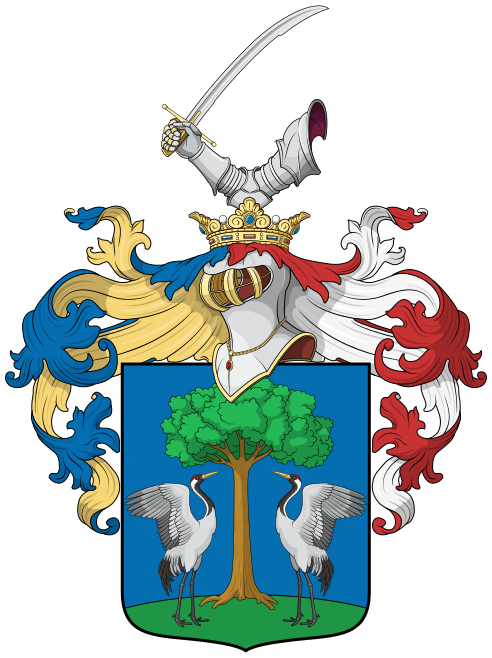
Coat of Arms of the Hodossy Family
Location:
Type:
Grantor:
Year:
Hodossy Family
The Hodossy family is an old Hungarian noble family that took its name from the settlement of Hodos in Pozsony County (today Nemeshodos, Slovakia). The village belonged to the well-known “noble villages,” where a significant portion of the inhabitants enjoyed noble privileges.
In 1651 the family received a charter of armorial nobility in Nógrád County. In the following centuries, its members spread to several other counties, including Hont, Bihar, Borsod, Sáros, Tolna, and Somogy.
The Reformed branch of the family moved in the second half of the 17th century from Sáros County to Tolna, and later to Somogy. The noble census of 1845 in Somogy County mentions the widow of János Hodossy; her husband’s grandfather had already been a landowner in the village of Gige in Somogy. This Transdanubian branch included János Hodossy († 1857), chief district magistrate (főszolgabíró) of Somogy County, whose son Lajos served as presiding judge of the Royal Court of Appeal in Győr. The family later also owned the estate of Szend puszta.
During the 17th and 18th centuries, several branches of the family spread to different regions of the country. Their presence is documented in Bihar and Hajdú Counties, as well as in the market town of Nádudvar, where a distinct Nádudvar branch developed. They lived there for several generations and played a role in local society.
Coat of Arms of the Hodossy Family
Azure, on a green base a broad green tree growing; beneath it two birds rising and facing each other toward the trunk.
Crest: an armored arm holding a sword.
Mantling: azure and or; gules and argent.
Hodossy Families
The nobility of the Hódosi (Hodosi, Hodosy, Hodossy) family can be traced back to the Árpádian age. The ancestor of the family, which played an outstanding role in the resettlement that began in the late 1720s, received a royal grant in 1287 for Hodos in Pozsony County.
At the beginning of the 18th century, the sons of Mihály Hodosy — Dávid, János and Mihály — moved to Polgár and later to Kenderes. The census of 1754–55 lists Gergely, István, János, Mihály and Péter Hodosy among the nobles of Kenderes; however, the family of the elder János Hodosy was already living in Nádudvar at that time due to a dispute with the Károlyi heirs.
János Hodosy, the resettler of the village, fought in the army of Sándor Károlyi during the War of Independence led by Francis II Rákóczi, and from this service stemmed a confidential relationship that lasted until the general’s death. After being widowed from his first wife, he married the also widowed Judit Magyary-Kossa in 1744, while his son, the younger János Hodosy, married Mrs. Judit’s daughter. The landowner living among the peasantry was at first looked down upon by his new relatives, and his wife and stepdaughter were criticized for the double marriage. The Magyary-Kossa family and their relatives of the Borbély kin regarded Hodosy — rough in manner but highly competent in estate management — with contempt; Borbély Sándor even referred to his father in one letter as a mere shepherd.
Although János Hodosy possessed a certain level of learned education, he lacked refinement of style. His letters, filled with Latin expressions yet awkwardly phrased, reflect this. His son, the younger János Hodosy, attained a much higher level of education. After completing his studies, he served in the 1730s in the hussar regiment of Ferenc Károlyi, achieved the rank of lieutenant, and for a short time acted as a military judge. During the war on the southern frontier he fell into Ottoman captivity but successfully escaped in 1738.
The elder Hodosy soon became so wealthy in Kenderes that when Sándor Károlyi and his son Ferenc encountered financial difficulties, they borrowed six thousand forints from him, granting him for four years, as interest, their Csány estate in Csongrád County. János Hodosy invested his income primarily in land purchases and in 1749 acquired estates in Kereki, Ádány and Ártánd in Bihar County. His frugality, bordering on miserliness, became proverbial among his relatives; yet he deeply loved his wife, Judit Magyary-Kossa. In his acquisitions he listed her as co-owner to ensure that both her two children from her first marriage and their two common children would inherit. His relations with his new kin later improved and even developed into friendship with his brother-in-law, István Magyary-Kossa. His lifestyle, however, continued to resemble that of a prosperous peasant proprietor rather than a noble lord: he wore a peasant’s sheepskin coat, transported goods himself, yet at the same time extended substantial loans to counts.
Mihály Borbély, one of the wealthiest landowners of the region, was a contemporary and close friend of Hodosy. His grandfather György Borbély settled in Abád in the mid-17th century. His son Balázs fought against the Ottomans and participated in the recapture of Eger in 1687, for which he received a coat-of-arms grant from King Leopold I. As a captain of a thousand under Francis II Rákóczi, he captured Szolnok Castle in 1703 and was rewarded with Tiszabura. He was effectively the founder of the family. His son, Mihály Borbély, acquired Abád, Tomaj and Bánhalma from Charles III and, among others, Tiszaroff from Maria Theresa; hence the family’s distinguishing predicate “roffi.”
The Borbély family later took an active part in the Revolution and War of Independence of 1848–49. Lajos Borbély became a member of parliament, while his brother Antal fought as a captain of the National Guard. The most prominent 20th-century figure of the family, György Borbély of Roff, served as a liberal MP between 1901 and 1905 and later as Lord Lieutenant of Jász-Nagykun-Szolnok County until his death in 1939. He introduced significant measures in maternal and infant welfare, river navigation on the Tisza, and the economic issues of smallholders.
The Magyary-Kossa family also played an important role in the settlement’s history. Originating from the Csallóköz region, they received a grant of arms from King Rudolf in 1599. By the late 18th century they appeared as landowners near Kenderes. In the 19th century they also became related to the Horthy family.
The Halasy family appeared among the landowners of Kenderes at the end of the 18th century. Their ancestors lived in Transylvania and later in Komárom County, receiving a coat-of-arms grant in 1618 from King Matthias II. Márton Halasy later became deputy lord lieutenant of Heves County and a parliamentary envoy, advocating for the Hungarian language in official administration.
The comital Nemes family, of Transylvanian origin, acquired estates in Bánhalma in the second half of the 19th century. After World War I, the French baron Piret de Bihain settled in Hungary, married Countess Anna Nemes, and later Magyarized his name to István Piret-Bihari. Their castle is still known as the Piret Castle.
Kenderes also produced several nationally renowned figures, including scholars, theologians, politicians and clergy. Among them were Kálmán Csiky, professor of administrative law; Ferenc Kiss, theologian and first rector of the University of Debrecen; and István Antal (1896–1973), who held several ministerial offices during World War II and was later sentenced to life imprisonment as a war criminal, being released in 1960.
Among the intellectuals settled in the village, the Reformed pastors achieved particular distinction. Lajos Győry compiled extensive local historical records, and László Kormos authored significant works on the history and ethnography of the Nagykunság region.
(Sources: Győry, Kempelen, Magyary-Kossa, Iván Nagy, Scheftsik, Szederkényi, Szilágyi, and the volumes of the Hungarian Biographical Lexicon, Budapest 1976, 1981, among others.)
Text source: ChatGPT and Arcanum.com

The visual content of this website may be freely used under the terms of the Creative Commons 4.0 license, provided that the source is clearly indicated and the attribution includes a full, clickable link to https://cimerek.hu or to the exact web address of the specific content.
