
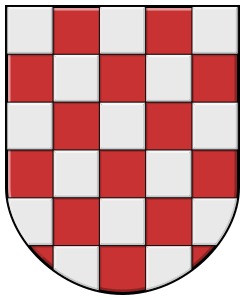
Coat of Arms of the Kingdom of Croatia-Slavonia
Location:
Típus:
Grantor:
Year:
Kingdom of Croatia-Slavonia – an autonomous partner realm of the Kingdom of Hungary (1868–1918)
The Kingdom of Croatia-Slavonia (Croatian: Kraljevina Hrvatska i Slavonija; German: Königreich Kroatien und Slawonien) existed between 1868 and 1918 as an autonomous part of the Kingdom of Hungary, constituting a distinct political entity among the Lands of the Crown of Saint Stephen. Its territory covered the southwestern regions of historic Hungary and enjoyed a special legal status within the post-Compromise dualist state structure.
Today, most of its former territory lies within Croatia, while the eastern areas of the former Syrmia County belong to Serbia (Vojvodina), and a few smaller settlements are located in Bosnia and Herzegovina, in the Una-Sana Canton. During the period, the Kingdom of Croatia-Slavonia covered 42,541 km² and displayed a diverse geographical character, ranging from the Adriatic coast through the plains along the Drava and Sava rivers to forested mountainous regions.
The Compromise and the Establishment of Autonomy
The Austro-Hungarian Compromise of 1867 fundamentally transformed the Habsburg Empire, creating the Austro-Hungarian Monarchy, composed of two equal state entities. The internal nationalities of the Hungarian half—among them the Croats—saw an opportunity to improve their political position. After persistent negotiations, the Croatian–Hungarian Compromise of 1868 was concluded, enacted in Hungary as Act XXX of 1868 and in Croatia as Act I of 1868.
The law declared that Croatia and Slavonia formed a state community with Hungary, while the Kingdom of Croatia-Slavonia possessed its own territory, an independent legislature, and internal self-government. The king ruled both state entities, while common affairs—foreign policy, military matters, and certain aspects of finance—were placed under joint administration.
The Role of the Sabor and the Ban in the Kingdom of Croatia-Slavonia
The center of autonomy was Zagreb, where the Croatian parliament, the Sabor, convened. The Sabor held authority over internal administration, justice, education, religious affairs, and local government. Executive power was exercised by the ban, who was appointed by the king upon the proposal of the Hungarian prime minister. The office of the ban symbolized a bridge between the autonomy of the Kingdom of Croatia-Slavonia and the unity of the Kingdom of Hungary.
In practice, the ban’s role extended beyond implementing laws to maintaining political relations between the two state entities. Several notable bans served during this period, playing key roles both in representing Croatian national interests and in cooperation with the Hungarian government.
Economic and Social Conditions
The kingdom’s population was ethnically and religiously diverse. Alongside the Croatian majority lived significant Serb, German, Hungarian, and other minority communities. The economy was primarily based on agriculture—especially grain cultivation, viticulture, and livestock breeding—while trade also played an important role. Fiume (Rijeka) functioned as a strategic port providing maritime access for the Monarchy; however, it was not legally part of the Kingdom of Croatia-Slavonia, instead being attached to Hungary as a separate entity (Corpus separatum).
Following the Compromise, railway development accelerated, linking Zagreb with the Hungarian rail network. This facilitated the faster movement of goods and labor and strengthened economic ties.
Political Tensions
Although the Compromise established a formally balanced relationship, in practice numerous disputes arose. Some Croatian political forces criticized what they perceived as the overreach of the Hungarian government, while others regarded the compromise as essential for stability. By the turn of the century, movements advocating independence and South Slavic unity gained increasing strength, contributing to growing tensions in the political life of the Kingdom of Croatia-Slavonia.
The situation was further complicated by economic conflicts, particularly regarding trade routes and the distribution of customs revenues.
The Process of Dissolution
At the end of World War I, the collapse of the Monarchy created a new political situation. In October 1918, the Croatian leadership declared a break with the Kingdom of Hungary, and the Kingdom of Croatia-Slavonia joined the emerging State of Slovenes, Croats and Serbs. A few months later, this entity united with the Kingdom of Serbia, forming the Kingdom of Serbs, Croats and Slovenes (later Yugoslavia).
With this, the Kingdom of Croatia-Slavonia ceased to exist as an autonomous land of the Crown of Saint Stephen. Although its existence spanned barely half a century, it played a significant role in shaping Croatian national identity, state self-government, and modern political culture. Its legacy continues to influence Croatia’s historical memory to this day.
Source: ChatGPT

The visual content of this website may be freely used under the terms of the Creative Commons 4.0 license, provided that the source is clearly indicated and the attribution includes a full, clickable link to https://cimerek.hu or to the exact web address of the specific content.
