
The Coat of arms of Šurany
Location:
Type:
Status:
Geographical Location and Demographics of Šurany
(Hungarian: Nagysurány) is an industrial-agricultural town located in the Nitra Region of Slovakia, within the Nové Zámky District, situated between the cities of Nové Zámky and Nitra.
Until the interwar period, the town and its surroundings formed a distinct Slovak linguistic island on the northern fringe of the Danubian Lowland (Kisalföld). Today, moving northeast toward Vráble, this linguistic pocket has completely merged into the continuous Slovak-speaking territory. Administratively, the municipality includes the districts of Nitriansky Hrádok (Kisvárad) and Kostolný Sek (Egyháznagyszeg).
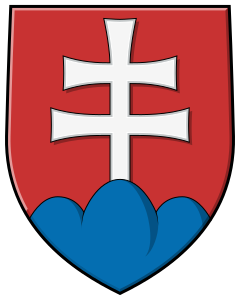
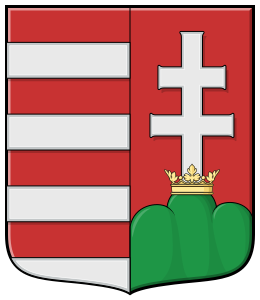
Coat of Arms of Šurany
The current official coat of arms of Nagysurány was redrawn based on a previous online visual source, faithfully preserving the traditional heraldic elements of the town.
Archaeological Significance
The town holds outstanding archaeological importance: the discovery site of one of Central Europe’s oldest and most famous Neolithic artifacts, the Venus of Hrádok (commonly known in Hungarian as the Váradi Vénusz), is located in the Nitriansky Hrádok district (on the Váradi embankment).
Etymology of the Name and Historical Debate
Regarding the origin of the town’s name, two conflicting theories exist within historical scholarship:
The Hungarian Hypothesis: The name originates from the old Hungarian personal name Súr, which is of Turkic origin. Following the Hungarian conquest of the Carpathian Basin, the area was likely the settlement of Chieftain Súr. This theory is supported by the fact that the early surrounding toponyms are predominantly of Hungarian, Pecheneg, and Cuman origin, suggesting that a significant Slavic population was unlikely in the 11th century. The distinguishing Nagy- (Great) prefix was added due to Kissurány (Little Surány), a settlement once located on the right bank of the Nitra River that has since vanished. In 1457, it was also recorded as Molneas Suran (Mill-Surány), referencing the royal mills operating on the river (the word molnos/molnas is an archaic Hungarian term for mill/miller adopted from the Slavic word mlin).
The Slovak Hypothesis: Slovak linguists derive the name from the Slovak word šúr, meaning a muddy meadow or marshy ground. They justify this by pointing out that the land between the Nitra and Hron (Garam) rivers was heavily marshy in the past—although geographical evidence shows this description was far more accurate for Nové Zámky to the south than for Surány itself.
Sources: Local historical monographs and the relevant Wikipedia articles.
The visual content of this website may be freely used under the terms of the Creative Commons 4.0 license, provided that the source is clearly indicated and the attribution includes a full, clickable link to https://cimerek.hu or to the exact web address of the specific content.
