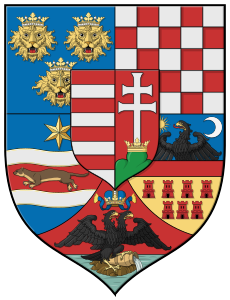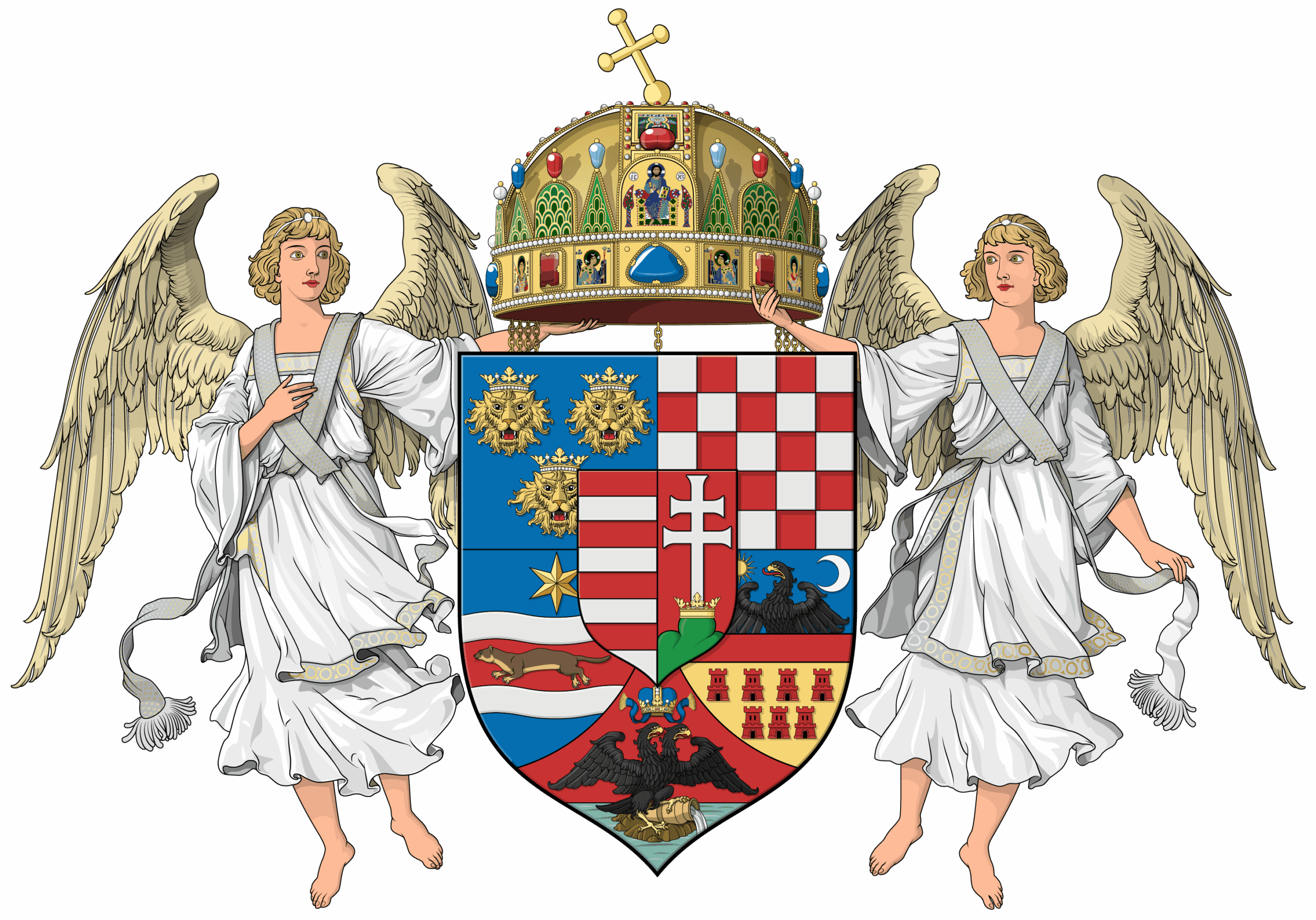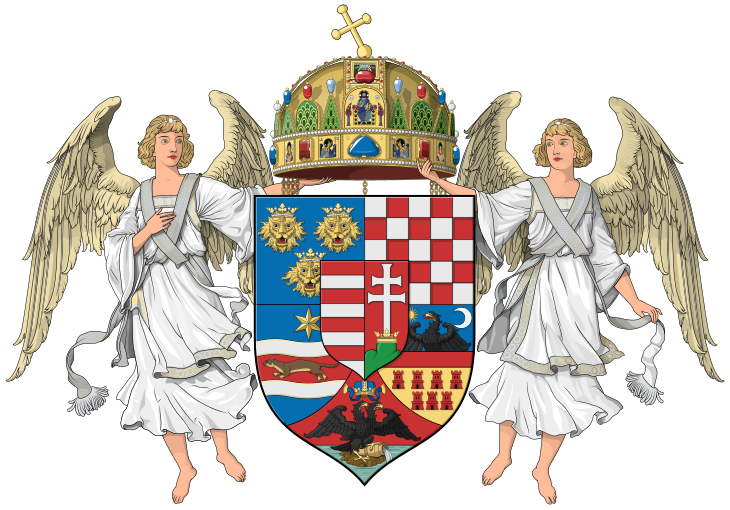
Coat of arms of the Lands of the Holy Hungarian Crown (1867)
Country:
Type of coat of arms:
Grantor:
Use:
Original drawing:
The angelic middle coat of Arms
The so-called Angel-Supported Middle Coat of Arms was used between 1874 and 1915, officially under the name United Middle Coat of Arms of the Lands of the Holy Crown of Hungary. Since Fiume was attached to the Holy Crown of Hungary by Act XXX of 1868, sanctioned on 17 November 1868, it became necessary to expand the Hungarian middle coat of arms.
On 9 February 1874, Franz Joseph I, by supreme decision, regulated the Hungarian state seal to be used by the Lands of the Holy Crown. As a result, the coat of arms of Fiume was incorporated into the united Hungarian middle coat of arms.
Since no officially published depiction of the coat of arms was issued in 1874, during the Millennial celebrations of Hungary Prime Minister Dezső Bánffy, by decree on 12 January 1896, published the official description and drawing of the coat of arms under the title “Description and drawing of the separate coat of arms of Hungary and the united coat of arms of the Lands of the Hungarian Crown” (see below).
This coat of arms remained in use until 10 October 1915, when Franz Joseph I ordered the introduction of a new middle coat of arms, in which the arms of Bosnia were also included alongside those of Fiume, together with other modifications.
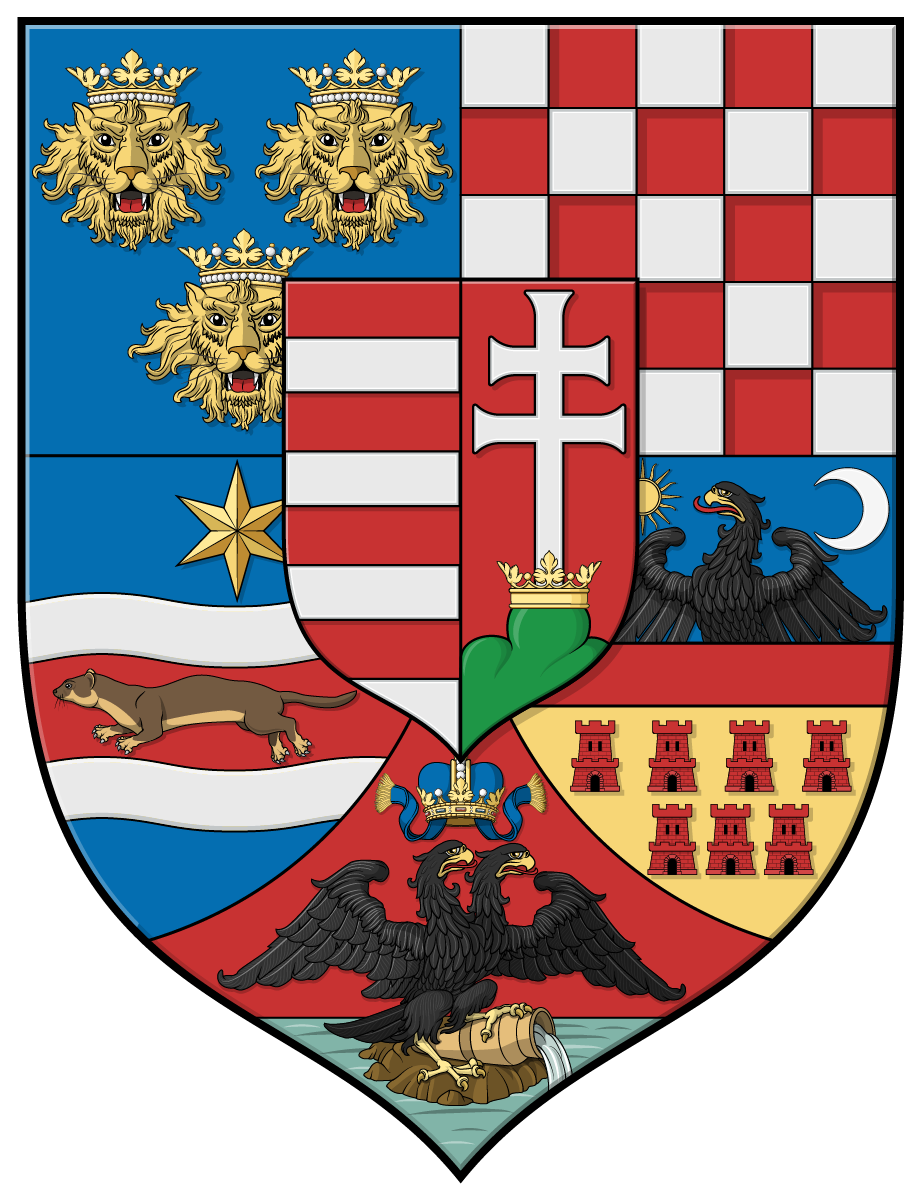
The United Middle Coat of Arms of the Lands of the Hungarian Crown
It consists of a larger outer shield, the centre of which is covered by a smaller inner shield.
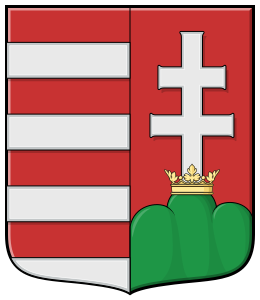
The central shield bears the separate coat of arms of Hungary. It is a shield per pale, that is, divided by a vertical line. Dexter: barry of eight gules and argent. Sinister: gules, a double cross argent issuing from an open crown or set upon a triple mount vert.
The triple mount is heraldically stylised and therefore does not reproduce the natural form of a hill. Of the three mounts, the two outer ones are of equal height, while the central one rises higher and more prominently. Upon it stands the so-called Roman-style cross issuing from a crown with five visible points—three larger and two smaller—the ends of the cross widening gradually rather than abruptly.
The outer shield is divided into four fields.
In the first is the coat of arms of Dalmatia: azure, three leopard heads caboshed or crowned or, two above and one below.
In the second is that of Croatia: chequy argent and gules, twenty-five squares arranged five by five, beginning with argent.
In the third is the coat of arms of Slavonia: azure, two barrulets wavy argent; between them in a field gules a marten proper courant to dexter; in the upper field a six-pointed star or.
In the fourth is the coat of arms of Transylvania: the shield divided by a fess gules. In the upper field azure a rising eagle sable, beaked or and langued gules, facing dexter; to its dexter a sun or, to its sinister a crescent argent. In the lower field or are seven castles gules (four above and three below), each consisting of a battlemented bastion and a central triple-tower with two loopholes and an open gate.
Between the third and fourth fields, inserted from below, appears the coat of arms of Fiume: gules, a double-headed eagle sable displayed beneath a ducal crown, the wings spread and the tongues gules. The eagle’s dexter foot rests upon a rock, while its sinister foot holds an elongated brown jug lying upon the rock, its mouth turned to sinister, from which water flows abundantly into a river washing the rock from the left.
Above the united coat of arms formed from these parts stands the Holy Crown of Hungary, whose faithful depiction is preserved in the drawings and plates of Arnold Ipolyi in the work “The Holy Crown of Hungary and the History and Description of the Coronation Insignia”, published by the Hungarian Academy of Sciences in Budapest in 1886.
Supporters: two floating angels. Their garments are white, ample and richly folded. Their posture is midway between standing and hovering. Their hair reaches approximately to the shoulders and is dark blond or light brown. Their type is that of an adolescent youth and never female.
What is a Middle Coat of Arms?
A middle coat of arms is primarily the coat of arms of a country which, on a composite shield, includes not only the principal territorial or dynastic arms but also other arms belonging to lands under the authority of that country or dynasty.
In general, however, it does not include all territories actually possessed or merely claimed, which usually appear only in the greater coat of arms.
The Coat of Arms of Hungary – Gyula Futtaky, Budapest, 1891
Source of the original image: Hugo Gerhard Ströhl: Wappenrolle Österreich-Ungarns. Third edition, Vienna, 1900, p. 5f.
Sources:
Description and drawing of the separate coat of arms of Hungary and the united coat of arms of the Lands of the Hungarian Crown, Budapest, Hungarian Royal State Printing House, 1896.
Ordasi Ágnes (2022): The status of Fiume during the Dualist period.
HU MNL OL-K-0026-1874-II-0268, pp. 92, 115.
Text by: András Martin
English translation: ChatGPT
The visual content of this website may be freely used under the terms of the Creative Commons 4.0 license, provided that the source is clearly indicated and the attribution includes a full, clickable link to https://cimerek.hu or to the exact web address of the specific content.