
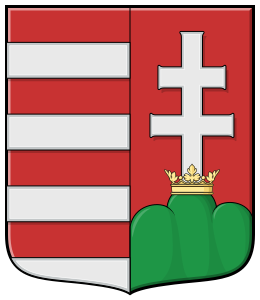
Coat of arms of Elizabeth Báthory
Country:
Type
Clan:
Grantor:
Year:
Title:
The Báthory Family
The Báthory family (earlier written as Bátori, or in another orthography Báthory) was a Hungarian high-noble house of Swabian origin, descending from the Bátori branch of the Majád main line of the Gutkeled kindred. From among its members came numerous medieval high dignitaries, voivodes and princes of Transylvania, and even one King of Poland. The family later split into three branches: the Ecsed, the Szaniszlófi, and the Somlyó branch, the latter descending from the Szaniszlófi line.
The dragon’s teeth in the coat of arms of the Gutkeled kindred— from whom the Báthorys also traced their descent, and from whom the heraldic ornaments of the Báthory arms derive— originate in the family’s founding legend. According to this tradition, one of their ancestors, the knight Opos Bátor, son of Márton of the Bavarian Wencelin line, in the time of Saint Stephen defeated and slew a dragon hiding in the marshes of Ecsed. As proof of his deed, the hero broke out three of the dragon’s teeth, and as a reward he received the Vid estate in Szabolcs County. This motif was reinforced by the membership of several Báthory ancestors in the Order of the Dragon, whose emblem was the dragon coiled around the shield: a dragon bent into a circle, winding its tail around its neck, split open lengthwise along its back from head to tail, bearing a red cross along the inner edge of the pale, bloodless wound. In Hungarian heraldry this is one of the most fully and precisely defined clan arms.
Elizabeth Báthory
Elizabeth Báthory of Ecsed (Nyírbátor, 7 August 1560 – Csejte, 21 August 1614) was a Hungarian countess, born into the historic Báthory family.
Her figure is surrounded by legends of horrific cruelty, which have become world-famous as a symbol of vampiric horror. Modern historical research, however, regards these accusations as politically motivated show trials. Nevertheless, ever-new retellings and fictionalized accounts continue to portray her in a negative light, reinforcing one of the most persistent misconceptions of Hungarian history.
What makes the case of Elizabeth Báthory opaque is not the horrifying testimonies of witnesses extracted under torture, but rather the obscure political and personal motives of her accusers.
Her husband, Count Ferenc Nádasdy, was a leading figure of the Hungarian estates’ opposition and one of the most prominent commanders of the frontier wars. He died in 1604. After his death the widowed Elizabeth soon became the target of serious attacks. As a widow she managed her vast estates of several hundred thousand acres, supported Hungarian students studying abroad, and treated her serfs with notable kindness. Her surviving letters show her to have been a socially sensitive, devout noblewoman. She also practiced healing, and her castle functioned as a hospital.
The likely motive behind the fabricated charges against her was the confiscation of her immense estates. Research also shows that Elizabeth maintained close family ties with her nephew, Prince Gabriel Báthory of Transylvania, who in 1605 openly sided with István Bocskai, elected Prince of Hungary and Transylvania. At the very time Elizabeth was accused, Gabriel Báthory was planning a major anti-Habsburg campaign— a circumstance that may also have contributed to the formulation of the false charges. Palatine György Thurzó may likewise have been motivated by his desire for her wealth and by personal grievances against the Báthorys. The interrogations were leading, and the confessions were extracted under torture— already unacceptable even by the legal standards of the time.
Elizabeth was married to Ferenc Nádasdy for thirty years. They had six children, of whom three— Anna, Katalin, and Pál— survived into adulthood. Two letters written by Elizabeth to her husband in 1596 survive, in which she writes tenderly about their children and their illnesses; nothing in them suggests any mental disturbance.
Her Family and Life
Elizabeth’s father was György Báthory of Ecsed, who died in 1570; her mother was Anna Báthory of Somlyó, whose brother was Stephen Báthory, Prince of Transylvania and later King of Poland. Elizabeth grew up in the castle of Ecsed. Her paternal grandparents were András Báthory, treasurer and lord-lieutenant of Szatmár, and Kata Rozgonyi; her maternal grandparents were Stephen Báthory, voivode of Transylvania, and Katalin Thelegdy.
She was betrothed at the age of eleven to Count Ferenc Nádasdy and married him in 1575. As a wedding gift, Nádasdy gave her the castle of Csejte and twelve surrounding villages. Ferenc Nádasdy, known to the Ottomans as the “Black Bey” because of his victories, was frequently away at war, leaving Elizabeth often alone. She became the patroness of widows and abused women of villages devastated by Ottoman raids, without regard to nationality.
After Nádasdy’s death in 1604, Elizabeth continued to manage her children’s inheritance with great care, arranging advantageous marriages for her daughters and ensuring the education and official advancement of her son.
The Legend of Blood Baths
The first to spread rumors of occult practices was István Magyari, a Protestant preacher. The legend later appeared in the 1729 Tragica Historia by the Jesuit László Turóczi, who claimed Elizabeth bathed in virgins’ blood to preserve her beauty. This story was repeated and embellished in later works by Mátyás Bél (1742), Alajos Mednyánszky (1826), and Kálmán Mikszáth (1886).
From a biological standpoint, such stories are impossible, as human blood coagulates and cannot be used for bathing. The accusations were first voiced only after Elizabeth’s arrest, and then only by servants whose testimonies were obtained under torture.
Since the main written sources were composed more than a century after her death, the historical basis of the “Blood Countess” legend is highly questionable.
Source of the original image: Internet
Text source: Wikipedia
The visual content of this website may be freely used under the terms of the Creative Commons 4.0 license, provided that the source is clearly indicated and the attribution includes a full, clickable link to https://cimerek.hu or to the exact web address of the specific content.
