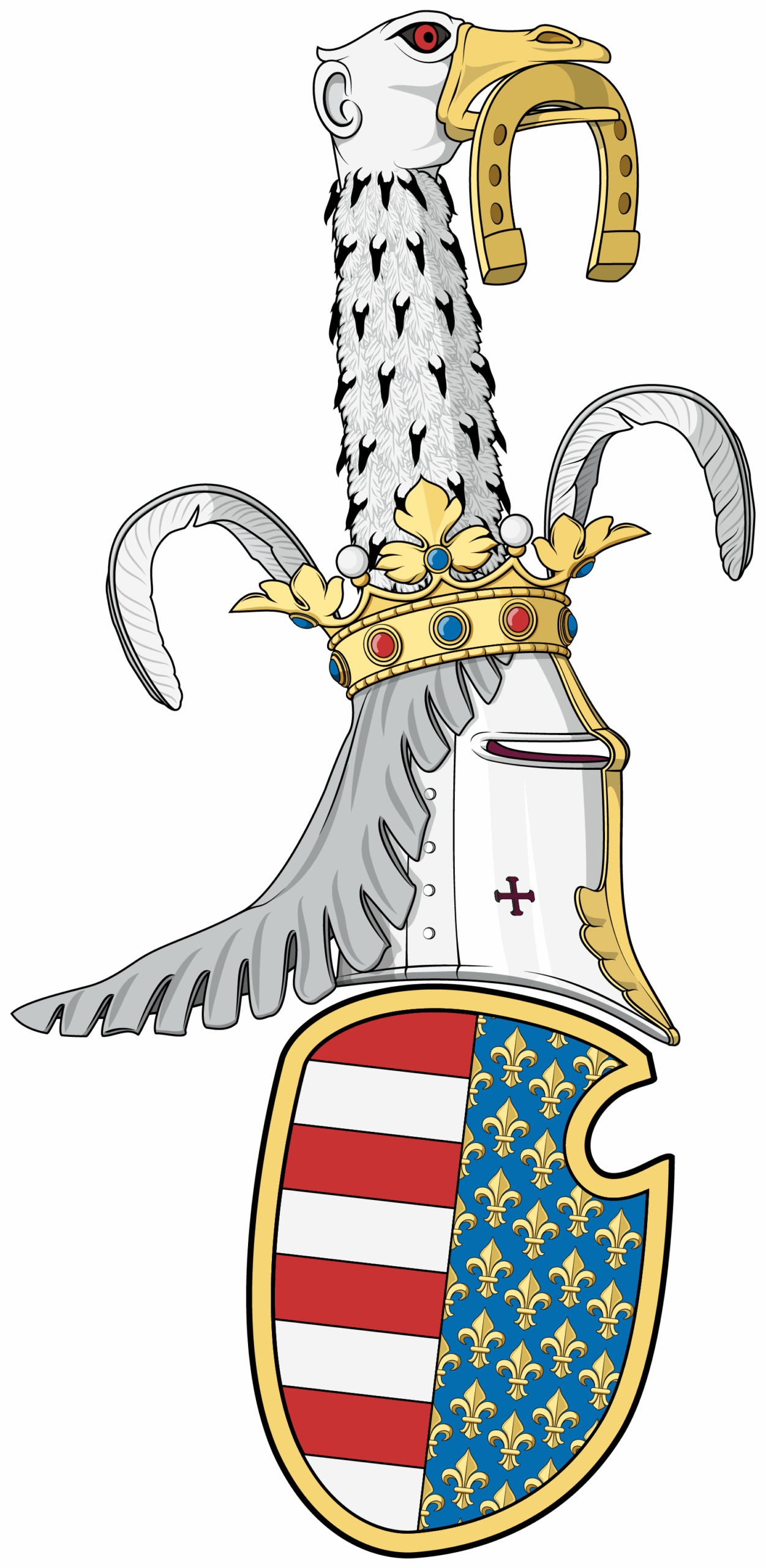
Coat of arms of King Louis I of Hungary
Name:
Epithet:
Country:
Title:
Dynasty:
Reign:
Coat of arms
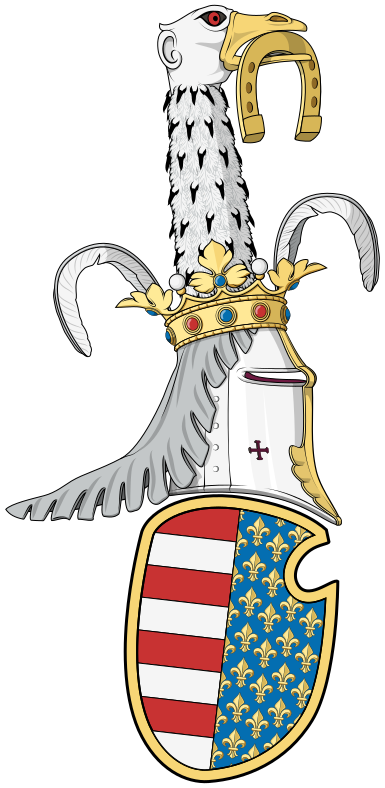
Vector reconstruction of the coat of arms of King Louis I of Hungary. The work was based jointly on the original clasp and the heraldic description.
Professional assistance: Dr. Imre Csáky
Description of the coat of arms
[…] Would that I were so ingenious and wise that I could extol, according to my will, the radiant splendor of the coat of arms which he bears with honor! No blemish mars his shield; it shines in silvery color and is divided into two equal fields. One field gleams in a bright hue with pure pearls and rubies and is polished to brilliance, and within it lie eight ornate horizontal bars; the other field is sky-blue, richly adorned with embossed golden fleurs-de-lis, which with their abundant rays have often protected the coat of arms and are most pleasing to behold.
The crest of the helmet is adorned with a richly decorated golden crown, in which many precious stones sparkle, and which is smoothly polished; from the crown rise two ostrich feathers, and from between them the ermine-covered neck of the ostrich may be seen; its eyes glitter toward the enemy with rubies, its beak is made of gold, in which it beautifully holds a finely curved, horseshoe-shaped object also made of gold. Its head is richly crowned with gold. […]
King Louis I of Hungary, also known as Louis the Great
(In Poland: Louis of Hungary; in Polish: Ludwik Węgierski; in Croatian: Ludovik I Anžuvinac; Visegrád, Kingdom of Hungary, 5 March 1326 – Trnava, Kingdom of Hungary, 10 September 1382) was a Hungarian royal prince of the Capetian–Angevin dynasty, King of Hungary and Croatia from 1342, and King of Poland from 1370 until his death. His father was King Charles I of Hungary, and his mother was Queen Elizabeth of Poland (Elizabeth Łokietek). Born as the third son of the royal couple, he was not originally considered a likely heir to the throne, but became the successor following the deaths of his elder brothers.
His reign marked one of the golden ages of the medieval Kingdom of Hungary. Internal peace, stable administration, and a foreign policy shaped by dynastic marriages fostered the development of society, the economy, and culture. Under Louis, Hungary was among the most advanced European kingdoms in international comparison. Through his active and resolute foreign policy and successful military campaigns, the Kingdom of Hungary rose to the status of a great European power.
Youth and Accession to the Throne
Louis spent his childhood largely in the disciplined atmosphere of the Angevin court. His father, Charles I, took special care to prepare his son thoroughly for governance: he received military training and acquired knowledge of state administration and diplomacy. In 1342, at the age of sixteen, he ascended the throne following his father’s death. Despite his youth, he soon proved his aptitude, and after an initial regency exercised by his mother, Queen Elizabeth, he ruled the affairs of the kingdom independently.
Reign and Foreign Policy
Louis’s reign was shaped by chivalric ideals: in his person, the warrior king and the Christian statesman were united. He led numerous military campaigns through which he strengthened the kingdom’s influence in the region.
He successfully asserted the supremacy of the Hungarian crown over Dalmatia and Croatia, extending royal authority to the coastal cities as well.
He fought several wars against Venice, among which the Peace of Zara (1358) secured the recovery of Hungary’s Adriatic territories.
He also entered into conflict over the throne of Naples, launching punitive campaigns following the murder of his brother, Prince Andrew of Naples. Although his attempts to gain lasting control over Naples were unsuccessful, these campaigns enhanced his international prestige.
In 1370, following the death of his uncle, King Casimir III of Poland, he inherited the Polish crown through his mother, thereby establishing the Hungarian–Polish personal union, which significantly increased Central Europe’s political weight. Although his authority in Poland was limited by the local nobility, his rule was accepted, and a close relationship developed between the two kingdoms under his person.
Internal Governance and Reforms
The domestic policy of Louis the Great was characterized by stability and the strengthening of the legal order. During his reign, he introduced several important measures:
In 1351, he reaffirmed the Golden Bull, which formed the foundation of noble rights. The law of entail (ősiség) introduced at that time determined the course of Hungarian noble land policy for centuries.
He supported the Church, founding several monasteries and churches, and maintained good relations with the papacy.
He promoted the development of mining, particularly gold and silver extraction, which increased the kingdom’s revenues.
Through his financial reforms, the revenues of the Kingdom of Hungary grew significantly, enabling the funding of military campaigns and the royal court.
Cultural Legacy
King Louis patronized the arts and culture. During his reign, Hungarian architecture and manuscript illumination flourished, and he maintained contacts with early representatives of Italian humanism. The expansion of the royal palaces at Visegrád and Buda is also associated with his name. His personal fame, chivalric virtues, and military campaigns later served as sources of inspiration for poets and writers of Hungarian national Romanticism in the 19th century.
Family Life and Legacy of King Louis I of Hungary
Louis’s wife was Elizabeth of Bosnia, with whom he had three daughters: Catherine, Mary, and Hedwig. He had no sons, which caused tensions regarding the succession. After his death, his daughter Mary succeeded him as Queen of Hungary, while in Poland his other daughter, Hedwig (later venerated as a sainted queen), ascended the throne.
Death and Historical Assessment
Louis I died on 10 September 1382 in Trnava. Following his death, the personal union dissolved, and Hungary and Poland went their separate ways. Nevertheless, his memory has been preserved in the histories of both countries as that of an outstanding ruler.
Louis the Great remains one of the most significant figures in Hungarian history: as a military leader, legislator, and patron of culture, he left a lasting legacy. As the fifth longest-reigning king of Hungary, his name continues to symbolize the greatness of the medieval Hungarian state.
Original image source: Internet
Text source: ChatGPT
The visual content of this website may be freely used under the terms of the Creative Commons 4.0 license, provided that the source is clearly indicated and the attribution includes a full, clickable link to https://cimerek.hu or to the exact web address of the specific content.