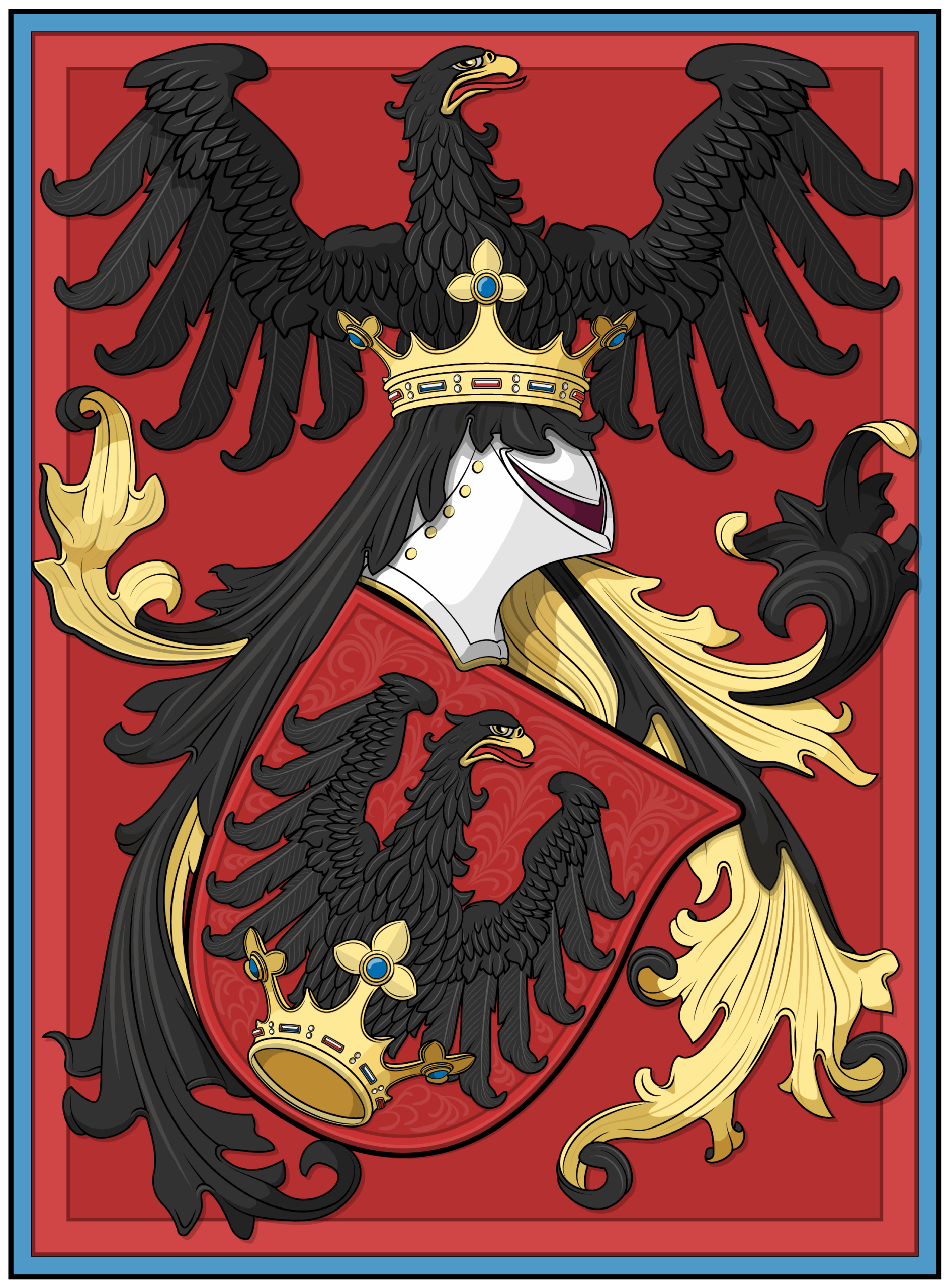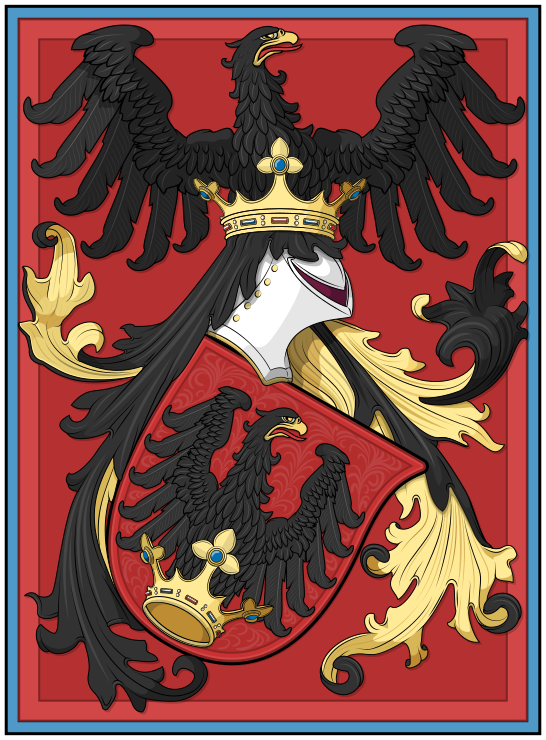
Coat of arms of the Sirokai Family
Location:
Type:
Clan:
Grantor:
Sirokai Family
The Sirokai family was an extinct ancient noble family of Sáros County, descended from the Aba kindred. Its origin is traced back to Count or ispán Péter Petencsi, lord of Salánc Castle, sharing common ancestors with the Báthory of Gagy, Frichy, Bertóthy, and Hedry families.
(Source: Wagner, Mss. Gen. tab. I.)
In 1330, a member of the lineage, Peter II, adopted the name “of Salánc.” His sons were Nicholas, George, Ladislaus, and Michael; his brothers were John and Peter; further relatives included Lawrence’s son Comes Ladislaus, his son Demeter, and Andrew’s son Luke. Together with Master William of Salánc (Vilermus), Lord Lieutenant (főispán) of Szepes and Sáros, they exchanged the ancestral Salánc Castle and its appurtenant estates—Salánc, Romántelke, Olasz-ispántelke, the village of Ocsvár, and the deserted land of Ruthke in Abaúj County—before the Chapter of Eger, with the consent of King Charles I, for the settlements of Bertóth, Hedricsfalva, Frics (Frichi), and Siroka in Sáros County. As early as 1344, Peter II was already referred to as “Peter of Siroka.” The brothers subsequently founded separate family branches, named after their respective estates.
(Sources: Wagner, Dipl. Sáros, p. 331; Fejér, Cod. dipl. IX/I, p. 244.)
Paul, son of George of Siroka, and Paul’s son Peter (“Tornyos”) were exiled for factional conflicts, but in 1393 King Sigismund—at the intercession of the kinsmen of John Vitéz—granted them pardon and restored their properties.
(Source: Wagner, Dipl. Sáros, p. 349.)
Ladislaus, son of Peter, who was himself the son of Ladislaus, served as Bishop of Naples and auxiliary bishop of Eger. He died on 24 January 1487, as attested by the red marble epitaph of the church at Sirok. In the inscription he is referred to as “de Syroka”; however, it is uncertain whether the tomb was located in Sirok in Heves County or in Siroka in Sáros County, so it cannot be ruled out that the monument belonged to a member of another family bearing the name Sirok.
(Source: Pray, Hierarchia, vol. I, p. 213.)
The Sirokai family became extinct during the course of the 15th century.
(Source: Iván Nagy: Families of Hungary.)
Description of the Sirokai Coat of Arms
The shield is of early Renaissance form. Within it rises the upper half of an eagle, facing to the dexter, with wings lowered from an open five-pointed crown.
This coat of arms provides an important reference for understanding the heraldry of the Aba kindred. It confirms the observation of József Csoma, according to whom the clan’s arms consisted of a black eagle on a red field, with the crest depicting the same charge rising from the shield. Csoma further claimed that the eagle held a green wreath in its beak; however, this element is absent from the coat of arms described here. It cannot be determined with certainty whether the families who received armorial grants later omitted the wreath, or whether Csoma’s assertion was incorrect and the wreath never formed part of the original arms of the Aba kindred.
(Source: László Fejérpataky – Antal Áldásy: Hungarian Armorial Monuments; Hungarian Heraldic and Genealogical Society, 1901–1926.)
Text source: ChatGPT
The visual content of this website may be freely used under the terms of the Creative Commons 4.0 license, provided that the source is clearly indicated and the attribution includes a full, clickable link to https://cimerek.hu or to the exact web address of the specific content.