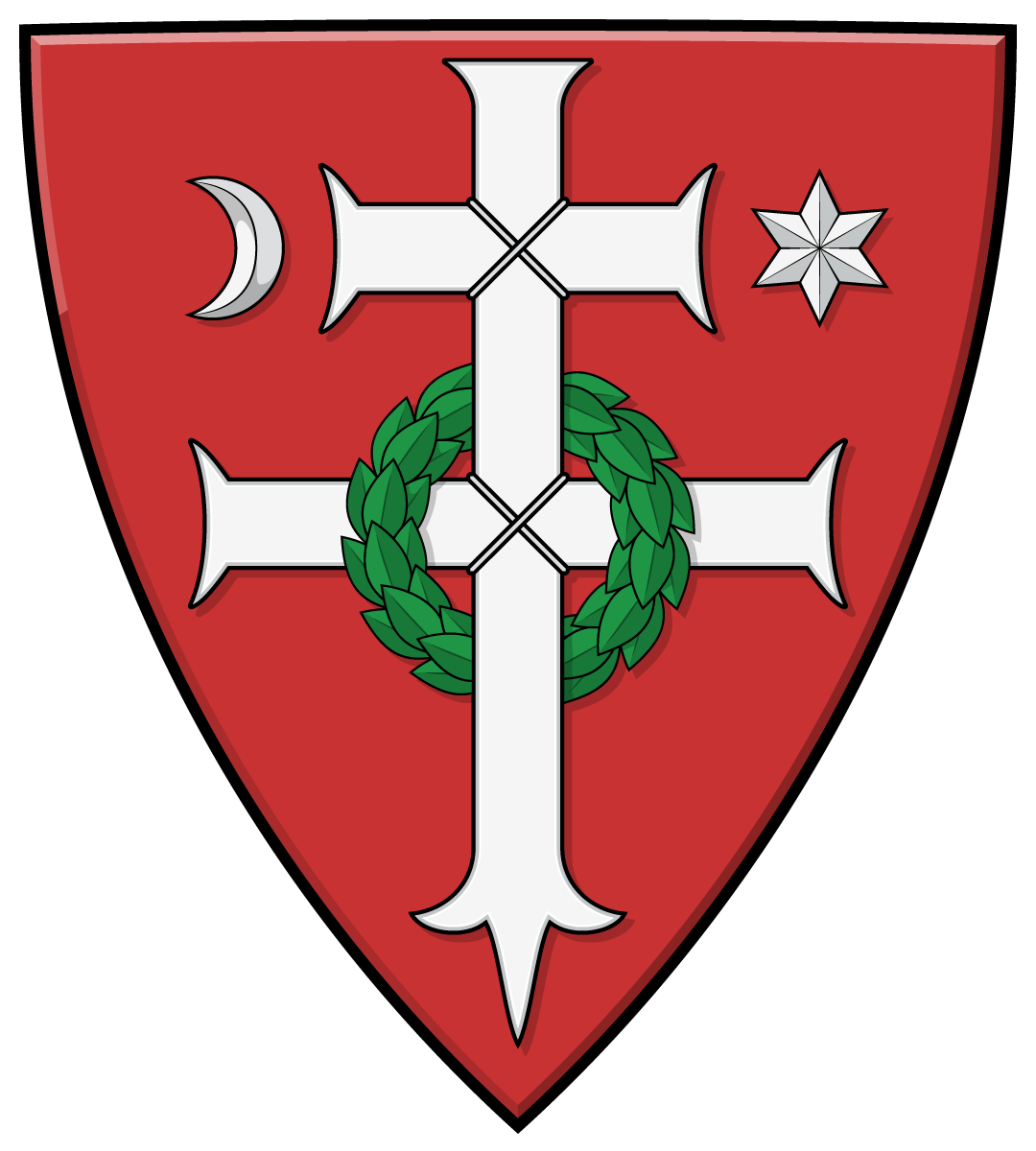
Coat of arms of King Andrew III of Hungary
Name:
Epithet:
Country:
Title:
Dynasty:
Reign:
Coat of arms redrawn based on his seal.
Andrew III, also known as Andrew of Venice
Andrew III of Hungary (Venice, 1265 – Buda, 14 January 1301) was King of Hungary from 1290 to 1301 and the last king of the House of Árpád born in the male line. His father was Prince Stephen, the youngest posthumous son of King Andrew II, while his mother, Tomasina Morosini, came from a Venetian patrician family. Through his ancestry, Andrew embodied a dual heritage: the bloodline of the Árpád dynasty and the cultural and political background of the Venetian elite.
At his death, Stephen Ákos, Palatine of Hungary, referred to him as “the last golden twig of the House of Árpád,” a phrase that has endured in historical memory. As the final Árpád king, his person and short reign hold particular significance in Hungarian history.
Youth and Claim to the Throne
Andrew spent his childhood in Venice under the care of his mother’s family, as his father, Prince Stephen, died relatively early. For a long time, the Hungarian political elite did not recognize him as a legitimate claimant to the throne; indeed, he was often regarded as a “pretender,” as doubts surrounded the circumstances of his birth and his father’s inheritance.
As a young man, Andrew traveled to Hungary several times to assert his claim to the crown. Owing to internal conflicts and the competing claims of foreign dynasties, however, he was only able to secure the throne after the death of King Ladislaus IV (“the Cuman”) in 1290. At that time, the papacy hesitated to recognize him, as other dynasties also sought the Hungarian crown, but the majority of the nobility and the higher clergy supported Andrew, seeing him as the legitimate representative of the Árpád legacy.
Reign of King Andrew III
The reign of Andrew III lasted only eleven years (1290–1301), yet it coincided with an exceptionally turbulent and crisis-ridden period. As royal authority had already been significantly weakened, powerful territorial lords emerged who exercised almost independent rule over vast estates. Andrew therefore faced a constant struggle to restore and strengthen central royal authority.
Domestic Policy
During his reign, he attempted to curb the power of the great oligarchic families (such as the Kőszegi clan, the family of Matthew Csák, and Amadeus Aba), but his resources were insufficient to re-establish full unity within the kingdom. He sought to recover royal estates and restore the prestige of the crown, yet he was often forced into compromises.
Foreign Policy
His claim to the throne was also challenged by foreign ruling houses. The Habsburg dynasty aspired to the Hungarian crown and periodically launched military campaigns against the kingdom. Although Andrew succeeded in defending his rule, dynastic rivalry remained a constant threat.
At the same time, his foreign policy displayed a degree of stability: he maintained relations with Venice, Italy, and the papacy, and sought agreements with the rulers of Poland and Bohemia.
Support of the Church
Andrew maintained good relations with the Catholic Church, as his legitimacy largely depended on ecclesiastical support. He made several donations of land to church institutions and sought to preserve the Christian character of the kingdom.
The End of the House of Árpád
With the death of Andrew III in 1301, the House of Árpád became extinct in the male line, ending nearly three centuries of dynastic rule in Hungary. After his death, the Hungarian throne became the object of competition among several European ruling houses, ushering in the so-called “age of royal elections,” a period marked by civil wars and dynastic struggles.
There was no consensus among the Hungarian magnates regarding the succession. Several dynasties claimed the crown, including the Habsburgs, the Přemyslid dynasty of Bohemia, and the Angevin House of Naples. Ultimately, the Angevins emerged victorious, and in 1308 Charles I (Charles Robert) began the rule of a new dynasty.
Evaluation and Memory
Andrew III is remembered by both contemporaries and posterity primarily as “the last Árpád king.” Although his reign was brief and he was unable to restore the full strength of royal authority, his political skill enabled him to retain the crown for more than a decade amid intense dynastic rivalry.
The epithet “the last golden twig” is more than a poetic expression: in Hungarian historical consciousness it symbolizes the closing of an era. With Andrew’s death, the dynastic continuity that had shaped the Hungarian kingdom since the time of the Conquest came to an end.
Legacy
The reign of Andrew III marked a transitional period in Hungarian history:
he was the last male descendant of the House of Árpád;
during his reign, the power of the territorial lords became firmly entrenched;
his death ushered in a period of succession struggles and interregnum, which ended only with the rise of the Angevins in the early 14th century.
Although his reign was not marked by spectacular military victories, he nevertheless succeeded in preserving the territorial integrity and sovereignty of the kingdom during a time of profound crisis.
Original image source: Internet
Text source: ChatGPT
The visual content of this website may be freely used under the terms of the Creative Commons 4.0 license, provided that the source is clearly indicated and the attribution includes a full, clickable link to https://cimerek.hu or to the exact web address of the specific content.