
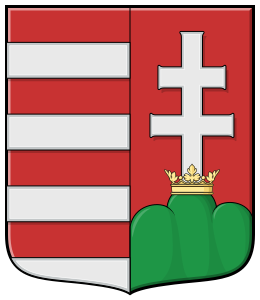
Historical coat of arms of Szeben County
Lokáció:
Típus:
Fennállás:
Adományozó:
Szeben County
Location
Szeben County was located in the southern part of Transylvania, in the valley of the Szeben and Olt rivers. To the north, it was bordered by the counties of Alsó-Fehér and Nagy-Küküllő; to the east by Fogaras; to the west by Hunyad; and to the south, the national border ran along the ridge of the Southern Carpathians. Its area was approximately 3,600 km². Its seat was Nagyszeben, and its second town with a regulated council was Szászsebes.
History of Szeben County
Szeben County was named after its seat, Nagyszeben. The city was one of the most important centers in the southern part of historical Transylvania and played a decisive role in the political, economic, and cultural life of the Transylvanian Saxons for centuries.
Szeben County was established based on Act XXXIII of 1876, during the reorganization of Hungarian administration. The majority of its territory was formed by the former Szeben seat, which also included the filial seats of Szelistye and Talmács. Furthermore, the new county incorporated a significant portion of the seats of Szászsebes, Szerdahely, and Újegyház, as well as several settlements and territories previously belonging to other administrative units.
Nagyszeben became the center of the county. The city had already been one of the most significant hubs of the Saxon lands, thus it played a prominent role in the administrative and economic life of the new county as well. At the end of the 19th century and the beginning of the 20th century, the expansion of the railway, industrial development, and the strengthening of trade further increased the importance of the region.
The population of Szeben County was multi-ethnic. According to the 1910 census, the majority of the county’s approximately 177,000 inhabitants were Romanians, alongside a significant number of Saxons and a smaller Hungarian population. The proportion of Romanians was 64.3%, Germans 28.1%, and Hungarians 5.7%.
At the end of World War I, Hungarian administration ceased in the area. As a result of the Treaty of Trianon, the territory of the historical county became part of Romania.
The history of the territory of Szeben County is closely intertwined with the history of the Transylvanian Saxons. The Saxon seats that developed during the Middle Ages formed a unique administrative and social system. The county reorganization of 1876 abolished this centuries-old administrative system and integrated their territories into the modern Hungarian county system.
During the existence of the county, Nagyszeben remained a significant cultural, educational, and economic center. The Saxon, Romanian, and Hungarian cultures were all present in the historical heritage of the region.
Coat of Arms
The first coat of arms of Szeben County was created after the formation of the county in 1876. The coat of arms was a simple, independent composition that did not adopt the coat of arms of any previous Saxon seat.
In a blue shield, there is a silver bastion with an open gate and two windows. From the battlements of the bastion, three golden ears of wheat lean out to the right and left.
The bastion can be interpreted as a heraldic motif referring to the fortified settlements of the area, while the ears of wheat refer to agriculture and fertile land. A characteristic feature of the coat of arms is that it did not directly display Saxon symbols in its external decorations; therefore, it can be considered the county’s own new coat of arms created in 1876.
The county later changed its coat of arms. On December 27, 1892, the general assembly adopted a new coat of arms that already combined the coats of arms of the former seats of Szeben, Szászsebes, Újegyház, and Szerdahely, as well as the emblem of the Transylvanian Saxon nation. The new coat of arms was confirmed by Franz Joseph I on March 17, 1893.
The coat of arms presented in this article is the first coat of arms of Szeben County created in 1876, which symbolizes the early period of the county’s history.
Sources of information: Hungarian Catholic Lexicon; Attila István Szekeres: Címerváltoztatások Romániában Trianon után (Change of Coats of Arms in Romania after Trianon).
Source of image: Hugo Gerard Ströhl’s 1890 Die Österreichisch-Ungarische Wappenrolle.
The visual content of this website may be freely used under the terms of the Creative Commons 4.0 license, provided that the source is clearly indicated and the attribution includes a full, clickable link to https://cimerek.hu or to the exact web address of the specific content.