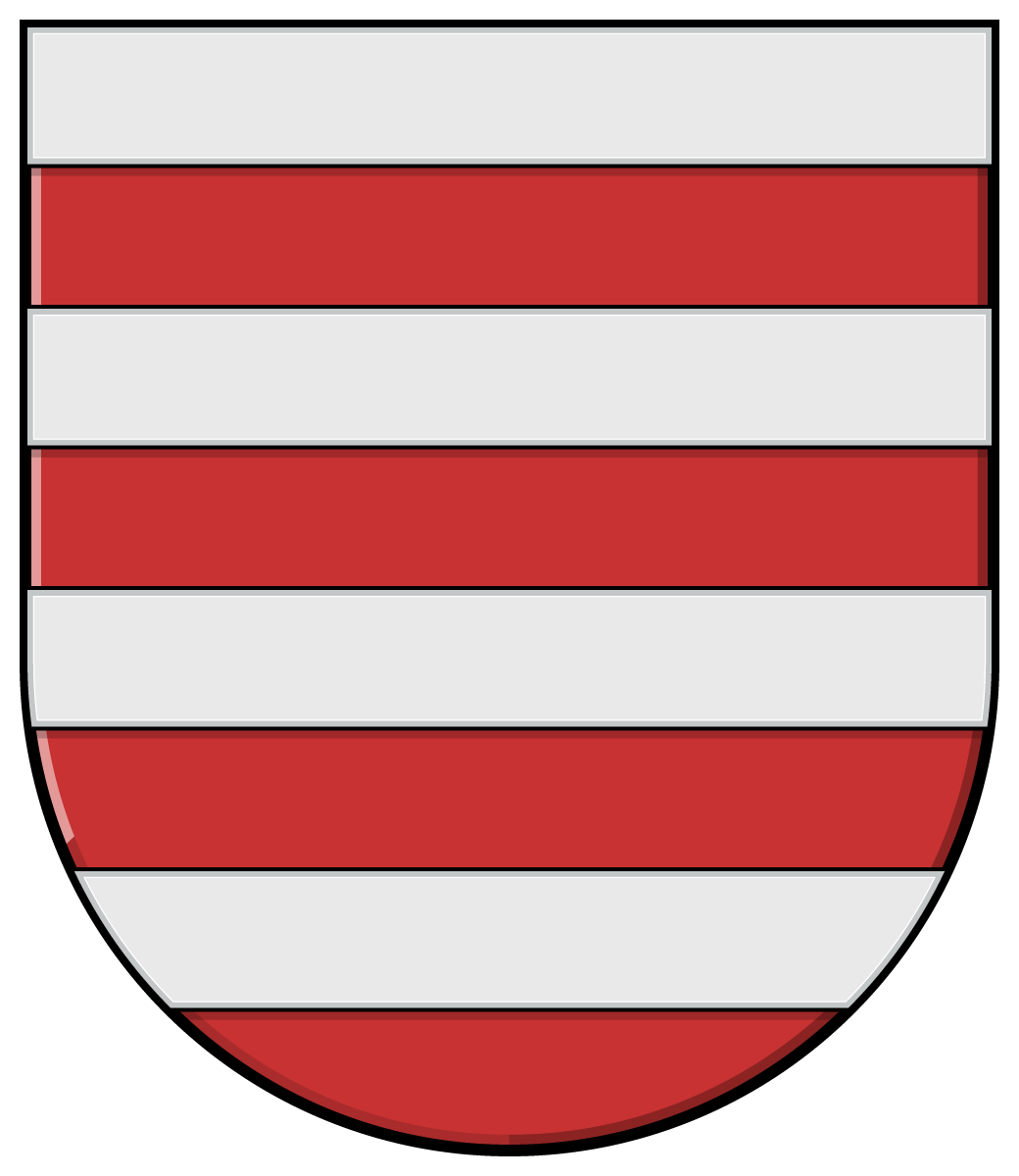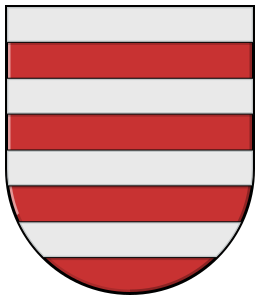
Coat of arms of Banská Bystrica
Location:
Type:
Grantor:
Year:
Status:
Banská Bystrica
Banská Bystrica (Hungarian: Besztercebánya, German: Neusohl, Latin: Neosolium) is a city in Slovakia, the seat of both the Banská Bystrica Region and District, and the episcopal see of the Diocese of Banská Bystrica.
Its coat of arms is a shield barry of seven, silver and red.
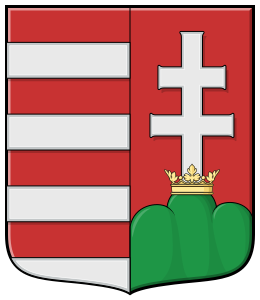
A surviving seal matrix from the mid-15th century is regarded as a variant of the royal arms. The seal shows a shield barry of seven, which at first glance corresponds to the state arms of the Árpád dynasty, which are likewise barry. However, on Banská Bystrica’s seal the protruding (thus brighter) silver bars are the 1st, 3rd, 5th and 7th, whereas on the royal seals these are the 2nd, 4th, 6th and 8th. The colouring of the Árpád arms is therefore in the reverse order. Novák considered this to be the city’s oldest coat of arms, and therefore defined it as the standard arms of the city.
Location
The former mining town is today the centre of Central Slovakia, situated at the first major bend of the Hron (Garam) River.
Origin of the name
The city takes its name from the Bystrica stream, at the mouth of which it was founded. The stream’s name derives from the Slavic word “bystrica” meaning “fast-flowing stream”. The suffix of the name refers to its ore-mining activity.
History of Banská Bystrica
The Quadi tribes already mined ore in the surrounding mountains. After the Hungarian Conquest, its small mining settlement belonged to Zólyom Castle. The town was founded by German settlers in the 12th century. It is first mentioned in 1255 as “Byzterchebana”, when King Béla IV granted it town status and resettled the community—destroyed during the Mongol invasion—with Thuringian Saxons.
It became one of the most important mining towns. Its first fortifications were built around the Gothic parish church in the 14th century, the town walls in the 15th century, and these were further strengthened in the 16th century. In 1620, Gábor Bethlen held a Diet here at which he was elected King of Hungary. In 1678 and 1680 the town was occupied by the forces of Imre Thököly, and in autumn 1703 by Rákóczi’s Kuruc troops. During the War of Independence it was an important military-industrial centre until it was recaptured by imperial forces on 25 October 1708. Its fortifications were then gradually dismantled; only the Butchers’ Bastion and the town tower survived. A great fire in 1761 devastated the town and its defences. The diocese was founded by Maria Theresa.
Source of the original image: Internet
Text source: Wikipedia
The visual content of this website may be freely used under the terms of the Creative Commons 4.0 license, provided that the source is clearly indicated and the attribution includes a full, clickable link to https://cimerek.hu or to the exact web address of the specific content.