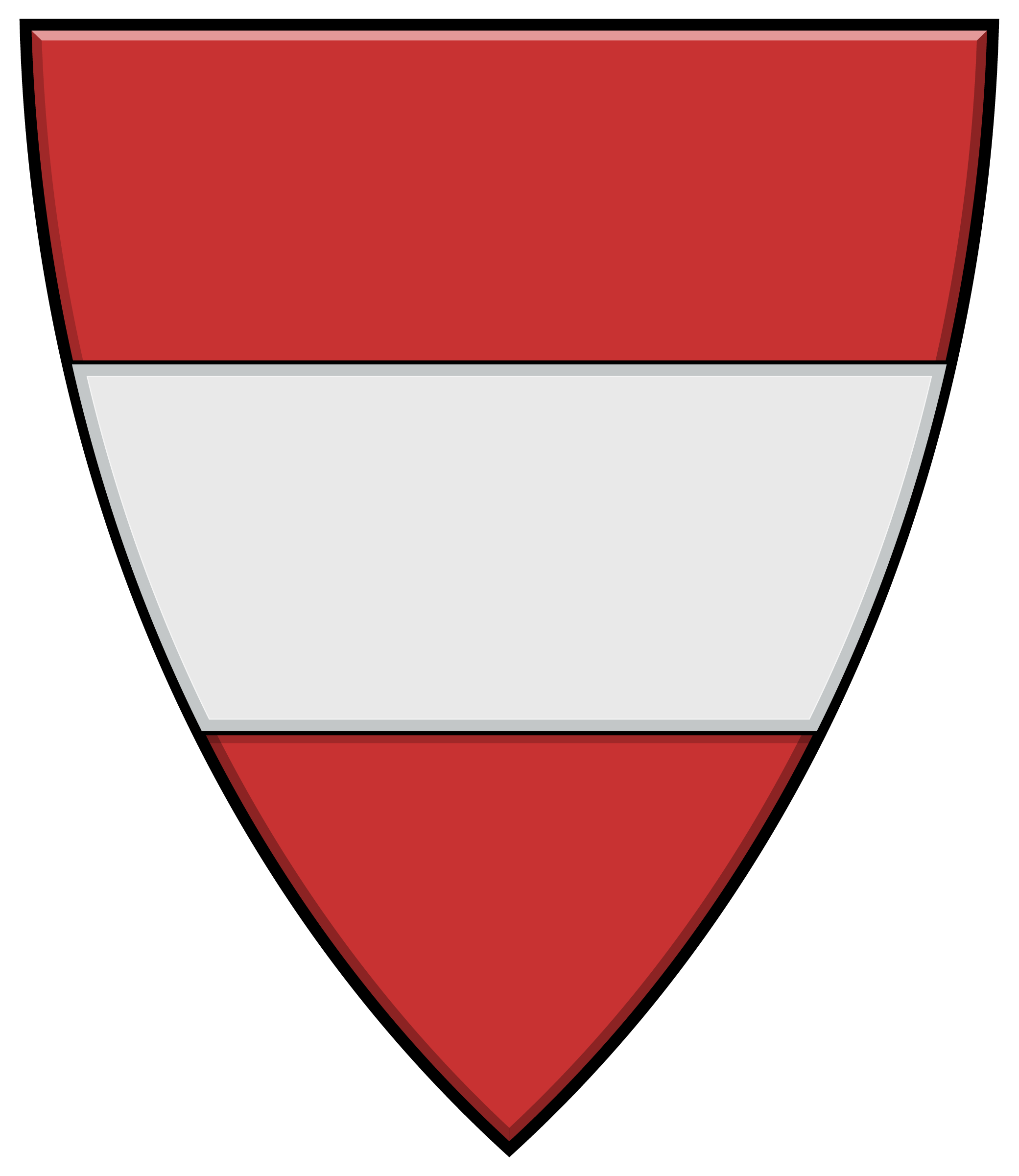
Coat of arms of Amade Aba
Country:
Type:
Clan:
Grantor:
Grantee of arms:
Year:
Title:
Amade Aba
(Amadeus Aba; Hungarian: Aba Amadé; Slovak: Omodej; c. 1240 – 5 September 1311, Košice)
One of the most powerful Hungarian oligarchs at the end of the Árpád era, Amadé exercised de facto independent authority over the northern and north-eastern counties of the Kingdom of Hungary (today parts of Hungary, Slovakia, and Ukraine). A member of the Amadé branch of the Aba kindred, he was the son of ispán Dávid and brother of Aba Péter and Finta, himself a former palatine.
Rise to Power
Amadé first distinguished himself in 1278 at the Battle on the Marchfeld, fighting alongside King Ladislaus IV of Hungary. Through loyal military service, inheritance, royal grants, and at times forceful territorial expansion, he built up a vast landed base in northeastern Hungary.
He served as Judge Royal (országbíró) from 1283 to 1285 and again in 1289, and held the office of Palatine (nádor) on seven occasions between 1288 and 1310. Under Andrew III of Hungary, the last Árpád king, he remained a loyal supporter, participating in campaigns and diplomatic missions, and joining alliances against rival magnates.
Provincial Lordship
After Andrew III’s death in 1301, Amadé emerged as a dominant territorial lord during the interregnum. His authority extended over Abaúj, Sáros, Zemplén, Ung, Bereg, and Szepes counties, with influence reaching neighboring regions. From his seat at Gönc, he organized a provincial administration modeled on royal structures, complete with a chancellery and judicial system; Vizsoly functioned as the center of his court.
Although initially cautious in the succession struggle, he eventually aligned himself with Charles I of Hungary (Charles Robert of Anjou). He took part in the assemblies confirming Charles’s kingship (1307–1309) and contributed to negotiations for the recovery of the Holy Crown. During the king’s early and vulnerable years, Amadé occasionally provided him protection and political support.
Conflict with Kassa and Death
Amadé’s rule combined lawful authority with the arbitrary practices typical of contemporary oligarchs. He appropriated estates, levied tolls, and exercised royal prerogatives within his territories. His most serious conflict arose with the royal free town of Kassa (Košice), whose strategic and economic importance he sought to control.
In September 1311, tensions culminated in a violent confrontation at the southern gate of the city between his retinue and the predominantly Saxon burghers. During the clash, Amadé was attacked and killed.
Collapse of the Aba Domain
Following his death, his sons attempted to preserve the family’s territorial power. However, King Charles I of Hungarymoved decisively to dismantle the oligarchic provinces. Allied with Matthew Csák, the Aba forces were defeated at the Battle of Rozgony in 1312. Their estates were gradually confiscated, and the Aba provincial lordship collapsed.
Amade Aba’s Character and Historical Significance
Contemporary sources portray Amadé as assertive and at times overbearing, yet personally devout and respectful toward ecclesiastical institutions. Unlike several other magnates of his age, he did not systematically plunder church properties and frequently relied on cathedral chapters in judicial matters.
Aba Amadé stands among the leading “little kings” (kiskirályok) of early fourteenth-century Hungary. His career illustrates both the fragmentation of royal authority after the extinction of the Árpád dynasty and the determined efforts of Charles I to restore centralized royal power.

The visual content of this website may be freely used under the terms of the Creative Commons 4.0 license, provided that the source is clearly indicated and the attribution includes a full, clickable link to https://cimerek.hu or to the exact web address of the specific content.