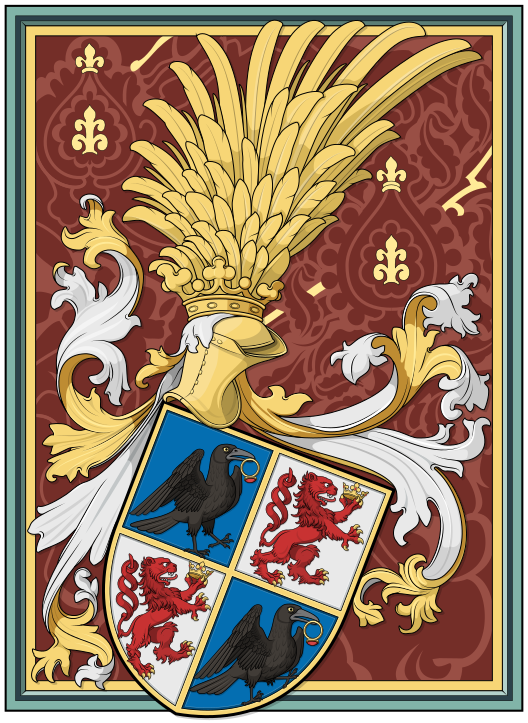
The augmented coat of arms of John Hunyadi
Name:
Epithet:
Country:
Title:
Dynasty:
Reign:
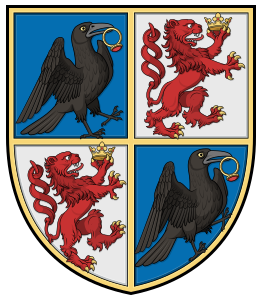
The coat of arms of John Hunyadi
Ladislaus, by the grace of God King of Hungary, Bohemia, Dalmatia, Croatia, etc. […], Duke of Austria and Styria, Margrave of Moravia, etc. […], having graciously and sincerely favored our beloved and faithful subject, the noble and magnificent John Hunyadi, formerly Governor of our realm, have elevated and exalted him to the hereditary comital dignity and office over our town and district of Bistrița in Transylvania, as we have set forth more fully, clearly, and formally in our charter issued thereon. It remains for us to unite the well-deserved affection we bear toward him with greater and more eminent tokens, and, having increased his honor, to augment it with higher and fitting insignia and ornaments.
For until now, by the grace of our holy royal predecessors, the aforesaid Count John, his ancestors and family possessed and publicly used, as a beneficent gift bestowed upon them, a coat of arms or noble emblem consisting of a raven painted in its natural colors, slightly raising its wings, holding a golden ring in its beak, set in an azure field. Henceforth, however, as a symbol of his new honor and magnificent dignity, by the counsel of our prelates and barons, we grant and add to his aforementioned former arms a whole red lion in a silver field, rising, with legs outspread, mouth open, fierce and attacking in aspect, holding or as if offering a golden crown in one of its forepaws; so that both coats of arms, doubled and divided according to their colors in the form of a cross, shall be placed and set upon one and the same shield.
Above this shield shall be placed a gilded helmet crowned with gold, from which the customary mantlings descend on either side, and as a crest there shall be set two similarly gilded, upward-reaching wings. […].
The figure of the red lion in the silver field signifies that the aforesaid Count John, during our present absence, namely after the pacification of the dissensions of this our realm, undertook and assumed, in our name, the office of general governor to his own honor and burden, and carried out, performed, and accomplished all that was suited to the defense of our kingdom and the protection of our rights, with sincere loyalty and concern, which sincerity is denoted by the white color. In these endeavors, having on many occasions launched brave campaigns, shedding his own blood and that of his followers with great presence of mind and—so to speak—lion-like boldness, he was not undeservedly likened to a fighting and blood-red lion. And the fact that in one of its forepaws it holds and offers a golden crown openly signifies that the aforesaid Count John, having wrested the rights of our crown and their possession from the hands of the attackers by his own toil and sweat, faithfully delivered them to our majesty, after offering his ability, and through his outstanding cooperation restored them and happily introduced us into their governance.
Issued in Pressburg, on the Friday before the Feast of the Blessed Virgin, in the Year of Our Lord 1453.
Legends of Origin and the Raven Emblem
“Most rulers who rose from humble origins feel the need to justify an ancient lineage. Matthias was no exception, and his loyal scribes did everything to unearth old, non-existent parchments. In 1409, Sigismund of Luxembourg granted Hunyad Castle and its appurtenances to his favored court knight, Vajk. The respected noble’s father may have been a Wallachian Cuman knez before Vajk fled to Hungary and entered royal service. This is also suggested by the fact that his later famous son was initially called John Hunyadi the Wallachian, a name used derisively. Malicious tongues whispered that Vajk’s beautiful wife had admitted the ruler to her bed, and that the valiant Turk-slayer was born of him. (It is not impossible that Matthias himself stood behind this rumor in order to prove his royal descent.) Sigismund allegedly gifted a special golden ring to the willing lady. According to legend, a raven later stole the ring from the young Hunyadi, but his uncle struck down the treasure-seeking bird with a single arrow. By the 1470s, Italian humanists already praised Matthias as being of Roman blood. The idea of kinship between the Hunyadi family and the Roman Corvinus clan was inspired by the image of the raven (corvus) appearing in their coat of arms.*
Perhaps this was meant to overshadow the nimbus of the imperial eagle. The raven holding a ring in its beak was most often the symbol of moneylenders and bankers. It is conceivable that the founders of the family were initially engaged in financial and pledge transactions. According to certain sources, Vajk possessed an estate called Raven’s Rock (Piatra Corbului), from which the distinctive animal figure may have been borrowed. Several humanist chroniclers mention that John Hunyadi was born on a Danube island near Wallachia called Covinum, which may be identical with Keve. Although many despise the raven, it is undoubtedly one of the most intelligent birds, often outwitting even the eagle.”
(Szabó Zoltán – Hegedűs Péter: The Legendary King of a Flayed Country, Interpress Magazine, May 2008)
Giulio Cesare Capaccio (1550–1634) wrote that John Hunyadi received the powerful crowned lion in addition to the family raven in his coat of arms from King Władysław I, because through his heroism he preserved the Crown of Hungary.
Research on the Hunyadi Origins
Between the two World Wars, Fráter Lénárt conducted comprehensive research on the origins of the Hunyadi family. He summarized his findings in The Hungarian Origin of the Hunyadis Based on Charters, concluding—on the basis of documentary and heraldic evidence—that John Hunyadi was the son of Péter Vereb, and that King Matthias was Péter Vereb’s grandson.
After John Hunyadi resigned from the office of governor, the young king elevated him, in recognition of his merits, to the hereditary county of Bistrița and granted him a new coat of arms. The augmentation depicts a red lion standing on its hind legs in a silver field, holding a golden crown in its paw. The new arms are arranged on a quartered shield: the first and fourth quarters display the original family arms, while the second and third quarters show the augmentation. A gold-crowned helmet with a crest surmounts the shield, and the edges are adorned with mantling. Exceptionally, the charter text also explains the meaning of the new heraldic figure: the red lion represents Count John wounded in battle, who guarded and defended the rights of the Crown through heroic struggles during the king’s minority, while the crown-holding paw symbolizes the moment when he returns supreme authority to the ruler.
John Hunyadi
(Romanian: Ioan de Hunedoara; Croatian: Janko Hunjadi; Serbian: Сибињанин Јанко / Sibinjanin Janko; Turkish: Hünyadi Yanoş; Cluj, 1407 – Zemun, 11 August 1456)
Hungarian military leader, one of the wealthiest landowners of the realm, and Governor (Regent) of the Kingdom of Hungary from 1446 to 1453. He served as ispán of several southern counties and as Voivode of Transylvania. He was the father of László Hunyadi and King Matthias Corvinus. Through his struggles against the Ottoman Empire—above all the victory at Belgrade—he earned even during his lifetime the epithet the Turk-slayer.
According to most contemporary sources, he belonged to a Wallachian-origin noble family. In recognition of his outstanding merits, he received extensive land grants and by the time of his death owned vast estates totaling approximately four million cadastral holds—an unprecedented concentration of landownership in the history of the Kingdom of Hungary. He devoted his immense wealth and political and military influence primarily to wars against the Ottomans.
Text source: Wikipedia, MNL.gov.hu and Wikibooks

The visual content of this website may be freely used under the terms of the Creative Commons 4.0 license, provided that the source is clearly indicated and the attribution includes a full, clickable link to https://cimerek.hu or to the exact web address of the specific content.