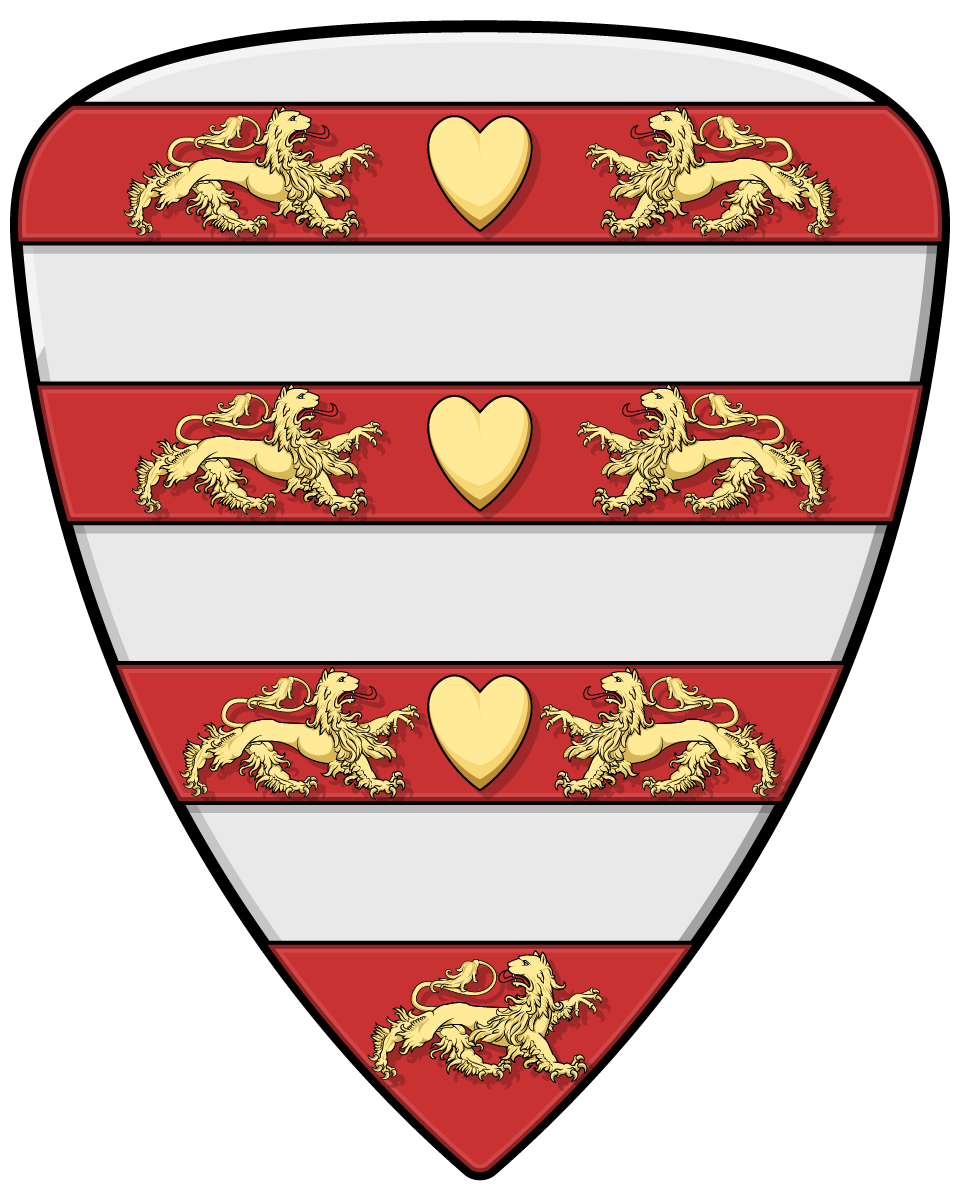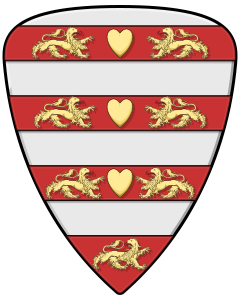
Coat of arms of King Andrew II of Hungary
Name:
Epithet:
Country:
Title:
Dynasty:
Reign:
On the reverse of his golden seal, there is a triangular shield divided seven times. In the second, fourth, and sixth fields, a small shield appears in the center, flanked on both sides by a pair of lions running toward it. In the eighth field, a lion is depicted running to the left (heraldically), turning its head backward. In total, there are seven lions on the coat of arms. This emblem was often depicted on royal seals and coins. The shield itself could appear either triangular or heart-shaped, depending on the specific depiction.
The shield augmented with lions originally symbolized his elder brother, King Emeric.
Andrew II (Andrew of Jerusalem), Árpádian King
Andrew II (also referred to as Endre in some sources), frequently called Andrew of Jerusalem, was born around 1176 or 1177 as the second son of King Béla III and Anna of Châtillon. Among his siblings were Emeric, who later became king, Constance, who became Byzantine empress, and Margaret of Hungary. As a prince, Andrew briefly ruled Galicia, but lost the title due to local resistance.
After the death of Béla III, the throne passed to Emeric, while Andrew received substantial lands and wealth, on the condition that he would undertake a crusade as his father wished. He became King of Hungary on May 7, 1205, and was officially crowned on May 29 in Székesfehérvár. He ruled for thirty years until his death on September 21, 1235.
Foreign Policy and the Crusade
A hallmark of his reign was an active foreign policy. He made multiple attempts to expand his influence in the Balkans and Galicia. He held the title “King of Halych and Lodomeria” and led several campaigns to regain control over the region.
His name is closely associated with the Fifth Crusade (1217–1218). Although it did not bring military success, it was significant diplomatically and culturally. Andrew established connections with the Jerusalemite legal order, adopting several of its principles, such as the right of resistance, which later gained legal form in the Hungarian Golden Bull.
Domestic Policy and the Golden Bull (1222)
Perhaps the most enduring achievement of his reign was the issuance of the Golden Bull in 1222, a milestone in Hungarian legal history. This charter guaranteed noble rights, limited royal power, and introduced the resistance clause. The nobility was thereby empowered to act against unlawful royal decrees.
The Golden Bull remained in effect for centuries and was a cornerstone of Hungarian constitutional development until 1848. Thus, Andrew II fundamentally shaped the long-term relationship between the nobility and the monarchy.
Diploma Andreanum (1224) and Relations with the Church
In 1224, he issued the Diploma Andreanum, which guaranteed privileges to the Saxon settlers in Transylvania, particularly around Hermannstadt (Sibiu). This facilitated economic development and German settlement.
At the same time, he had conflicts with the Church. He employed Jews and Muslims in managing the royal treasury, a practice sharply criticized by the papacy. In 1233, under the Bereg Agreement, he pledged to cease this practice.
The Teutonic Order and Power Dynamics
The Teutonic Order settled in Transylvania in 1211 with Andrew’s approval to defend against the Cumans. They received broad privileges, including tax exemption and autonomous governance. However, their ambitions exceeded the king’s intentions, and in 1225 they were expelled from Hungary. This illustrates Andrew II’s balancing act between external support and maintaining internal authority.
Marriages, Offspring, and Internal Conflicts
He married three times. His first wife was Gertrude of Merania, who was assassinated by Hungarian nobles in 1213. Among their children were Béla IV, the future king, and Saint Elizabeth, one of Europe’s most renowned saints.
From his second marriage came Yolanda, who later became Queen of Aragon. His third wife, Beatrice of Este, bore a son, Stephen, whom Béla IV never recognized as a legitimate heir, causing further dynastic tensions.
Legacy and Historical Significance
Andrew II’s reign marked a turning point. The Golden Bull and Diploma Andreanum secured noble and urban privileges, forming the foundation for the development of the medieval Kingdom of Hungary. His foreign policy efforts, participation in the crusade, and dealings with the military orders all contributed to his enduring reputation.
Although often criticized for excessive land grants, his policies laid the groundwork for the rule of law and social order. After his death, the Hungarian kingdom did not return to the model of an all-powerful ruler—his legal and political reforms fundamentally shaped the course of medieval Hungary.
Original image source: Internet
Text source: ChatGPT
The visual content of this website may be freely used under the terms of the Creative Commons 4.0 license, provided that the source is clearly indicated and the attribution includes a full, clickable link to https://cimerek.hu or to the exact web address of the specific content.