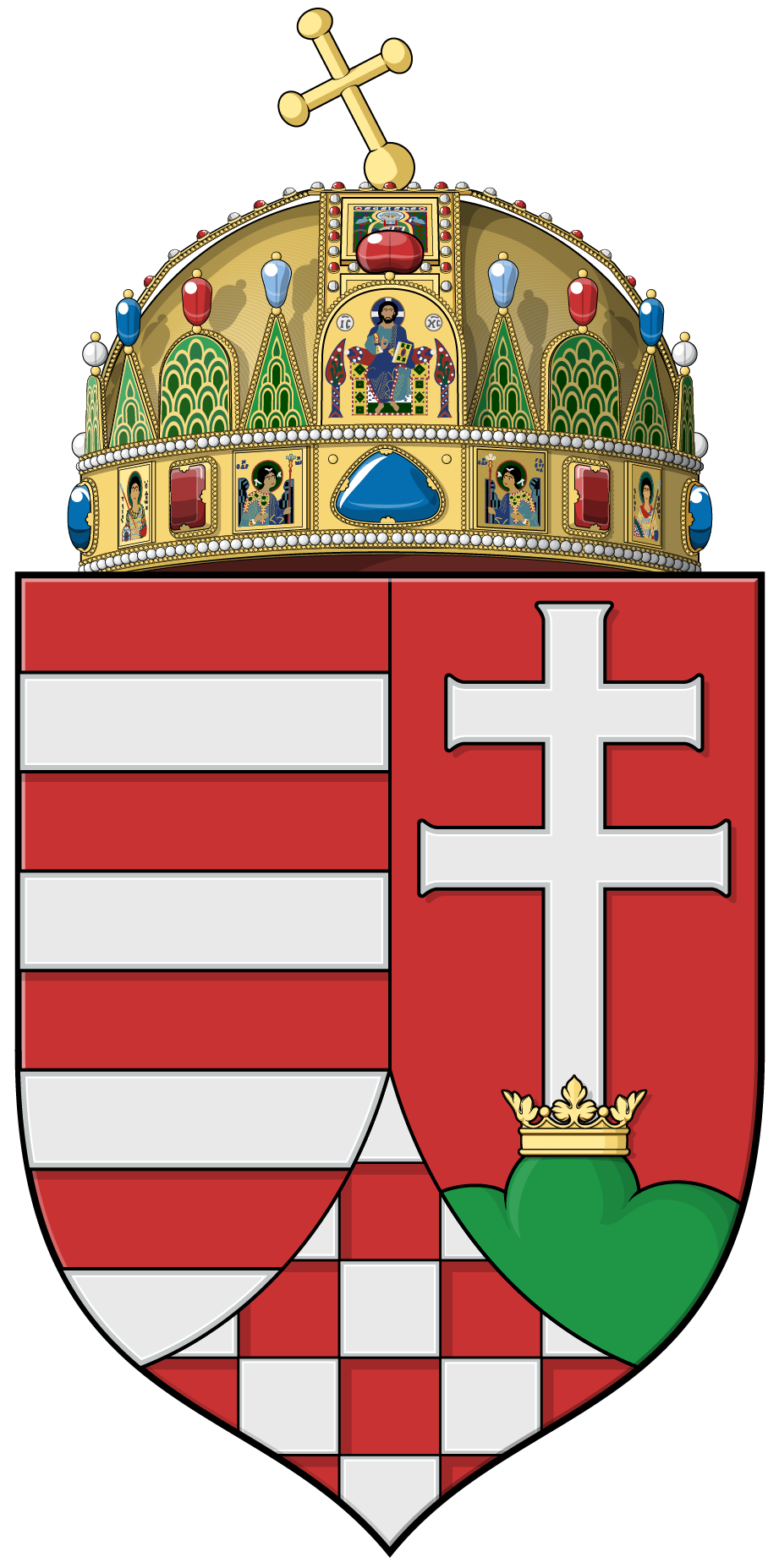
Lesser coat of arms of the Kingdom of Hungary (1916)
Location:
Type:
Grantor:
Year:
Made by:
Lesser Coat of Arms (1916)
Description of the lesser unified coat of arms of the Lands of the Hungarian Holy Crown (Plate VI).
The lesser coat of arms of 1916 features a per pale shield with an indented, inward-curving wedge at the base.
On the dexter side, a field barry of seven gules and argent; on the sinister side, in a red field, a silver double cross with a base, rising from the golden-crowned central hill of a green triple mount. On the wedge—whose upper point reaches the fifth dividing line from the top of the dexter field—a field chequy of five rows argent and gules. The shield is surmounted by the Holy Crown of Hungary.
At the official promulgation of this coat of arms, published in issue no. 60 of the Budapesti Közlöny on 14 March 1916, the following note was placed beneath the illustration:
“The coat of arms depicted above shall not be used on its own.”
Accordingly, this coat of arms is at present used exclusively within the lesser common coat of arms (Plate VII). Its establishment does not in any way affect the continued use of the traditional lesser coat of arms of the Hungarian state, definitively established by Act XXI of 1848.
This coat of arms is an unchanged per pale shield: on the dexter side, a field barry of seven gules and argent; on the sinister side, in a red field, a silver double cross with a base rising from the golden-crowned central hill of a green triple mount. The shield is surmounted by the Holy Crown of Hungary. The shield may be used alone, or flanked on the right by an oak branch and on the left by an olive branch, or held on both sides by two floating angels clad in white.
Issued in Budapest on 9 March 1916.
Count István Tisza,
Royal Hungarian Prime Minister.
Established by supreme rescript of 2 March 1916.
What is a lesser coat of arms?
A lesser coat of arms is a state coat of arms that contains only the most important heraldic elements. In the case of ruling dynasties, the lesser coat of arms serves as a shield for the placement of less significant titles borne by sovereign rulers, and generally corresponds to the family coat of arms.
József Keöpeczi Sebestyén’s article on the 1916 lesser coat of arms (published in Turul)
A description of the new Austrian, Hungarian, and common coats of arms. Seven colour-printed plates based on the originals by H. G. Ströhl, with five heraldic descriptions and one explanatory sketch. Published following the supreme rescripts of 10 and 11 October 1915 and 2 and 5 March 1916. Vienna, 1916. Printed by the Imperial and Royal Court and State Printing House.
A finely produced booklet was published under this title, containing Hungarian and German text. The seven colour plates testify to Ströhl’s artistry; he prepared the heraldic drawings attached to the supreme rescripts on the Austrian side during the rearrangement of the coats of arms.
Plate I shows the middle coat of arms of the Austrian provinces; Plate II its enlarged shield; Plate III the lesser coat of arms of the Austrian provinces; Plate IV the unified coat of arms of the Lands of the Hungarian Holy Crown; Plate V the middle coat of arms for use by the common institutions; Plate VI the lesser unified coat of arms of the Lands of the Hungarian Holy Crown; and Plate VII the lesser coat of arms for use by the common institutions. In addition to the plates, the booklet contains the German and Hungarian descriptions of the listed coats of arms as prescribed by the supreme rescripts, as well as the division of the large shield of the Austrian middle coat of arms.
The structure of the coats of arms cannot be discussed here; this review focuses solely on style and heraldic artistry. From a stylistic perspective, it must be noted as an unfortunate circumstance that the officially established form of the Hungarian coat of arms does not correspond to the form of the Hungarian arms used in the coats of arms for the common institutions. The shield of the Hungarian state coat of arms is triangular, whereas that of the common coats of arms has a pointed base. This shield form is very common in French heraldry, but never used in Hungary or by the Germans. Ströhl himself shows a very similar shield in figure 4 of Plate V of his Heraldic Atlas, presenting it as a 15th-century French triangular shield. The coats of arms of the Austrian provinces could have been placed perfectly well in a triangular shield similar to ours, and thus there would have been no need to borrow this less attractive and foreign-looking shield form from the French.
The inescutcheon of the Hungarian middle coat of arms—the lesser coat of arms—is very small and placed lower than in the official Hungarian coat of arms. The double cross is tall and narrow; its crossbars are very close together, making it less monumental than in the official Hungarian arms. The triple mount is stylized in an alien manner; the open crown resting on the central hill differs in all four Hungarian representations in this work from the official form, sometimes showing a crown with cypripedium-shaped leaves, while Ströhl mostly drew a slightly pointed clover-leaf crown. The Dalmatian coat of arms depicts lion heads with green eyes and jeweled crowns, contrary to the official Hungarian determination. The wing feathers of the Transylvanian eagle fill a semicircle laid within the rectangular field, as if the charge had been transferred unchanged from the lower field of a rounded, divided shield, whereas—as in the official Hungarian arms—it should fill the entire field. The bastions in the coat of arms of Transylvania are also very tall. The coat of arms of Bosnia-Herzegovina shows even greater deviations. In the official Hungarian drawing, the arm emerges from natural, billowing clouds; Ströhl depicts these clouds in an unusually regular, folded, ruffle-like manner unfamiliar to our heraldry. The form of the rock and the blue-lined crown in the coat of arms of Fiume should likewise have followed the official Hungarian depiction, as this is how it was incorporated according to the city’s charter of arms of 1659.
It was also an unfortunate idea on the author’s part to shape the genealogical shield connecting the two national coats of arms differently from the two large shields. Using two different shield shapes within a single heraldic composition is not stylistically appropriate.
The sixth plate shows the unified coat of arms of the Lands of the Hungarian Holy Crown—the Hungarian lesser coat of arms with the chequered wedge (Croatia). As ordered by the supreme rescript, this coat of arms is not used on its own, and therefore it was unnecessary to publish it on a separate plate when it also appears on the following plate within the common lesser coat of arms. Perhaps it was precisely this drawing that caused the misunderstanding whereby this coat of arms was erroneously placed on the cover of the coronation issue of the Leipziger Illustrirte Zeitung, on official coal ration vouchers, and elsewhere.
The typographical quality of the booklet—whose official status is unclear—is first-rate and stands as a credit to the Imperial and Royal Court and State Printing House in Vienna.
See also: The angel-supported unified middle coat of arms of the Lands of the Hungarian Holy Crown
Original image source: Hugo Gerhard Ströhl – Die neuen österreichischen, ungarischen und gemeinsamen Wappen
Text seource: Arcanum.com and Wikipedia
The visual content of this website may be freely used under the terms of the Creative Commons 4.0 license, provided that the source is clearly indicated and the attribution includes a full, clickable link to https://cimerek.hu or to the exact web address of the specific content.