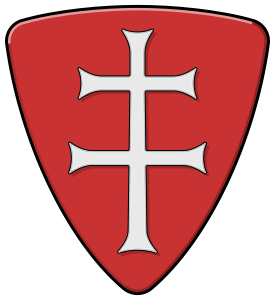
Coat of arms of King Béla IV of Hungary
Name:
Epithet:
Country:
Title:
Dynasty:
Reign:
On the reverse of his golden seal, a double cross appears in a triangular shield, reflecting the special veneration of the relics of Christ in the 13th century.
Béla IV
Béla IV (29 November 1206 – 3 May 1270) was King of Hungary from 1235 until his death and one of the most important rulers in Hungarian history. He was the second child of King Andrew II and his first wife, Gertrude of Merania. He is traditionally counted among the greatest Hungarian kings, primarily because of the reconstruction after the Mongol invasion, which earned him the honorary title “the Second Founder of the State.” He is also credited with the founding of Buda Castle, which later became a symbol of Hungarian statehood.
Youth and accession to the throne
Béla spent his childhood at the Hungarian royal court in the early 13th century, where the experience of his father’s policies and the murder of his mother in 1213 shaped his character at an early age. During his father’s reign he was entrusted with several offices: in 1214 he was crowned co-king, later became Duke of Transylvania, and then Prince of Galicia (Halych). Even in his youth he showed strong statesmanlike abilities, but he often came into conflict with his father, especially over Andrew II’s generous land-grant policy. Béla already advocated the strengthening of royal authority and royal lands.
He ascended the throne in 1235, after his father’s death. One of his first actions was to restore the authority of the crown: he tried to reclaim many of the lands granted away by his father and introduced strict accountability for royal officials.
The Mongol invasion
The most dramatic event of his reign was the Mongol invasion of 1241–1242, which shook the Kingdom of Hungary to its foundations. The armies of the Mongol Empire, led by Batu Khan, invaded the country. On 11 April 1241, the Hungarian army suffered a crushing defeat at the Battle of Muhi. Béla was forced to flee—first to Dalmatia, then to the city of Trogir (Trau)—and only the Mongols’ unexpected withdrawal in spring 1242 saved the kingdom from total destruction.
The consequences were catastrophic: a large part of the population perished, hundreds of settlements were destroyed, and the economy was paralysed for years.
Rebuilding the country
After the catastrophe, Béla devoted the rest of his reign to the reorganisation and strengthening of the kingdom. His main measures included:
Castle building: He realised that stone fortresses were essential for defence against future invasions. He authorised the construction of many castles, including Buda Castle, which became the new royal centre.
Settlement policy: He invited foreign settlers (Germans, Walloons, Italians, Cumans, and Jasz people) to repopulate the devastated lands and revive the economy.
Economic reforms: He encouraged urban development and granted privileges to many towns, launching the early phase of Hungarian urbanisation.
Support of the Church: He founded new bishoprics, supported monasteries, and promoted monastic orders, which played an important role in education and economic recovery.
As a result of these reforms, Hungary recovered from the devastation of the Mongol invasion within a few decades and again became a strong Central European power.
Foreign and domestic policy
Béla sought peaceful relations with neighbouring states but was involved in several conflicts:
He fought over Styria and Austrian lands connected to the Babenberg inheritance.
He formed alliances with the kings of Bohemia, though clashes also occurred.
He played an important role in Balkan politics, especially in relations with the Serbs and Bulgarians.
Domestically, he faced opposition from powerful nobles. His land policy, which tried to balance royal rights with the interests of the great landowners, often forced him into compromise.
Family
Béla IV was married to Maria Laskarina, a Byzantine imperial princess. They had several children, among whom Saint Margaret of Hungary is especially notable. She was dedicated to the religious life because of a vow made during the Mongol invasion and was later canonised. His son Stephen V succeeded him on the throne.
Death and legacy
Béla IV died on 3 May 1270 and was buried in the cathedral of Esztergom. He was succeeded by his son Stephen V.
In Hungarian historical memory he is revered as the “Second Founder of the State”, who rebuilt the country from the ruins of the Mongol invasion, strengthened royal power, and placed the economy and society on new foundations. As the founder of Buda Castle, he is also a key figure in the history of Budapest.
Assessment of King Béla IV of Hungary
Hungarian historiography and national memory alike rank Béla IV among the greatest kings. His political wisdom, perseverance, and foresight in rebuilding the country after catastrophe set an example for centuries. After the trauma of the Mongol invasion, he not only restored but also strengthened the Kingdom of Hungary, making him a central figure in the survival of the medieval Hungarian state.
Source of the original image: Internet
Text source: ChatGPT
The visual content of this website may be freely used under the terms of the Creative Commons 4.0 license, provided that the source is clearly indicated and the attribution includes a full, clickable link to https://cimerek.hu or to the exact web address of the specific content.
