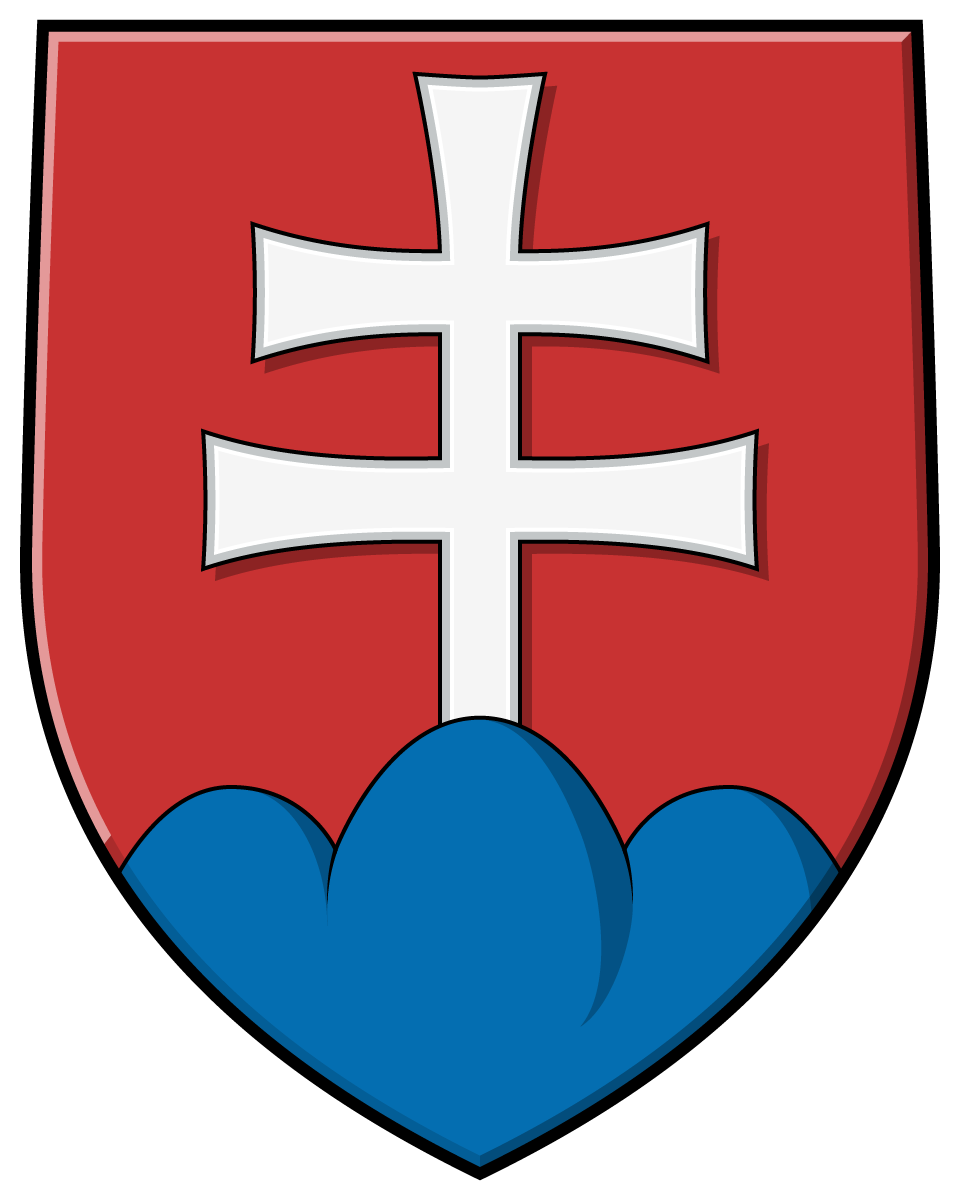
Coat of Arms of Slovakia
Location:
Type:
Grantor:
Year:
Made by:
The coat of arms of Slovakia is one of the state symbols of the Slovak Republic.
The arms are shown on a red late-Gothic shield. In the centre is a silver double cross standing on a blue triple hill. It resembles the double cross in the coat of arms of Hungary, which stands on a green triple hill and a golden crown in the red field on the right side of that shield.
The national coat of arms also appears on the flag of Slovakia.
Direct predecessors of the Slovak coat of arms
In 1992 Slovakia and the Czech Republic agreed that neither state would use the symbols of Czechoslovakia. After the Czech Republic retained the former state’s flag without modification, a serious international dispute arose between the two neighbouring countries.
The origin of the double cross
Slovak and Hungarian historians hold differing views on the origin of the double cross. According to the Slovak perspective, the symbol was introduced through the missionary activity of the Byzantine monks Saints Cyril and Methodius and represents Slovakia’s Christian and Pan-Slavic traditions and heritage. According to an earlier Hungarian interpretation, the double cross was granted by Pope Sylvester II to Saint Stephen at the time of his coronation as the royal emblem of the Apostolic King.
The theory most widely accepted by scholars, however, is that the double cross appeared under Byzantine influence during the reign of King Béla III of Hungary at the end of the 12th century, and that it first appeared on shields and coins at that time. The latest numismatic research suggests, however, that coins bearing the double cross date not to Béla III but to the early, pre-Mongol-invasion period of King Béla IV. On this basis, the first known coat of arms of the Árpád dynasty may have been the striped shield. There is no other evidence that Béla III or Andrew II used a coat of arms with a double cross.
The triple hill and the Slovak coat of arms
In popular interpretation, the triple hill represents three mountain ranges that marked the mountainous northern frontier of historical Hungary. These three ranges symbolize the Tatra, Fatra and Mátra mountains— even though the Mátra region ultimately did not become part of Slovakia under the peace treaties that ended the First World War. The same three hills appear in the Hungarian coat of arms. They entered Slovak national symbolism through the long shared history of the two peoples, recalling the role of Hungary in the formation of the Slovak nation.
The colours of the coat of arms were also adapted to the Pan-Slavic colours in order to distinguish it from the Hungarian arms.
Source: Wikipedia
The visual content of this website may be freely used under the terms of the Creative Commons 4.0 license, provided that the source is clearly indicated and the attribution includes a full, clickable link to https://cimerek.hu or to the exact web address of the specific content.