
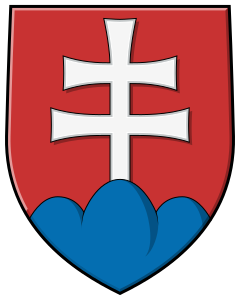
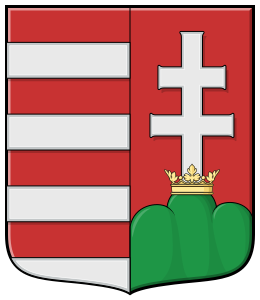
Coat of arms of Spišská Stará Ves
Location:
Type:
Status:
Grantor:
Spišská Stará Ves
(Hungarian: Szepesófalu; German: Altendorf; Polish: Stara Wieś Spiska; Latin: Antiqua Villa) is a town in Slovakia, located in the Kežmarok District of the Prešov Region. The settlement of Tarhegy belongs administratively to the town.
The coat of arms has been redrawn based on an image found on the internet.
Location
Spišská Stará Ves lies 37 km north of Kežmarok, near the Slovak–Polish border, above the confluence of the Rieka stream flowing into the Dunajec River.
History of Spišská Stará Ves
A settlement on the site of the present town is mentioned as early as the beginning of the 13th century under the name Antiqua Villa. The town was founded in 1308 by Friedrich, the reeve of Hunfalva, on the commission of Comes Kakas; its boundary was called Katzwinkel, meaning “cat’s corner.” In 1337 the settlement became the property of the Carthusian monks of Lower Lechnica, and thanks to its linen weavers and merchants it developed rapidly. It held weekly markets and fairs, and its goods enjoyed exemption from customs duties.
Already in the Árpád period it was a significant border town, where Hungarian kings concluded alliances with Polish rulers. In 1399 King Sigismund granted it town privileges. In 1411 Sigismund met the Polish king Władysław here. The town was burned by the Hussites in 1431 and again in 1433. King Matthias reconciled with the Polish king Casimir here on 21 February 1474, after the expulsion of the Hussites.
The town began to decline in 1563, when the Carthusians were replaced by secular landlords who deprived it of its privileges. In 1655 Emperor Ferdinand III again granted the town the right to hold markets. In 1710 a plague killed almost the entire population, and in 1712 the town was completely destroyed by fire. Between 1746 and 1760 four more fires occurred; in the last one, everything burned down.
At the end of the 18th century András Vályi wrote the following about the town:
“ÓFALU. A market town in Szepes County, owned by the Royal Chamber; its inhabitants are Catholics. It lies on the border of Poland, has a thirtieth-duty station, and its territory is similar to that of Lechnica.”
After 1849 it became the seat of the Magura District.
In his geographical dictionary published in 1851, Elek Fényes wrote about the town:
“Ófalu, Antiquavilla, a Slovak market town in Szepes County, on the border of Galicia, near the waters of the Dunajec: 1,066 Catholics, 90 Jewish inhabitants; a Catholic parish, salt and thirtieth-duty customs office. Its fairs are very well attended; it produces much linen and carries on extensive trade in salmon caught in the Dunajec. Its lords are the Greek Catholic bishop and chapter of Eperjes, and it belongs to the Lechnica estate. Post station: Kežmarok.”
Until the Treaty of Trianon, Szepesófalu was the seat of the Spišská Stará Ves District of Szepes County. Today it serves as a road border crossing toward Poland, in the direction of Kraków.
In 1960 it ceased to be a district seat.
Forrás: Wikipedia
The visual content of this website may be freely used under the terms of the Creative Commons 4.0 license, provided that the source is clearly indicated and the attribution includes a full, clickable link to https://cimerek.hu or to the exact web address of the specific content.
