Hungarian Heraldry
The Origins and Characteristics of Hungarian Heraldry
Hungarian heraldry developed as part of medieval European martial culture, yet over the centuries, it evolved numerous distinct features. Local coats of arms are characterized by a rich narrative style, a naturalistic approach to representation, and the frequent use of motifs originating from military service. The following overview presents the historical development, unique traits, and most common charges of Hungarian heraldry.
The Origins and Periods of Hungarian Heraldry
According to József Csoma’s seminal work, “The Periods of Hungarian Heraldry” (A magyar heraldika korszakai), the development of domestic heraldry can be divided into three functionally distinct eras:
The Era of Military or Living Heraldry (13th Century – Mid-15th Century) During this period, coats of arms primarily served the practical purpose of self-identification on the battlefield and on seals. Shield shapes were simple, motifs were easily recognizable, and the royal chancellery adhered closely to international heraldic practices.

The Era of Artistic or Renaissance Heraldry (Mid-15th Century – Early 16th Century) This period spans the reigns of Matthias Corvinus and the Jagiellonian kings. Coats of arms gradually lost their direct military function and became instruments of social representation. Naturalistic and highly detailed depictions became increasingly common. The illuminators working in King Matthias’s chancellery exerted a significant influence on the subsequent development of Hungarian heraldry. Elements of Renaissance art—such as landscape backgrounds, three-dimensional figures, and lifelike details—gradually appeared on shields. The resulting armorial heraldry often drifted away from the simpler, more easily identifiable compositions of the past.

The Era of Paper Heraldry (Mid-16th Century – Early 20th Century) Armorial letters (armales or patents of nobility) became the primary medium for coats of arms. Heraldic compositions grew increasingly complex and ornate, while their military function receded deep into the background.
Characteristics of Hungarian Heraldry
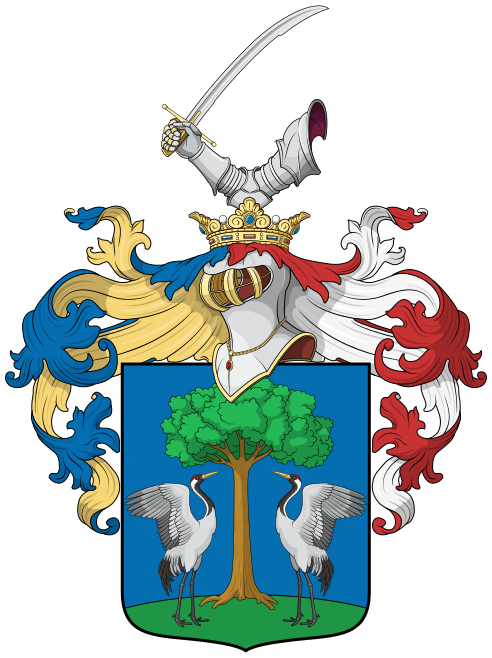
- Relaxed Application of the Rule of Tinctures: A core principle of classical European heraldry states that metal must not be placed upon metal (gold on silver / silver on gold) and color must not be placed upon color, as this diminishes the legibility of the coat of arms. In late medieval and early modern Hungarian heraldry, this rule was frequently disregarded due to the overwhelming dominance of blue fields and the preference for naturalistic depictions.
- Prevalence of the Blue Field: The use of a blue background (azure) is exceptionally widespread in Hungarian coats of arms.
- Naturalistic Elements: Hungarian armorial heraldry frequently features green mounds, grassy ground, rocks, lifelike animal depictions, and highly detailed human figures. Due to these naturalistic compositions, the application of classical heraldic rules was often modified.
- Rarity of Divided Shields: Compared to Western European traditions, multi-part, quartered, or marshalled shields are relatively rare in the heraldry of the Hungarian untitled nobility (nobiles). The use of a single-field shield with one dominant central charge is far more common.
- Rarity of Mobile (Floating) Charges: In Hungarian heraldry, charges rarely float freely in the middle of the shield; instead, they usually stand on a base, mound, crown, or rock. The crown placed inside the shield base often did not denote a specific noble rank; rather, it served as a purely compositional element—a pedestal designed to prevent the charge from floating.
- Emphasis on Helm Crests: In late medieval and early modern Hungarian heraldry, crests often became remarkably prominent. Figures emerging from the helm crown were frequently more detailed than the charges inside the shield itself, and they did not always repeat the motifs found on the coat of arms.
- Frequent Use of the Sabre: The sabre is a significantly more common weapon representation in Hungarian heraldry than in the armorial traditions of Western Europe.
- High Proportion of Human Figures: The inclusion of human figures, soldiers, warriors, and armored arms is particularly frequent in Hungarian coats of arms.
The Most Common Hungarian Heraldic Charges
- Armored or Robed Arm Holding a Sword The absolute most frequent motif in Hungarian heraldry. It is typically an arm embowed at the elbow, grasping a sword or a sabre, symbolizing military obligation, privilege, and defense of the realm.
- Lion One of the most common animal charges. In Hungarian heraldry, it usually appears in a rampant position, frequently holding a weapon or another object in its paws.
- Severed Turk’s Head: A motif preserving the memory of the 16th and 17th-century wars against the Ottoman Empire, directly pointing to military merit or personal valor in combat.
- Griffin: A mythological creature combining the attributes of an eagle and a lion, which is highly prevalent in Hungarian heraldry.
- Vigilant Crane: A crane holding a stone or pebble in its raised claw, serving as a traditional symbol of vigilance and duty.
- Pelican in her Piety: A pelican vulning herself to feed her young with her own blood, representing the well-known Christian symbol of self-sacrifice.
- Star and Crescent: Usually appearing together as secondary charges (additions) in the upper corners of the shield.
- Wild Beasts: Bears, wolves, and stags are also frequent participants in Hungarian heraldic designs.
Armorial Heraldry and the Process of Heraldic Design
Armorial letters (armales), or patents of nobility, played a prominent role in the evolution of Hungarian heraldry. During the 16th to 18th centuries, personal nobility accompanied by a coat of arms was granted in exceptionally high numbers. This practice directly contributed to the creation of Hungary’s rich and highly diverse world of motifs. In Hungarian armorial heraldry, the petitioner or the newly ennobled individual often had the opportunity to influence the content of the design. Consequently, it is not always necessary to search for complex symbolic meanings behind the motifs. The charges frequently refer directly to the specific circumstances of acquiring nobility—such as a military feat, a duel, or even a remarkable hunting achievement. As a result, strongly narrative representations depicting concrete events are uniquely common in Hungarian heraldry. This specific evaluation of individual requests and official approval was systematically carried out through a multi-step chancellery process:- Submission of the Concept Sketch (Minium Drawing): The individual applying for ennoblement submitted a preliminary draft either alongside the petition or following a favorable royal decision, known as a minium drawing. The name derives from minium (red lead oxide pigment), which was used to sketch the outlines and initial designs. Applicants often went to extremes, sometimes overcrowding the shield out of pride or martial enthusiasm (e.g., featuring too many severed Turks’ heads, or simultaneously requesting a lion, a griffin, a crown, and stars).
-
Chancellery Evaluation and the “Striking Out”: The officials of the chancellery (clerks and chancery scribes) reviewed and audited the design based on two primary criteria:
- Heraldic Regularity: Ensuring the design did not violate fundamental rules (such as the rule of tinctures: color must not be placed upon color, metal upon metal).
- Political and Social Rank: Certain highly representative elements, such as supporters (e.g., angels) or specific types of rank-bearing crowns above the helm, were strictly reserved for the upper nobility (barons and counts). If a member of the untitled nobility requested such external ornaments, the chancellery struck them from the draft.
- Implementation of Modifications and Corrections: If a component was deemed inappropriate, the chancellery official (the chancellery clerk or the chancellor himself) modified the minium drawing using red ink or brown/black writing ink. Unwanted elements (such as an unauthorized supporter or an extra crescent moon) were simply crossed out (deleted). Frequently, official chancellery notations were written in Latin along the margins or beneath the drawing (e.g., “omittatur” – to be omitted, or “cassetur” – to be cancelled). If a composition was approved but a figure was poorly positioned, it was adjusted using red ink arrows or partial redraws to guide the final coat of arms painter (illuminator).
- Final Approval and the Ornate Patent of Nobility: Once the chancellery audited and approved the draft, the monarch signed the patent of nobility. The document was then handed over to the official painter, who executed the final coat of arms onto the parchment (kutyabőr) in rich detail and high quality using expensive pigments (genuine gold, silver, and ultramarine blue) based on the corrected minium drawing. This finished, folded document, secured with a pendant seal, was known as the armalis or címereslevél.