
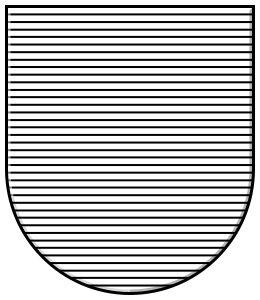
Blue - Azure
Blue in Heraldry
Blue is one of the tinctures used in heraldry. In international heraldic terminology, it is known as azure.
In Hungarian heraldry, blue occupies a particularly prominent position. Surviving coats of arms and grants of arms indicate that it is the most common colour of the shield field. Especially widespread is the light sky-blue shade (coelestini), whose bright tone provides strong contrast for gold, silver, and red charges. More rarely, historical sources also refer to a darker sea-blue shade (coerulei).
In heraldic painting, blue was generally shaded with darker blue tones, while highlights were rendered with lighter blue or whitish pigments.
From the seventeenth century onward, blue was represented in black-and-white heraldic engravings by horizontal hatching.
In early systems of planetary colour symbolism, blue was associated with Jupiter (♃).
Etymology and Terminology
The heraldic name azure derives from the Persian word lazhward (لاژورد), originally referring to the principal source of lapis lazuli.
Through Arabic and Mediterranean intermediaries, the term entered Medieval Latin and subsequently Old French, where it became part of the developing heraldic vocabulary.
Following the Norman Conquest of England in 1066, a linguistic distinction emerged between the French-speaking nobility and the English-speaking population. Heralds and nobles employed the technical term azure, while the common English word blue remained in everyday use.
Symbolism
In the so-called “dead heraldry” of the late Middle Ages and the early modern period, blue acquired a variety of symbolic meanings.
In the system of Jean Courtois, known as Sicile, and later heraldic writers, blue represented beauty, nobility, and exalted status.
In his heraldic treatise published in 1622, Alonso López de Haro associated the colour with the heavens and pure air.
The medieval herald cited by Philipp Jakob Spener under the name Heraldus Britannus referred to blue by the classical term veneto.
Later heraldic literature frequently connected blue with loyalty, constancy, justice, honour, and truth.
Mineral Blue Pigments
Ultramarine
The most valuable blue pigment was ultramarine, produced from the semi-precious stone lapis lazuli. The principal source of the mineral was the Badakhshan region of present-day Afghanistan, from where it was exported to Europe for centuries.
Its name derives from the Latin ultra marinum (“from beyond the sea”). Owing to its extraordinary cost, ultramarine was reserved primarily for the finest manuscripts, grants of arms, and paintings.
The pigment required a complex purification process. The best-known description of its preparation was recorded by Cennino Cennini in the early fifteenth century in his Il libro dell’arte.
The value of ultramarine occasionally rivalled that of precious metals. According to some historical accounts, pigment was sometimes recovered from damaged or obsolete manuscripts for reuse, reflecting its exceptional worth.
Azurite
In medieval and early modern heraldic painting, azurite was used far more frequently than ultramarine. This mineral pigment consists of basic copper carbonate.
Its principal advantages were lower cost and greater availability, as it could be obtained from numerous European copper deposits. Heraldic painters typically ground the mineral into a fine powder and purified it through washing and sedimentation.
Smalt and Cobalt-Based Pigments
Medieval and early modern artists also employed various cobalt-containing glass pigments and blue frits. The most important of these was smalt, produced from finely ground cobalt glass.
Modern cobalt blue pigment did not appear until the early nineteenth century and therefore was not available to medieval heraldic painters.
Organic Blue Dyes
Woad and Indigo
During the Middle Ages, blue dyes were obtained primarily from woad (Isatis tinctoria). Later, indigo imported from India and other tropical regions became increasingly important.
Both dyes derive their colour from indigotin and were used mainly in textile production. Although they occasionally appeared in manuscript illumination and decorative painting, they played a relatively minor role in heraldic painting compared with ultramarine and azurite, largely because of their lower covering power and different ageing characteristics.
Ageing and Discolouration of Heraldic Blue
The blue fields of historical coats of arms often underwent significant colour changes over the centuries.
The most common cause was the chemical instability of azurite.
During a process known as greening, azurite may gradually transform into malachite under the influence of atmospheric moisture. As a result, fields that were originally blue can acquire a greenish appearance.
Under prolonged exposure to moisture and unfavourable chemical conditions, further deterioration may occur, leading to dark brown or even black discolouration.
Organic blue dyes, by contrast, tend to fade rather than darken and may therefore appear much paler today than they originally were.
This phenomenon has important methodological implications for heraldic research. A field that now appears green, grey, or black may originally have been azure. Consequently, the ageing behaviour of historical pigments must be taken into account when identifying the original colours of coats of arms.