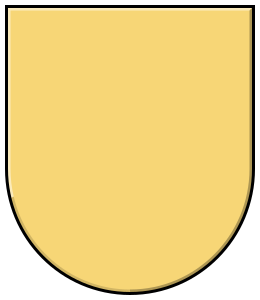
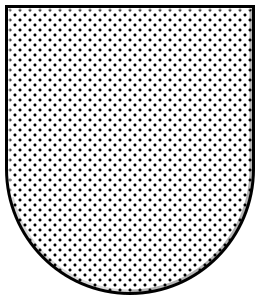
Gold - Or
Gold in Heraldry
Gold is one of the heraldic metals. In heraldry, it is not regarded as a shade of yellow but as a distinct category of tincture alongside silver. Even during the age of living heraldry, gold was considered one of the most prestigious heraldic metals and was frequently granted as a mark of distinction in augmentations of arms.
In early grants of arms and heraldic paintings, gold was represented using genuine gold leaf or powdered gold. In less elaborate works, however, the precious metal was often substituted with yellow pigments.
In heraldic painting, gold surfaces were commonly modelled with brownish, reddish, or orange tones to convey the reflective qualities and depth of metal.
From the seventeenth century onward, gold was represented in black-and-white heraldic engravings by a field covered with dots.
In early systems of heraldic tincture notation, gold was represented by the symbol of the Sun (☉), reflecting the alchemical tradition that regarded gold as the metal of the Sun.
Etymology and Terminology
The French and English heraldic term Or derives from the Latin word aurum (“gold”).
The concept of gold was similarly qualified by references to yellow in several European languages:
Latin: aurum fulvum (“yellow” or “gleaming gold”)
Italian: oro giallo
French: or jaune
In heraldic terminology, the word Or denotes both the precious metal itself and its heraldic representation.
Symbolism and Cultural Significance
In the so-called “dead heraldry” of the late Middle Ages and the early modern period, gold acquired a variety of symbolic meanings.
In the system of Jean Prinsault, gold represented nobility, benevolence, exaltation, and excellence.
The medieval herald known as Heraldus Britannus, cited by Philipp Jakob Spener, referred to gold as cytrine. The term derives from alchemical tradition, where citrination represented a stage in the process of perfection and transformation.
Some medieval mystical writers, including Johannes Tauler, associated yellow with intellectual clarity and spiritual illumination.
Later heraldic literature frequently connected gold with wealth, generosity, glory, power, and distinction.
The Representation of Gold in Heraldic Painting
Gold Leaf and Powdered Gold
The finest heraldic works employed genuine gold. Goldsmiths hammered the metal into extremely thin sheets, which were then applied to parchment or other surfaces as gold leaf.
The principal advantage of gold leaf was its ability to reflect light, producing a metallic brilliance that pigments could imitate only imperfectly.
For finer details, artists often used powdered gold mixed with various binding media to create a paintable substance.
Because of its extraordinary value, gold was used primarily in royal charters, elaborate grants of arms, prestigious armorials, and illuminated manuscripts.
Mineral Pigments
Orpiment
Orpiment (arsenic trisulfide, As₂S₃) was a brilliant yellow pigment known since antiquity. The Greeks called it arsenikon, while Pliny the Elder referred to it as auripigmentum.
Its rich golden-yellow colour made it one of the most important substitutes for gold in medieval painting. Although it lacked the metallic sheen of genuine gold, its bright appearance made it suitable for symbolically representing the metal.
Organic Yellow Dyes
During the Middle Ages and the early modern period, a variety of plant-based dyes were used to produce yellow and gold-like colours.
Saffron
Saffron (Crocus sativus) was among the most valuable yellow dyes. The colouring agent was obtained from the flower’s stigmas. Although its production required considerable labour, it yielded an intense and remarkably pure yellow colour.
Safflower
Safflower (Carthamus tinctorius), sometimes known as false saffron, contained both yellow and red colouring agents. The yellow dye was easier to obtain and therefore more commonly used.
Weld
Weld (Reseda luteola) was one of the most durable and lightfast sources of yellow dye available to medieval and early modern artists.
Dyer’s Greenweed
Dyer’s greenweed (Genista tinctoria) was used primarily for dyeing textiles but could also produce strong yellow hues suitable for decorative painting.
Ageing and Discolouration of Heraldic Gold
The gold surfaces of historical heraldic artworks often changed considerably over the centuries.
Gold itself is chemically very stable and generally does not corrode. Most visible discolouration results not from the metal but from the ageing of binders, ground layers, varnishes, or accumulated surface deposits.
The adhesive layers beneath gold leaf may darken with age, causing gilded areas to appear browner than originally intended. Mechanical damage can also lead to the partial or complete loss of the gold layer.
Yellow pigments used as substitutes for gold are often more vulnerable to fading and discolouration. Consequently, a surface originally intended to represent gold may now appear dull yellow, brownish, or grey.
This phenomenon has important methodological implications for heraldic research. A field that today appears faded or brownish may originally have been executed in genuine gold. The ageing characteristics of historical materials must therefore be considered when identifying the original tinctures and metals of coats of arms.