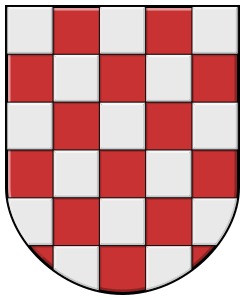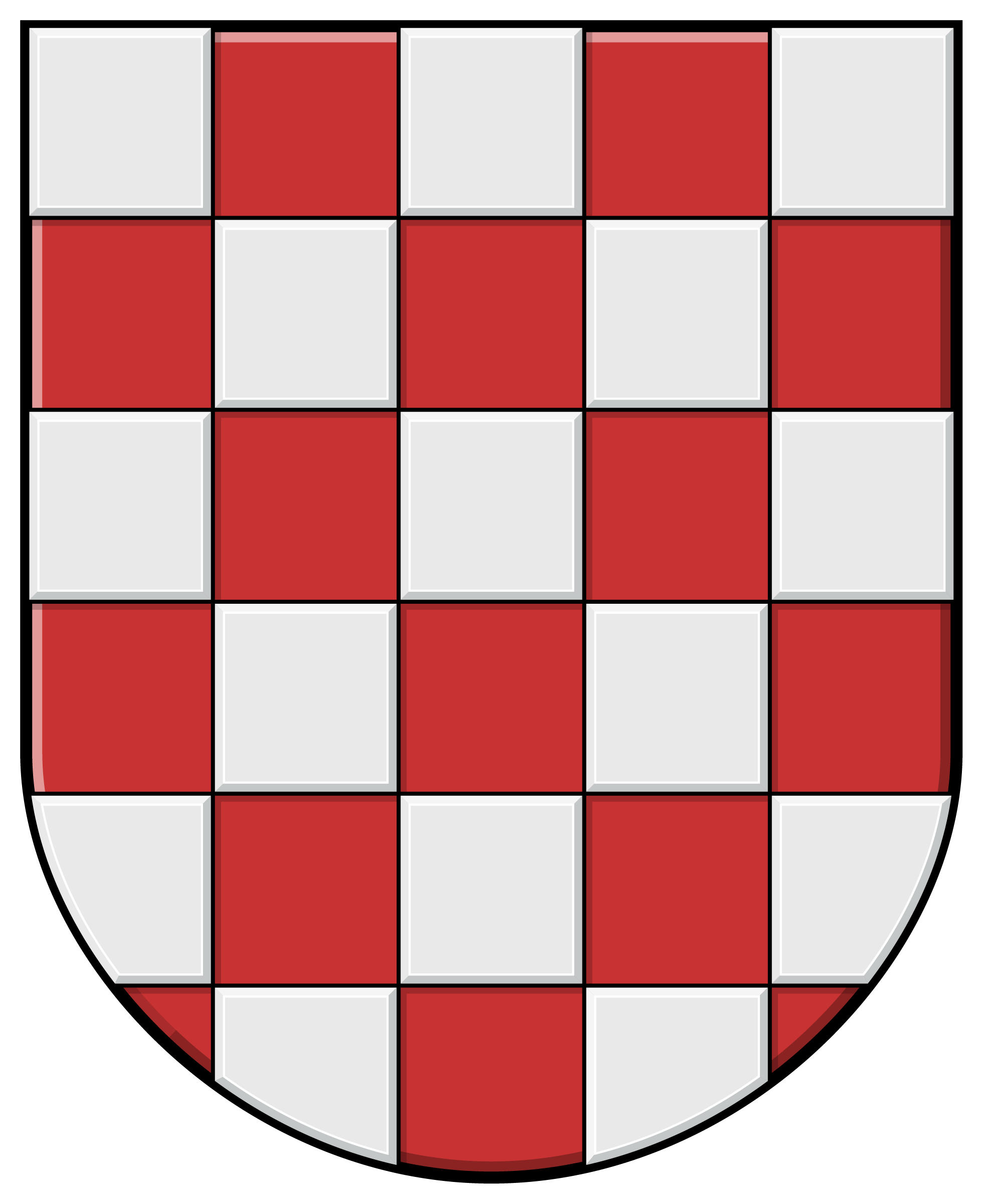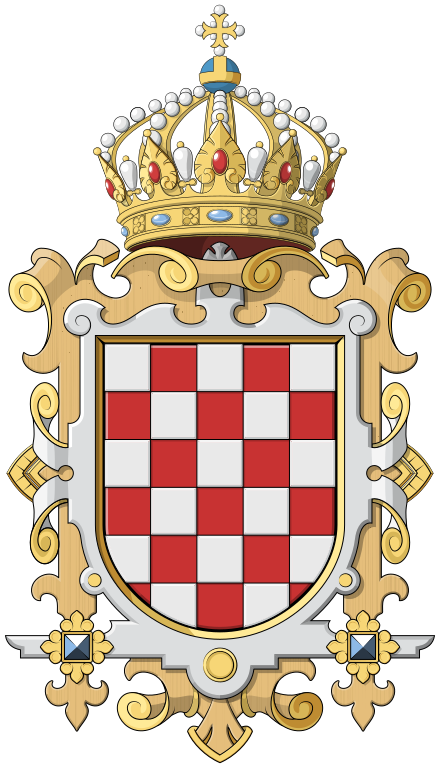
Historical coat of arms of the Kingdom of Croatia
Location:
Coat of arms type:
Year:
Made by:
The historical Croatian coat of arms
Croatia lies in Central and Southeastern Europe, along the eastern coast of the Adriatic Sea. The territory of modern Croatia comprises several regions with distinct historical development, including historical Croatia proper, Dalmatia, Slavonia, and Istria. Each of these possessed its own historical and heraldic traditions, which in turn influenced the later development of Croatian state heraldry.
From the Middle Ages, the historical Kingdom of Croatia was closely linked to the Kingdom of Hungary. From 1102, the Hungarian monarch also bore the title of King of Croatia, the two kingdoms being joined in a personal union. This relationship persisted in the following centuries, and Croatia became part of the Lands of the Hungarian Holy Crown.
The best-known emblem of Croatian heraldry is the chequy shield of red and silver fields, known in Croatian as šahovnica. This motif can be traced in surviving heraldic monuments from the end of the late Middle Ages onward, and over time it became one of the foremost symbols of Croatian statehood.
History of the arms of the Kingdom of Croatia
The earliest known depictions of the Croatian chequy arms date to the late 15th century. One early instance is found on the tombstone of Ludovik Perović (d. 1491) in Senj; another appears around 1495 in Innsbruck, in the courtly milieu of Emperor Maximilian I, where it served as a Croatian claim-arms (Anspruchswappen).
By the 16th century, the chequy shield was already the defining element of the heraldry of the Kingdom of Croatia. In 1527, the Croatian estates, assembled at the Diet of Cetin, elected Ferdinand of Habsburg as king. Another early record connected with the history of the arms is a commemorative medal of the Hungarian king Louis II, struck in 1525, which Hugo Gerhard Ströhl later discusses among the early appearances of the Croatian arms in his work.
Various traditions and legendary explanations later became attached to the origin of the chequy shield. Some narratives trace the motif back to earlier medieval rulers, including Dmitar Zvonimir or Držislav. These origin stories, however, appear only in considerably later sources and therefore cannot be treated as evidence for the early use of the chequy arms.
By the 19th century, the red-and-silver chequy pattern had become a constant and easily recognizable element of Croatian heraldry. It remained a defining feature through the period following the Croatian–Hungarian Settlement (Ausgleich), and continued in use in the various Croatian state coats of arms of the 20th century. The central shield of the modern Republic of Croatia’s coat of arms is likewise formed by this chequy pattern.
The Ströhl depiction
In his work Oesterreichisch-ungarische Wappenrolle, published in Vienna in 1890, Hugo Gerhard Ströhl presents the Croatian arms under the designation „Königreich Croatien”, i.e., the Kingdom of Croatia.
In keeping with the heraldic conventions of his time, Ströhl rendered the historical countries and provinces of the Monarchy in a detailed, stylistically unified manner. In the case of the Croatian arms, he depicts a shield chequy of red and silver in 5×5 fields, surmounted by a royal crown.
One notable feature of the Ströhl version concerns the starting field of the chequy pattern. The dexter chief field of the shield – that is, the uppermost field to the viewer’s left – is silver. This differs from the regulated version of the modern Croatian state arms, in which the sequence begins with a red field. The discrepancy illustrates that differences may exist between historical heraldic depictions and the later, uniformly regulated state arms.
The arms of the Kingdom of Croatia and the crown
A royal crown is shown above the shield in Ströhl’s depiction. It is not advisable to identify this crown with any specific, physically surviving Croatian royal crown.
Historical sources do attest to coronation traditions among the rulers of the medieval Kingdom of Croatia: at the coronation of Dmitar Zvonimir as king in 1075, a crown was sent from the papal court, though its exact form is unknown, and the crown itself has not survived as an identifiable historical artifact.
The crown used by Ströhl is therefore best understood primarily as a heraldic marker of royal rank rather than a depiction of a specific historical object. Nor can it be established with any certainty that the crown shown above the shield represents the Hungarian Holy Crown. The historical and constitutional relationship between the Kingdom of Croatia and the Hungarian Crown, on the one hand, and the heraldic significance of the crown placed above this particular coat of arms, on the other, are two separate questions.
The Ströhl version should therefore not be regarded as a simple contemporary precursor of the modern Croatian state arms, but rather as a late-19th-century heraldic representation of the Kingdom of Croatia. The present reconstruction likewise follows this historical version.
Source: Hugo Gerhard Ströhl, Oesterreichisch-ungarische Wappenrolle, Vienna, 1890.
The visual content of this website may be freely used under the terms of the Creative Commons 4.0 license, provided that the source is clearly indicated and the attribution includes a full, clickable link to https://cimerek.hu or to the exact web address of the specific content.