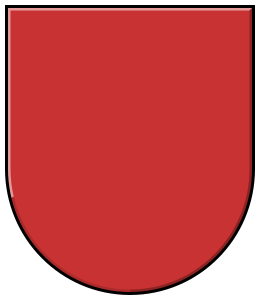
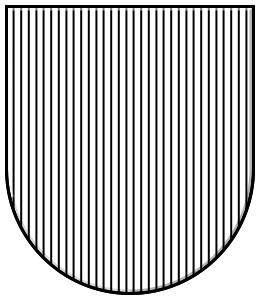
Red - Gules
Red in heraldry
Red in heraldry is one of the fundamental tinctures in heraldic tradition. In classical European heraldry, it was traditionally represented as a vivid cinnabar-red tone and is known in blazon as gules (French: gueules).
Historically, red was one of the most widely used heraldic colours, playing a central role in armorial design from the Middle Ages through the early modern period.
Historical use and shades
In early heraldic practice, red was commonly produced using minium (red lead), while cinnabar (HgS) became increasingly dominant in later periods.
Due to differences in material quality, cost, and application methods, the appearance of red varied significantly in medieval and early modern armorial documents.
In heraldic painting:
- darker tones were often modelled with violet hues
- lighter highlights were occasionally rendered using orange-red transitions
From the 17th century onwards, red in black-and-white heraldic representation was indicated by vertical hatching.
Surviving armorial manuscripts and rolls of arms often show red fields as significantly darker than originally intended, a result of pigment degradation and chemical alteration over time.
Etymology and terminology
The heraldic term for red derives from the French gueules (English: gules), which originates from Old French goulesor gueules, meaning “throat.”
Originally, the term referred to the reddish colour of an animal’s throat area, from which the English word gullet also derives.
The linguistic root traces back to Latin gula (“throat”, “gullet”).
From the 17th century onwards, a competing (but now largely rejected) theory suggested derivation from Persian gul(“rose”), possibly transmitted through Muslim Spain or the Crusades. While this etymology remains historically interesting, it is generally considered unlikely by modern scholarship.
In early French heraldic vocabulary, several terms were used for red:
- rouge – red
- vermeil – cinnabar red
- sinople – early usage: reddish tone
The semantic shift of sinople
The term sinople derives from the city of Sinope in Asia Minor, known for its red ochre deposits, similar to modern sienna.
Until the mid-14th century, green was generally referred to as vert in French heraldry. However, by the early 15th century (certainly before 1415), the meaning of sinople shifted from red to green.
The exact cause of this semantic shift remains uncertain. It has been suggested that it may have been introduced to avoid confusion between similar-sounding terms such as vert (green) and vair (a fur pattern).
By the 15th century, sinopis and related forms consistently referred to green in literary usage, while vert remained the dominant vernacular term.
Symbolism
In late medieval and early modern heraldic theory—often referred to as “historical heraldry”—red was regarded as one of the most prestigious tinctures.
According to medieval heraldic writers such as Jean Prinsault, red symbolised:
- courage
- martial strength
- readiness for battle and sacrifice
In certain armorial grants, such as the 1597 augmentation of the Rákóczi family arms, the red field symbolically expressed willingness to shed blood and endure warfare.
Philipp Jakob Spener, citing the Heraldus Britannus, also refers to red under the term coccin (“scarlet”).
In the planetary systems associated with heraldic tinctures, red corresponded to the planet Mars. In alchemical (♂) and astrological tradition, Mars symbolized warfare, courage, and military virtue, closely reflecting the meanings that heraldic writers attached to the colour red.
Mineral-based red pigments
Cinnabar (vermilion)
Cinnabar (HgS) was the most important and prestigious red pigment in heraldic painting. Its English name vermilionderives from French vermeil, ultimately from Latin vermiculum, originally referring to dye obtained from the insect Kermes vermilio.
Natural cinnabar was highly valued and expensive, making it a luxury pigment in illuminated manuscripts and armorial documents.
The medieval painter Cennino Cennini famously wrote:
“If you grind it every day for twenty years, it would only become better and more perfect.”
Cennini also warned that cinnabar should be stored in sealed containers away from light, as it is prone to darkening when exposed to air and light.
From the late Middle Ages, cinnabar was also synthetically produced by combining mercury and molten sulfur, followed by sublimation purification.
Due to its high value, it was frequently adulterated with cheaper materials such as chalk, brick dust, or minium.
Vitruvius also described a test for authenticity: pure cinnabar darkens when heated on a metal plate but returns to its original red colour upon cooling, provided it is not overheated.
Minium (red lead)
Minium (Pb₃O₄), also known as minium secundarium, Paris red, or German “Orangemennig”, is a heavy red-orange pigment produced by heating lead oxide (massicot) at approximately 300–400 °C.
In heraldic practice, the relationship between minium and cinnabar largely determined both the cost and quality of painted arms. Lower-cost armorials were often executed entirely in minium, while more prestigious commissions used minium as a base layer over which cinnabar or organic carmine was applied.
Sandaracum and realgar
The medieval term sandaracum referred to different substances depending on context. In pigment terminology, it often denotes realgar, an arsenic sulfide mineral with a bright orange-red colour and high toxicity. In other contexts, it could also refer to the resin of Tetraclinis articulata.
Organic red pigments
Plant-based: alizarin
Alizarin, extracted primarily from madder root (Rubia tinctorum), is one of the oldest known red dyes.
Its hue varied depending on the mordant used, ranging from brick red to deep crimson.
Animal-based: kermes and Polish cochineal
Before the discovery of the Americas, high-quality red dyes were mainly produced from:
- Kermes vermilio (kermes insect)
- Porphyrophora polonica (Polish cochineal)
These highly expensive dyes were widely used in royal manuscripts, armorial rolls, and ceremonial heraldic documents.
American cochineal and carmine
From the 16th century onwards, European artists increasingly used dyes derived from the Mexican cochineal insect (Dactylopius coccus).
Carmine produced from this source provided a more intense and brilliant red than its Old World counterparts.
Heraldic painters often applied carmine as a translucent glaze over mineral-based layers to achieve deeper and more luminous red tones, particularly in Renaissance and Baroque armorial painting.
Aging and alteration of heraldic red
Heraldic pigments do not always preserve their original appearance. Over centuries, red fields in armorial manuscripts and coats of arms may undergo significant alteration.
Two main chemical processes are responsible:
- Decomposition of minium: exposure to hydrogen sulfide, moisture, light, and binders can transform it into darker lead compounds such as PbO₂ and PbS.
- Structural changes in cinnabar: prolonged exposure to light and air may cause cinnabar to darken and lose its original brilliance.
Organic red dyes such as carmine, in contrast, tend to fade rather than darken.
As a result, historical heraldic artefacts often display a combination of:
- darkened mineral-based reds
- faded organic highlights
The semantic shift of sinople
The term sinople derives from the city of Sinope in Asia Minor, known for its red ochre deposits, similar to modern sienna.
Until the mid-14th century, green was generally referred to as vert in French heraldry. However, by the early 15th century (certainly before 1415), the meaning of sinople shifted from red to green.
The exact cause of this semantic shift remains uncertain. It has been suggested that it may have been introduced to avoid confusion between similar-sounding terms such as vert (green) and vair (a fur pattern).
By the 15th century, sinopis and related forms consistently referred to green in literary usage, while vert remained the dominant vernacular term.
Symbolism
In late medieval and early modern heraldic theory—often referred to as “historical heraldry”—red was regarded as one of the most prestigious tinctures.
According to medieval heraldic writers such as Jean Prinsault, red symbolised:
- courage
- martial strength
- readiness for battle and sacrifice
In certain armorial grants, such as the 1597 augmentation of the Rákóczi family arms, the red field symbolically expressed willingness to shed blood and endure warfare.
Philipp Jakob Spener, citing the Heraldus Britannus, also refers to red under the term coccin (“scarlet”).
In the planetary systems associated with heraldic tinctures, red corresponded to the planet Mars. In alchemical (♂) and astrological tradition, Mars symbolized warfare, courage, and military virtue, closely reflecting the meanings that heraldic writers attached to the colour red.
Mineral-based red pigments
Cinnabar (vermilion)
Cinnabar (HgS) was the most important and prestigious red pigment in heraldic painting. Its English name vermilionderives from French vermeil, ultimately from Latin vermiculum, originally referring to dye obtained from the insect Kermes vermilio.
Natural cinnabar was highly valued and expensive, making it a luxury pigment in illuminated manuscripts and armorial documents.
The medieval painter Cennino Cennini famously wrote:
“If you grind it every day for twenty years, it would only become better and more perfect.”
Cennini also warned that cinnabar should be stored in sealed containers away from light, as it is prone to darkening when exposed to air and light.
From the late Middle Ages, cinnabar was also synthetically produced by combining mercury and molten sulfur, followed by sublimation purification.
Due to its high value, it was frequently adulterated with cheaper materials such as chalk, brick dust, or minium.
Vitruvius also described a test for authenticity: pure cinnabar darkens when heated on a metal plate but returns to its original red colour upon cooling, provided it is not overheated.
Minium (red lead)
Minium (Pb₃O₄), also known as minium secundarium, Paris red, or German “Orangemennig”, is a heavy red-orange pigment produced by heating lead oxide (massicot) at approximately 300–400 °C.
In heraldic practice, the relationship between minium and cinnabar largely determined both the cost and quality of painted arms. Lower-cost armorials were often executed entirely in minium, while more prestigious commissions used minium as a base layer over which cinnabar or organic carmine was applied.
Sandaracum and realgar
The medieval term sandaracum referred to different substances depending on context. In pigment terminology, it often denotes realgar, an arsenic sulfide mineral with a bright orange-red colour and high toxicity. In other contexts, it could also refer to the resin of Tetraclinis articulata.
Organic red pigments
Plant-based: alizarin
Alizarin, extracted primarily from madder root (Rubia tinctorum), is one of the oldest known red dyes. Its hue varied depending on the mordant used, ranging from brick red to deep crimson.
Animal-based: kermes and Polish cochineal
Before the discovery of the Americas, high-quality red dyes were mainly produced from:
- Kermes vermilio (kermes insect)
- Porphyrophora polonica (Polish cochineal)
These highly expensive dyes were widely used in royal manuscripts, armorial rolls, and ceremonial heraldic documents.
American cochineal and carmine
From the 16th century onwards, European artists increasingly used dyes derived from the Mexican cochineal insect (Dactylopius coccus).
Carmine produced from this source provided a more intense and brilliant red than its Old World counterparts.
Heraldic painters often applied carmine as a translucent glaze over mineral-based layers to achieve deeper and more luminous red tones, particularly in Renaissance and Baroque armorial painting.
Aging and alteration of heraldic red
Heraldic pigments do not always preserve their original appearance. Over centuries, red fields in armorial manuscripts and coats of arms may undergo significant alteration.
Two main chemical processes are responsible:
- Decomposition of minium: exposure to hydrogen sulfide, moisture, light, and binders can transform it into darker lead compounds such as PbO₂ and PbS.
- Structural changes in cinnabar: prolonged exposure to light and air may cause cinnabar to darken and lose its original brilliance.
Organic red dyes such as carmine, in contrast, tend to fade rather than darken.
As a result, historical heraldic artefacts often display a combination of:
- darkened mineral-based reds
- faded organic highlights