Purple - Purpure
Purple (Purpure) in Heraldry
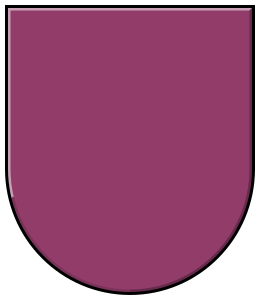
Purpure is one of the secondary heraldic tinctures. In modern heraldic practice it is usually represented as a reddish-purple or violet tone, but its historical meaning and appearance are considerably more complex. Medieval heraldic sources did not always clearly distinguish between purpure and red, while other traditions described it as brownish or greyish-brown rather than a saturated purple hue.
In heraldry, purpure was always among the rarer tinctures. It appears less frequently on shields than the principal colours or the two metals, but it was commonly used for rank-related elements such as mantling, tented arms (cimiers), crown linings, and other ceremonial heraldic components.
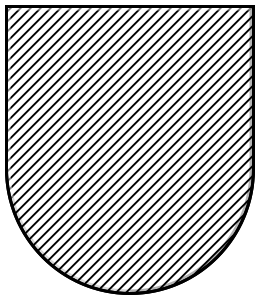
From the 17th century onwards, purpure in black-and-white heraldic representation was indicated by diagonal hatching running from the upper left to the lower right.
Etymology and Terminology
The term purpure derives from the Latin purpura, which referred simultaneously to the purple dye, the sea snail used to produce it, and the purple-dyed fabric itself. The word ultimately traces back to the Greek porphyra.
In early French heraldic terminology, the precursor of modern purpure was long represented by bis, which denoted a greyish-brown shade. From the late 13th century onwards, purpure gradually replaced earlier terminology and became standard.
One of the defining characteristics of heraldic purpure is that its interpretation changed significantly over time. Medieval sources often describe it as brownish, reddish-brown, or dull purple, while later heraldic literature increasingly treated it as a transition between red and blue.
Symbolism
In the so-called “dead heraldry” of the late medieval and early modern periods, purpure was associated with a range of symbolic meanings.
In the system of Jean Prinsault, it represented abundance, dignity, and wisdom. As it was considered a composite colour rather than a primary tincture, it was not classified among the simplest heraldic colours.
The medieval herald known as Heraldus Britannus, cited by Philipp Jakob Spener, referred to purpure under the name oiscy. In later symbolic systems, purpure was frequently associated with the amethyst.
In heraldic and alchemical colour symbolism systems, purpure was often associated with the planet Mercury (☿). Mercury was regarded as the principle of change, transition, and mediation between opposites, which corresponds well to the dual and historically unstable character of purpure, as it was variously described in sources as brownish, reddish-purple, or bluish in tone depending on period and tradition.
Throughout centuries, purpure remained a colour of dignity, authority, and imperial association, partly due to the extreme cost and prestige of its historical dye sources.
The History of Purple Dye
Tyrian Purple
The most famous ancient purple dye was derived from marine molluscs, primarily Murex brandaris and Hexaplex trunculus.
Its production was extremely labour-intensive, requiring thousands of shells for a very small amount of dye, making it one of the most expensive luxury materials of the ancient world.
The Phoenician city of Tyre became particularly renowned for its production. In the Roman period, the use of specific shades of purple was regulated by law, with certain tones reserved exclusively for imperial use.
One of the remarkable properties of Tyrian purple was its exceptional colourfastness; properly dyed fabrics retained their colour even after repeated washing.
Kermes, Carmine, and Later Substitutes
By the late medieval period, classical Tyrian purple production had largely declined. Instead, dyers increasingly relied on red dyes derived from kermes insects and later from the American cochineal.
In 1456, Pope Callixtus III ordered that ecclesiastical purple garments should be produced using these alternative dyes. By this time, “purple” had ceased to refer strictly to a single dye and had become more of a symbolic rank colour.
The Problem of Heraldic Purple
Heraldic purpure occupies a unique position in the history of tinctures, as its exact hue was never fully standardised.
Before the 15th century, it was often described as a brownish or grey-brown tone. During the Renaissance, with the renewed interest in classical antiquity, it was increasingly associated with the ancient Roman imperial purple, gradually shifting towards a more violet interpretation.
In Virgil Solis’ heraldic tables (1555), the Latin purpureus is still rendered in German as braun (“brown”). By contrast, Charles Segoing (1660) describes it as a transition between red and blue.
In modern heraldic practice, purpure is generally depicted as violet or reddish-purple, although significant variation remains across national traditions.
Purpure in Heraldry
Purpure was relatively rare in medieval heraldry. It was used less frequently on shields than the primary tinctures and metals.
It appears more commonly in ceremonial contexts such as mantling, tented arms, crown linings, and similar rank-indicating elements. In German heraldic terminology, one form of heraldic tent was known as Purpurbaldachin.
In Hungarian heraldic tradition, purpure is also rare. Sources mention its use in the arms of certain noble families, including Apor, Csekonics, Joseph, Török, and the Horváth family of Boosfalva.
The Evolution and Interpretation of Heraldic Purple
The interpretation of historical depictions of purpure is complicated not only by pigment degradation but also by the shifting meaning of the colour itself over time.
A medieval purpure field may originally have appeared brownish, reddish-brown, or greyish in tone, whereas modern reconstructions typically render it as violet or reddish-purple.
For this reason, interpreting heraldic purpure requires attention not only to the chemical ageing of pigments but also to the historical evolution of colour terminology and visual conventions in heraldic practice.