
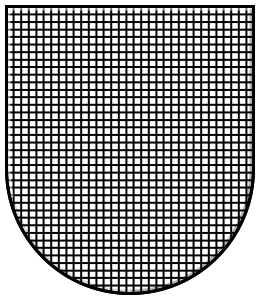
Black - Sable
Black in Heraldry
Black is one of the heraldic colours (tinctures). In heraldic terminology it is known as sable. It was widely used in medieval and early modern heraldry, particularly for depicting animals, weapons, and other charges where a dark colour provided strong visual contrast.
Black is among the most stable heraldic tinctures. While many heraldic colours and metals can undergo significant chemical changes over the centuries, high-quality carbon-based black pigments often retain much of their original appearance even after hundreds of years.
From the seventeenth century onward, black was represented in monochrome heraldic engravings by a combination of vertical and horizontal hatching. In early systems that associated heraldic colours with planets, black corresponded to Saturn (♄).
Etymology and Terminology
The heraldic name for black in Western European heraldry is generally believed to derive from the sable fur.
The French and English term sable originally referred to the sable (Martes zibellina), whose dark, almost black fur was among the most valuable luxury furs of the Middle Ages. The German heraldic term Zobel preserves the same origin.
Some scholars have suggested that heraldic black may originally have been associated with the use of dark furs on shields or garments, although direct evidence for this theory remains limited.
Symbolism
In the so-called “dead heraldry” of the late Middle Ages and the early modern period, numerous symbolic meanings were attached to black.
In the system of Jean Prinsault, black represented mourning and wealth. Other heraldic writers associated it with constancy, prudence, wisdom, and self-discipline.
The medieval herald cited by Philipp Jakob Spener under the name Heraldus Britannus referred to black as mauro.
In later European symbolism, black became closely associated with mourning, death, and mortality. At the same time, it could also signify dignity, authority, and prestige. Deep black textiles were expensive to produce in the medieval and early modern periods, meaning that black was not exclusively regarded as a negative colour.
Black Pigments in Heraldic Painting
Lamp Black and Carbon Black
The most important black pigments used in heraldic painting were carbon-based blacks.
They were produced by burning resinous wood, tar, oils, or other organic materials under conditions of limited oxygen. The resulting soot was collected and mixed with suitable binding media to create paint.
Among the finest pigments were lamp black and wick black, both valued for their extremely fine particle size and deep, uniform colour.
Chemically, these pigments consist primarily of elemental carbon, which accounts for their exceptional stability.
Bone Black
Bone black was produced by heating animal bones in an oxygen-poor environment.
In addition to carbon, it contains calcium phosphate, giving it a slightly warmer and sometimes brownish tone compared with pure carbon black.
It was widely used in painting and manuscript illumination from the Middle Ages onward.
Vine Black
Vine black was produced by charring grapevines and vine cuttings.
The pigment was already known in antiquity and is associated with the practices of Greek painters such as Polygnotusand Micon.
Compared with lamp black, vine black generally produced a softer and somewhat warmer black tone.
Ageing and Interpretation of Heraldic Black
Most black pigments belong to the most chemically stable colourants used in heraldic art. Carbon-based blacks often preserve their original appearance for centuries, although slight browning or greying may occasionally occur.
From the perspective of heraldic research, however, an important methodological problem arises: not every surface that appears black today was originally intended to be black.
Areas painted with genuine silver or covered with silver leaf may oxidize over time and become dark grey or nearly black. As a result, many historical grants of arms, banners, and heraldic paintings now display dark elements that were originally silver.
This phenomenon has contributed to numerous errors in historical reconstructions. For this reason, heraldic interpretation must always take into account the chemical ageing of pigments and metals before identifying a dark field as genuinely black.
The ageing processes associated with black do not always affect the pigment itself. Medieval and early modern charters, armorial grants, and manuscripts were often written using iron gall ink, which can chemically damage parchment and paper over time.
The iron compounds and acidic components of the ink may cause the support material to brown, become brittle, crack, and in severe cases even develop holes. Consequently, iron gall ink corrosion remains a major concern in the conservation and restoration of historical heraldic documents.
From a methodological standpoint, black occupies a unique position among the heraldic tinctures. With most colours, the challenge is determining how the original hue has changed over time. In the case of black, the opposite question often arises: was the surface originally black, or are we looking at a heraldic metal—most commonly silver—that has darkened through centuries of oxidation?