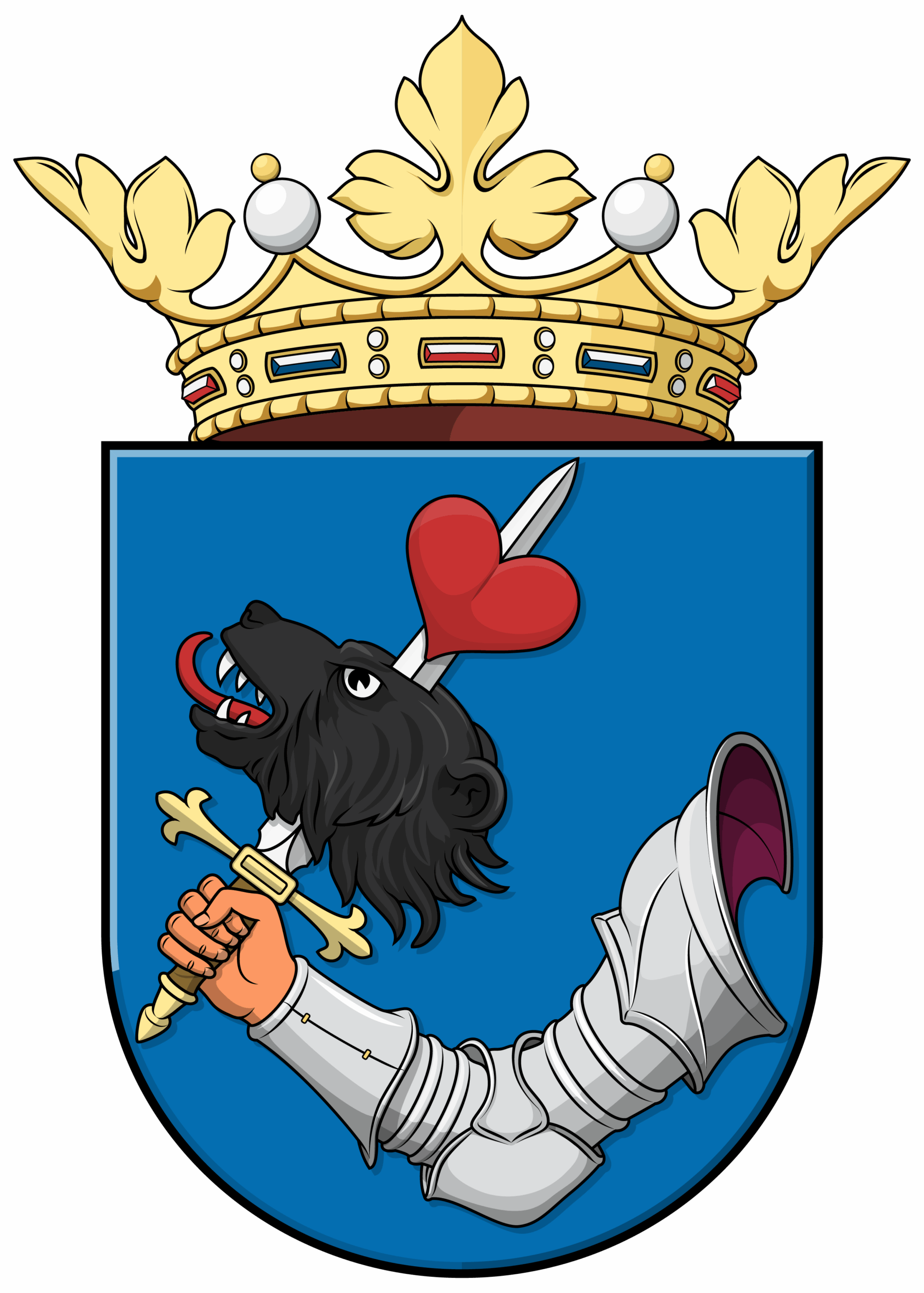
Old coat of arms of Târgu Mureș
Location:
Type:
State:
Blazon
Redrawn in vector graphic format based on the work of Hugo Gerhard Ströhl: Heraldischer Atlas (Stuttgart, 1899).
Coat of arms of 1616:
In a blue field, a silver sword with a golden hilt, standing upright with its point upwards, pierced by a red heart and, above it, a black bear’s head.
Granted by: Matthias II
Târgu Mureș
(Hungarian: Marosvásárhely) is one of Transylvania’s most important historical and cultural centers, located on both banks of the Mureș River. The city lies in present-day Romania, in Mureș County, and is often referred to as the gateway to Székely Land. Throughout its history, its population has always been multiethnic: Hungarians, Romanians, Saxons, and other groups have lived together here. This diversity has left a strong imprint on the city’s appearance, architecture, and cultural heritage.
History of Târgu Mureș
The first written mention of Marosvásárhely dates back to the 14th century, when it was referred to as a market town. During the Middle Ages, the city developed rapidly and became an important commercial center, attracting inhabitants from surrounding settlements. In the 17th and 18th centuries, it played a particularly significant role in the political life of Székely Land and Transylvania, hosting several sessions of the Transylvanian Diet. The city’s name itself reflects its long-standing function as an important market town.
During the Habsburg period, Marosvásárhely became a major administrative and cultural center. In the 19th century, industrialization and the construction of the railway further strengthened its economic position. However, the upheavals of the 20th century—World War I, World War II, and the changing of national borders—had a profound impact on the city’s life.
Cultural and Educational Center
Marosvásárhely has long been renowned for its educational institutions. The University of Medicine, Pharmacy, Science and Technology of Târgu Mureș operates here and enjoys international recognition, offering programs in Romanian, Hungarian, and English. The presence of the university contributes greatly to the city’s youthful atmosphere.
Another outstanding institution is the Târgu Mureș National Theatre, which hosts both Hungarian and Romanian companies. In addition to the theatre, numerous cultural festivals, music events, and exhibitions enrich the city’s cultural life. Târgu Mureș is also one of the artistic centers of Székely Land, where tradition and contemporary art meet.
Landmarks and Sights
One of the city’s most famous buildings is the Palace of Culture, constructed between 1911 and 1913 in the Art Nouveau style. Its mosaics, stained-glass windows, and interior decorations rank among the outstanding works of the period. The building houses the fine arts department of the Mureș County Museum, where works by Hungarian and Romanian painters can be seen alongside international collections.
The Teleki Library (Teleki Téka) is also noteworthy; it is one of Transylvania’s oldest and richest libraries. Founded at the end of the 18th century, the collection preserves tens of thousands of volumes, including rare first editions.
The fortress church and the medieval citadel of the city are likewise part of its historical heritage. Today, museums and cultural institutions operate within the fortress, making it not only a historical monument but also a living community space.
Economic and Social Life
The economy of Târgu Mureș is diverse: industry, services, and education all play important roles. The presence of universities stimulates not only academic life but also the city’s economy. Trade and tourism also contribute to development, as the city’s cultural heritage and events attract many visitors.
From a transportation perspective, the city is well positioned, with the Târgu Mureș International Airport nearby, providing connections to several major cities in Romania and Europe. This facilitates the expansion of tourism and business relations alike.
Târgu Mureș Today
Today, Marosvásárhely is a dynamically developing city that has preserved its multiethnic character. The coexistence of Hungarian, Romanian, and other communities gives the city a distinctive atmosphere. Cultural programs, festivals, and educational opportunities all contribute to maintaining Marosvásárhely’s role as one of Transylvania’s key centers.
The city simultaneously preserves its historical heritage and embraces modern directions. The combination of built heritage, a vibrant cultural life, and a diverse society is what makes Târgu Mureș truly unique.
Original image source: Internet
Text source: Wikipedia, ChatGPT

The visual content of this website may be freely used under the terms of the Creative Commons 4.0 license, provided that the source is clearly indicated and the attribution includes a full, clickable link to https://cimerek.hu or to the exact web address of the specific content.