Coat of arms of the Sas heraldic clan
Lokáció:
Típus:
Sas Heraldic Clan
The Sas, known in Polish as Sas, is one of the old heraldic clans of Polish-Lithuanian heraldry. Its coat of arms was used by numerous noble families from the Middle Ages onwards. The coat of arms was known in the territories of the historic Kingdom of Hungary, Transylvania, Red Ruthenia, Galicia, as well as the Kingdom of Poland and the Grand Duchy of Lithuania. Its origins have been explained in several different ways, and traditions associated with the coat of arms include Hungarian, Transylvanian Saxon, Ruthenian and Wallachian connections.
The Sas coat of arms is also referred to in historical sources in connection with the name Szász, as well as in the Latin and Romanian forms Sas and Saș. Its use can be traced back to the 13th century, while later heraldic sources record numerous variants and derivative forms.
The Sas Coat of Arms
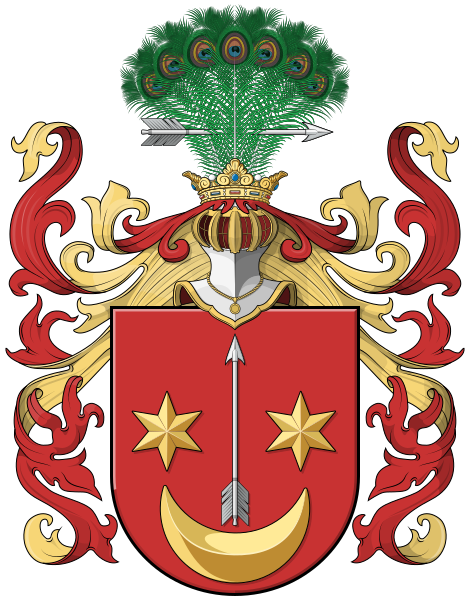
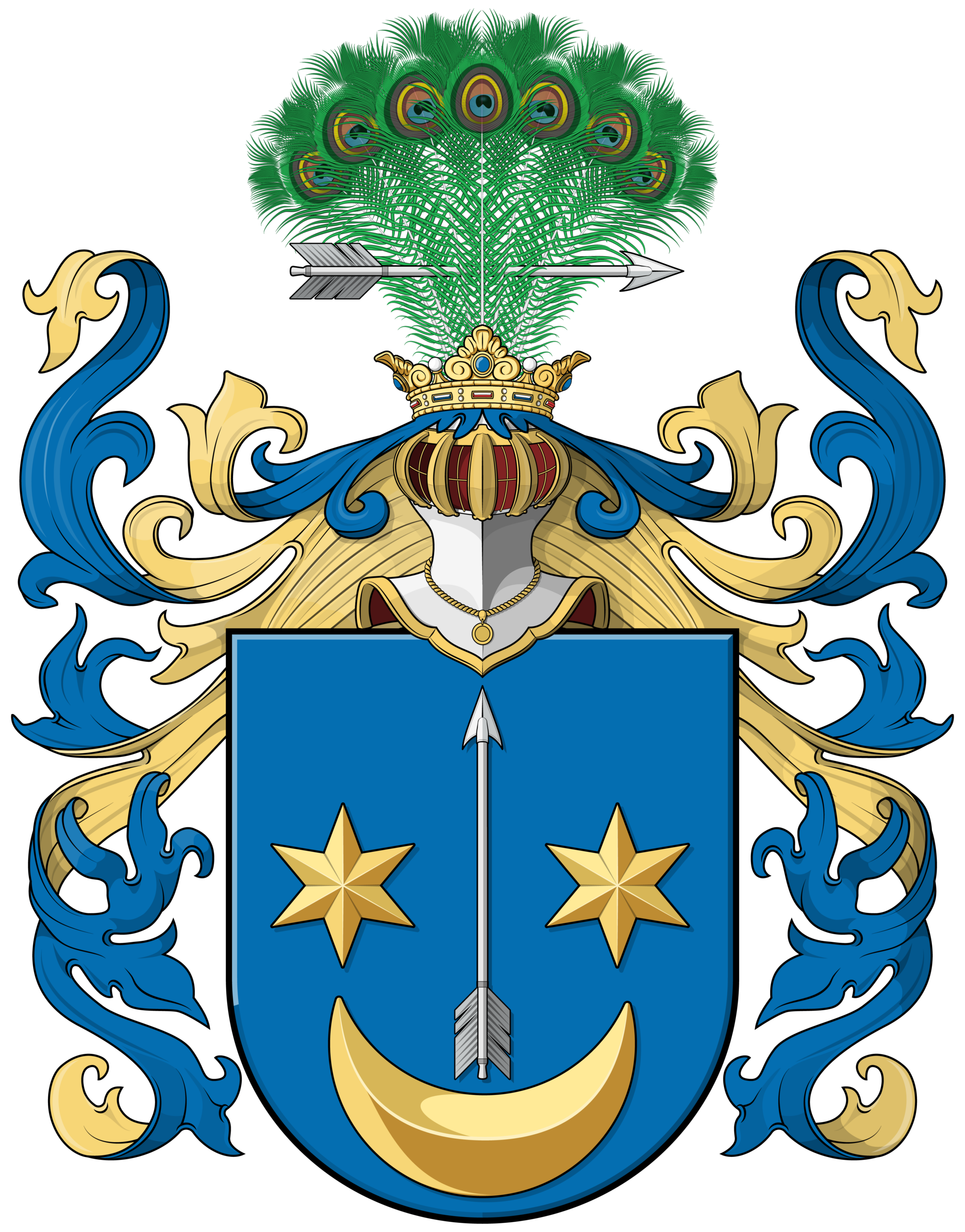
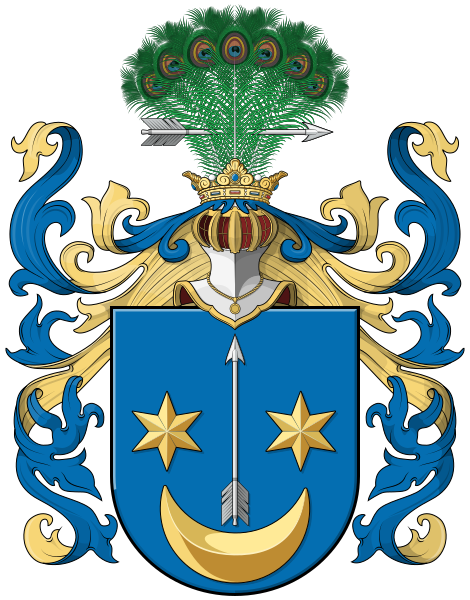
The classical version of the Sas coat of arms features a blue shield. On the shield is a golden crescent with its horns pointing upwards, with a golden six-pointed star placed on each horn. An upright arrow rises from the centre of the crescent. In the traditional version the arrow is silver, although some heraldic representations show it in gold.
One of the most distinctive elements of the coat of arms is the crest. Seven peacock feathers rise from the crown or coronet, pierced by a silver arrow. The direction of the arrow and details of the crest may vary in different heraldic representations.
Variants of the Sas Coat of Arms
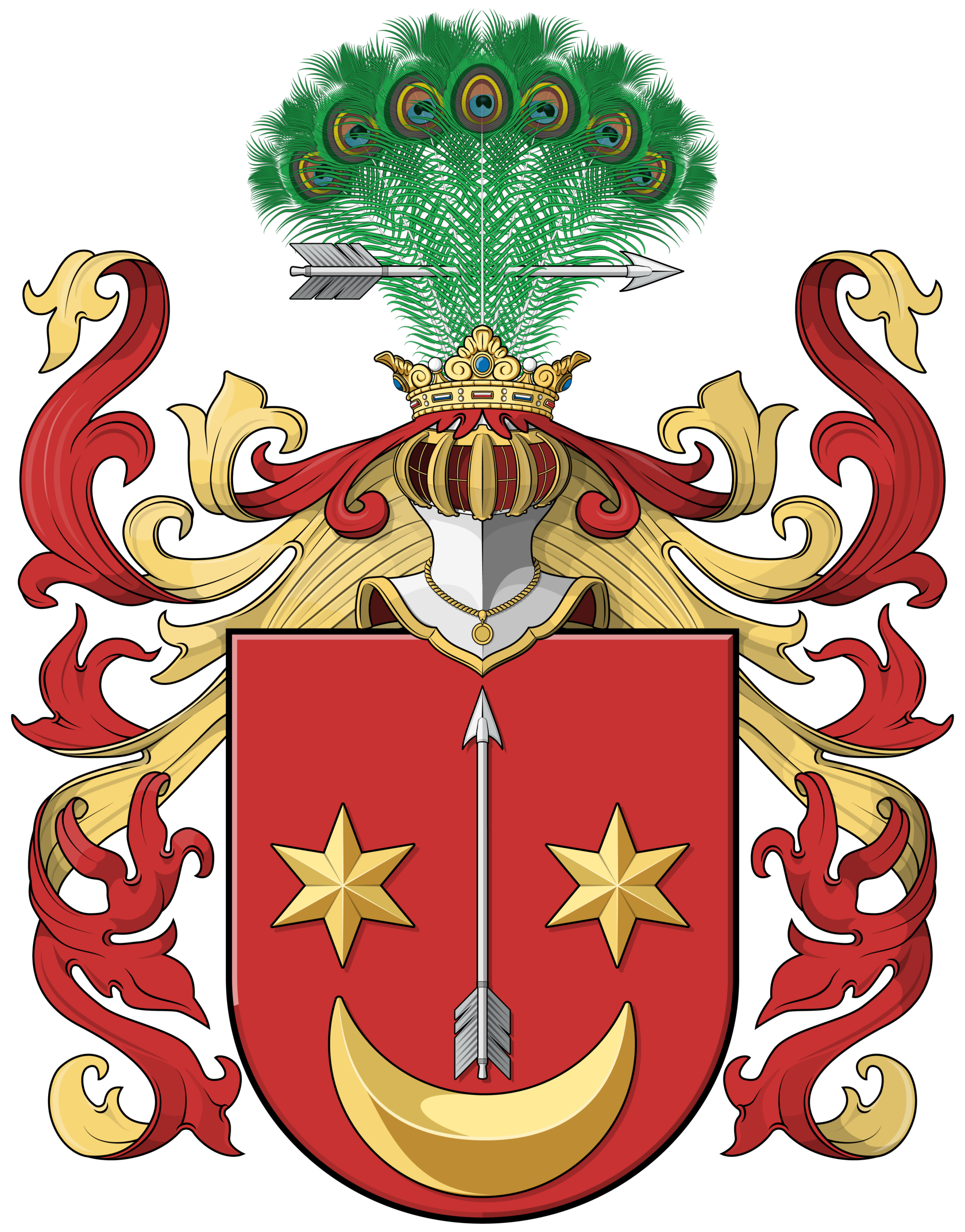
Numerous family and historical variants of the Sas coat of arms are known. These differ not only in the crest, but also in the colour of the shield and in details of the individual charges. One of the principal variants is Sas II, which has a red field instead of blue, while the principal charges – the golden crescent, the two golden stars and the upright arrow – remain essentially unchanged.
Historical sources and later Polish armorials preserve numerous other variants as well. In some families, additional crowns, supporters or other marks of rank were associated with the coat of arms, while in other cases the position or colour of the charges was altered. The Sas therefore does not represent a single design used in exactly the same form by every family, but rather a heraldic community associated with a large number of noble families and represented in numerous variants.
History of the Sas Heraldic Clan
Several different traditions concerning the origins of the Sas have survived. An older Polish historiographical tradition associated the origin of the coat of arms with people who had migrated from Saxony to the Kingdom of Hungary. In the middle of the 12th century, during the reign of King Géza II, a considerable number of German settlers, particularly Saxons, arrived in Transylvania, where they later enjoyed a privileged position within the Kingdom of Hungary.
Later traditions connect the history of the coat of arms with the region of Galicia–Volhynia in the 13th century and with military contingents arriving from Hungary. A tradition associated with the figure of Comes Huyd or Hujd, mentioned in medieval chronicles, states that he received estates in Red Ruthenia for his military service, and that the noble groups under his leadership later became associated with the Sas coat of arms.
The Hungarian connections in the history of the coat of arms are further supported by the fact that the Sas was used by several noble families of Transylvanian and Hungarian origin. Among them was the Bélteki Drágffy family, whose members rose to prominence among the leading magnates of the medieval Kingdom of Hungary. The Sas coat of arms also appeared in Moldavia and Ruthenian territories before becoming widely established among the Polish nobility.
Between the 16th and 19th centuries, the Sas coat of arms was recorded in several important Polish armorials. It appears in Bartosz Paprocki’s Herby rycerstwa polskiego, published in 1584, in Szymon Okolski’s Orbis Polonus, published between 1641 and 1643, and in Kasper Niesiecki’s Herbarz Polski.
The number of families using the Sas coat of arms was considerable. Historical armorials include, among others, the Daniłowicz, Dzieduszycki, Drágffy, Komarnicki, Strutyński and Uruski families among its bearers. The noble families associated with the coat of arms included families from Hungarian, Ruthenian, Ukrainian and Polish territories alike.

A webhely képi tartalmai a Creative Commons 4.0 licenc feltételei szerint szabadon felhasználhatók, amennyiben a forrás egyértelműen meg van jelölve, és a hivatkozás egy teljes értékű, kattintható link formájában a https://cimerek.hu oldalra vagy az adott tartalom pontos webcímére mutat.