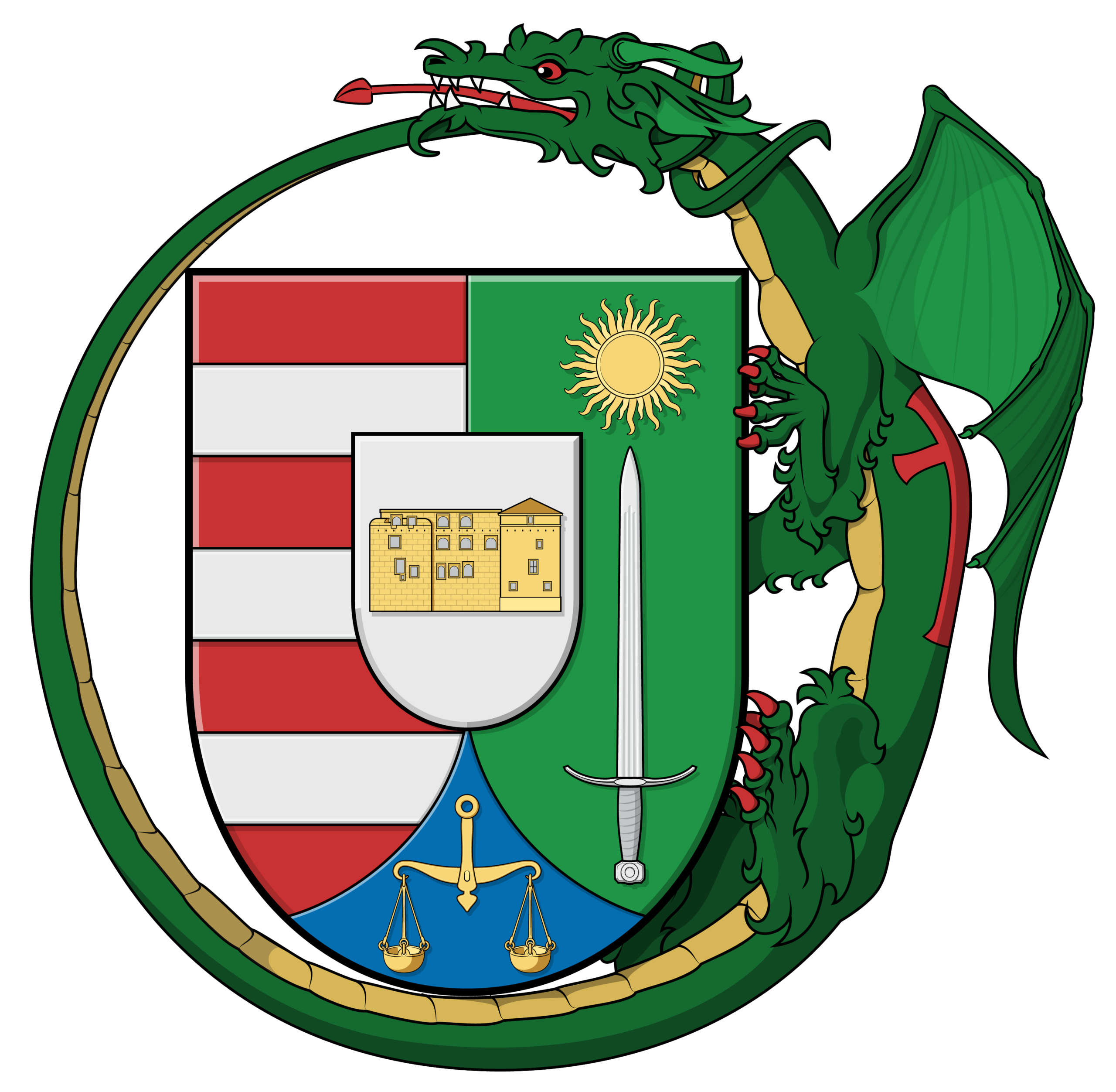
Coat of arms of Kisvárda
Location:
Type:
Status:
Kisvárda
A town in northeastern Hungary, in Szabolcs-Szatmár-Bereg County, and the administrative centre of the Kisvárda District. The settlement lies on the border of the Nyírség and the Rétköz regions, about 47 km northeast of Nyíregyháza and approximately 22 km from the Ukrainian border. The town is an important transport junction along Main Road 4 and the railway line leading to Záhony.
History of Kisvárda
The name Kisvárda derives from the Hungarian word vár (“castle” or “fort”), referring to a smaller fortified place. The settlement was named by the conquering Hungarians after the earthwork fort located in the area. In medieval charters it appears as Warda or Warada. The prefix kis (“small”) distinguishes it from the city of Nagyvárad (today Oradea in Romania).
After the Hungarian conquest the settlement had an important border-defence role. According to tradition, King Saint Ladislaus defeated a Cuman attack here in 1085. From the 12th century the area belonged to the Gutkeled clan, and later the Várday family became the most influential landowners in the town’s history.
In the 15th century the castle of Kisvárda was built, serving as the town’s main defensive structure. In 1421 the Várday family granted market-town privileges to the settlement, after which it developed into an important trading centre. In the following centuries the town experienced several sieges and military conflicts, and by the 18th century the castle had lost its military significance.
In the second half of the 20th century industrial and economic development began, and in 1970 Kisvárda regained official town status.
Sights
The best-known historical monument of the town is the Castle of Kisvárda, whose ruins today serve as a venue for cultural events and theatre performances. Several churches, museums and public sculptures can also be found in the town.
Coat of arms of Kisvárda
The coat of arms is a round-based shield divided into three parts by an upward-curving triangular partition, with a central inescutcheon.
The dexter field of the main shield is seven times barred red and silver. In the sinister field, on a green background, there is a golden sun above a silver upright double-edged sword. In the base of the shield, on a blue field, there is a golden balance scale. The inescutcheon is silver, bearing a stylised golden image of the Castle of Kisvárda. Surrounding the shield is a green winged dragon facing to the right, its tail coiled around its neck and its claws gripping the left side of the shield.
The coat of arms is a complex heraldic composition symbolising the historical and economic significance of the town. The castle depicted on the inescutcheon refers to the fortification that gave the settlement its name and once served an important defensive role.
The red and silver bars recall the motif of the Hungarian national coat of arms and symbolise the town’s connection to the early Hungarian state and the Árpád dynasty.
The sun in the left field symbolises the development and renewal of the settlement, including the acquisition of market-town privileges in the Middle Ages and the restoration of town status in modern times.
The sword refers to Kisvárda’s administrative importance in county life: between the 15th and 18th centuries county assemblies were held here and the deputy lord lieutenants had their seat in the town.
The balance scale represents the town’s long-standing commercial role. Since the Middle Ages Kisvárda has been an important market and fair-holding centre, maintaining its economic importance in later centuries as well.
The dragon surrounding the shield originates from the coat of arms of the Várday family. The dragon with its tail coiled around its neck was the emblem of the Order of the Dragon, founded by King Sigismund in 1408, of which several members of the family were part.
Original image source: Nemzetijelkepek.hu
Source: ChatGPT

The visual content of this website may be freely used under the terms of the Creative Commons 4.0 license, provided that the source is clearly indicated and the attribution includes a full, clickable link to https://cimerek.hu or to the exact web address of the specific content.