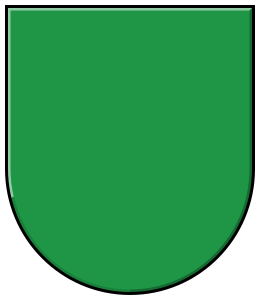
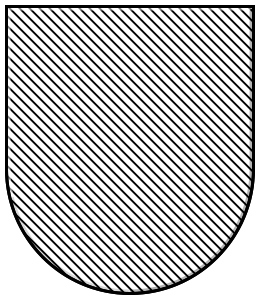
Green - Vert
Green in Heraldry
Green is one of the heraldic colours (tinctures). In classical heraldry it is generally depicted as a medium or emerald green and is known in heraldic terminology as vert. In the earliest centuries of heraldry it appeared less frequently than red, blue, or black, although its use gradually became more common from the late Middle Ages onward.
Earlier writers often explained the relative rarity of green by suggesting that it did not stand out sufficiently against the natural landscape on the battlefield. Modern scholarship tends to place greater emphasis on the difficulty of producing durable and well-covering green pigments compared with many other heraldic colours.
From the seventeenth century onward, green was represented in black-and-white heraldic engravings by diagonal hatching running from the upper left to the lower right. In early systems that associated heraldic colours with planets, green corresponded to Venus (♀).
Etymology and Terminology
The English heraldic term vert derives from the Old French vert, ultimately originating from the Latin viridis, meaning “green,” “flourishing,” or “vigorous.”
In French heraldry, the term vert was gradually replaced during the late Middle Ages by sinople. This word originally derived from the city of Sinope in Asia Minor, which was known for its reddish earth pigments. In early heraldic sources, sinople referred to a shade of red, but during the fourteenth and fifteenth centuries its meaning gradually shifted to green.
The exact reason for this change remains uncertain. Some scholars have suggested that it may have helped avoid confusion between the similarly sounding terms vert and vair (the squirrel-fur heraldic fur).
In everyday French, however, vert remained the ordinary word for the colour green.
Symbolism
In the so-called “dead heraldry” of the late Middle Ages and the early modern period, green acquired a variety of symbolic meanings.
In Jean Prinsault’s system, it represented love, honour, and courtesy. Later heraldic writers associated it with hope, freedom, joy, renewal, and prosperity.
The medieval herald cited by Philipp Jakob Spener under the name Heraldus Britannus referred to green as prasino, a term derived from the Greek prasinos, meaning “leek-green.”
Mineral and Copper-Based Green Pigments
Malachite
One of the most important early green pigments used in heraldic painting was malachite, a basic copper carbonate with the chemical formula Cu₂CO₃(OH)₂.
Malachite had been employed as a pigment since antiquity. The mineral was ground into a fine powder and mixed with various binding agents to create paint. The fineness of grinding significantly influenced the resulting shade: coarse particles produced darker greens, while finer particles yielded lighter tones.
The pigment was widely used in Egyptian, Greek, Roman, and medieval European art. During the Middle Ages it also found occasional use in medicine.
Because of its chemical composition, malachite is closely related to azurite, one of the principal mineral pigments historically used to produce heraldic blue.
Verdigris
Another important historical green pigment was verdigris.
It was produced by exposing copper plates to the vapours of vinegar, grape juice, or other acidic substances. The green copper compounds that formed on the surface were periodically scraped off, dried, and used as pigment.
Verdigris produced a particularly brilliant and vivid green, but it was chemically less stable than malachite. For this reason, it continues to present challenges for the conservation and restoration of medieval manuscripts and grants of arms.
Medieval and early modern artists did not rely solely on naturally occurring green pigments. Green could also be obtained by mixing blue and yellow colourants. Combinations of azurite and orpiment were particularly valued, while various plant-based yellow dyes were likewise employed to produce different shades of green. Although these mixtures offered considerable flexibility, their long-term stability often proved inferior to that of mineral pigments such as malachite.
Later Green Pigments
Viridian
The nineteenth century saw the introduction of viridian, a hydrated chromium oxide pigment whose name likewise derives from the Latin viridis.
Viridian proved exceptionally stable, lightfast, and chemically resistant. Its colour is somewhat cooler and deeper than traditional malachite green, making it particularly popular in modern heraldic and artistic representations.
Schweinfurt Green
One of the best-known green pigments of the nineteenth century was Schweinfurt Green (copper acetoarsenite).
Its intense colour made it highly popular, but its considerable arsenic content rendered it extremely toxic. Although widely used in nineteenth-century decorative arts, it was gradually abandoned as safer alternatives became available.
Ageing and Discolouration of Heraldic Green
The green fields of historical heraldic artworks have often undergone significant changes over the centuries.
Copper-based pigments are particularly sensitive to environmental influences. Malachite may deteriorate in acidic conditions, while verdigris can darken or turn brown over time. In some cases, copper compounds may also react with binding media and support materials, causing damage to the paint layer itself.
As a result of these ageing processes, surfaces that were originally bright green often appear today as dull green, brownish-green, or grey-green.
This phenomenon is especially important in the study of medieval manuscripts, grants of arms, and heraldic paintings. A field that now appears faded or brownish may originally have been a vivid heraldic green whose appearance has been altered by centuries of chemical change.
From a methodological perspective, the chemical transformation of green pigments must always be considered when interpreting historical heraldic artworks. Alongside gold and silver, green is among the heraldic tinctures whose original appearance may be most significantly affected by the natural ageing of pigments.