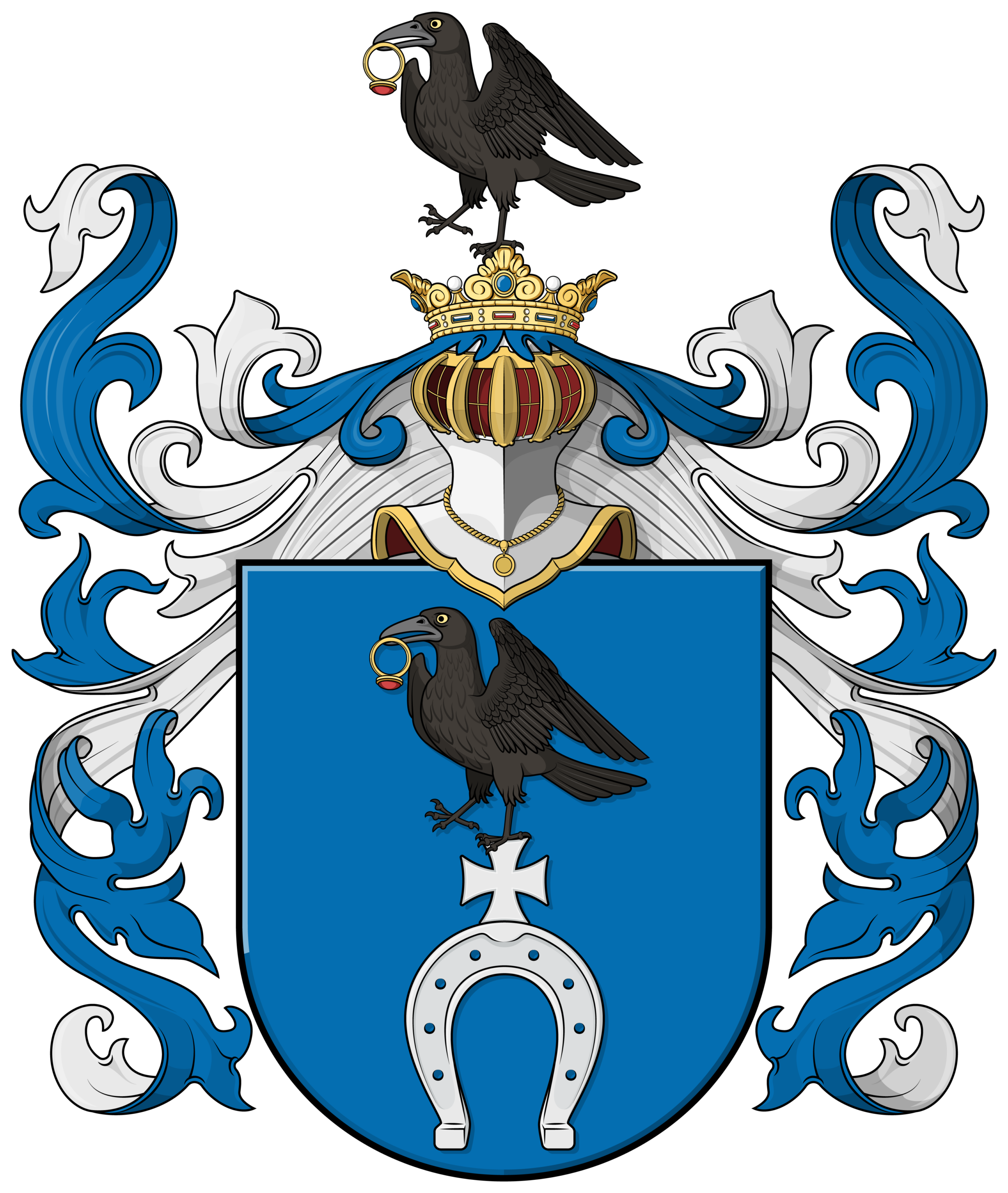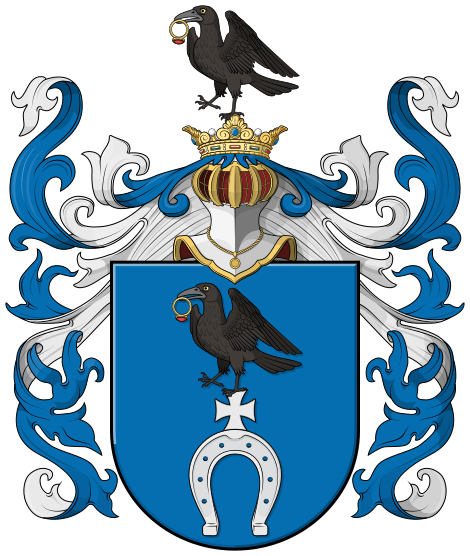
Coat of Arms of the Ślepowron Heraldic Clan
Location:
Type:
The Ślepowron Coat of Arms and the Polish Noble Clans
The Ślepowron coat of arms is not merely a family emblem, but one of the oldest and most widespread communal coats of arms in Polish history. Its earliest recorded references date from 1352 (seal) and 1389 (written source), though its origins reach much deeper into the medieval past of Poland.
The Polish Heraldic System: “Herb” and “Ród”
Polish heraldry differs fundamentally from Western European and Hungarian practice.
Collective Rather Than Individual
In Hungary and much of Western Europe, a coat of arms belongs to a specific family lineage. In Poland, however, the nobility was organized into so-called heraldic clans (ród).
The Clan (Ród)
A clan was a social unit whose members — sometimes hundreds of families with different surnames — shared the same name and the same coat of arms (herb).
Shared Identity
Members of a clan were not necessarily blood relatives. During the Middle Ages, it was common for entire groups to be incorporated under an existing coat of arms following military campaigns or royal land grants — a practice known as adoptio heraldica.
The Ślepowron clan includes more than 450 different families.
Description of the Ślepowron Coat of Arms
Shield: In a blue field, an upright silver horseshoe with its ends pointing upward; upon it rests a golden knight’s cross.
Principal charge: On the cross stands a black raven, facing left (or affronté), wings extended, holding a golden ring in its beak.
Crest: The same ring-bearing raven as on the shield.
The Legend of the Raven: Facts and Misconceptions
The romantic tale of a ring falling during a duel is more legend than documented tradition. Historical and heraldic research suggests two principal explanations:
The Korwin Connection
According to tradition, the raven motif derives from the Roman commander Valerius Maximus, who allegedly defeated a giant Gallic warrior with the help of a raven.
In Polish heraldic tradition, Ślepowron emerged in the 13th century from the union of two coats of arms:
Korwin (the raven motif)
Pobóg (the horseshoe and cross)
This merger is said to have occurred through marriage between Wawrzęta Korwin and a lady of the Pobóg clan.
Meaning of the Name
The word Ślepowron literally means “blind raven” or “night raven” (in fact referring to the black-crowned night heron). The name most likely originated from an ancient nickname or from a specific locality associated with the clan’s early history.
Symbolism of the Ring
The ring in the raven’s beak represents more than mere luck. In medieval legal symbolism, a ring signified fidelity, authority, and transferred power. It was a visible emblem of commitment and integrity.
Kazimierz Pułaski
The most famous member of the Ślepowron clan was undoubtedly Kazimierz Pułaski (1745–1779).
Kazimierz Pułaski and Mihály Kováts: Founders of American Cavalry
When Pułaski arrived in the American colonies in 1777, the Continental Army had no organized independent cavalry. George Washington’s forces consisted largely of infantry and poorly trained militia, who were ineffective against British dragoons in open-field engagements.
The Founding of the “Pułaski Legion”
Recognizing this weakness, Pułaski persuaded Washington to authorize the creation of an independent mixed-arms unit. This became the famous Pułaski Legion.
Pułaski introduced European — particularly Polish and Hungarian — light cavalry tactics. These included rapid maneuvering, surprise attacks, and coordinated operations between cavalry and infantry.
Washington was so satisfied with his performance that he appointed him Commander of the Horse, making Pułaski the first American general officer of cavalry.
The Hungarian Companion: Mihály Kováts (Michael Kovats de Fabriczy)
Pułaski understood that effective organization required an experienced professional familiar with the finest cavalry traditions of the era — namely, Hungarian hussar warfare. He therefore enlisted Mihály Kováts of Karcag.
Kováts had served in the Prussian army and mastered the Hungarian hussar method. Pułaski appointed him colonel of the Legion and its practical training commander.
Kováts drafted the first regulations for American cavalry. He taught American soldiers how to use the horse as a combat instrument, how to maintain formation at full gallop, and how to fight effectively with the saber.
The fates of the two men became tragically intertwined. On May 11, 1779, Kováts fell heroically during the defense of Charleston. Less than half a year later, Pułaski was mortally wounded during the Siege of Savannah.
Why This Matters from a Polish and Hungarian Perspective
American military historiography regards Pułaski as the “Father of the American Cavalry,” while Mihály Kováts is remembered as its principal trainer.
Their partnership stands as a powerful example of Polish-Hungarian military brotherhood: a Polish nobleman of the Ślepowron clan and a Hungarian hussar officer together laid one of the foundation stones of what would become the world’s most powerful modern army.
For Pułaski, fighting under the Ślepowron coat of arms came to symbolize not only the cause of Poland, but also the liberty of a new nation — alongside his Hungarian ally.

The visual content of this website may be freely used under the terms of the Creative Commons 4.0 license, provided that the source is clearly indicated and the attribution includes a full, clickable link to https://cimerek.hu or to the exact web address of the specific content.