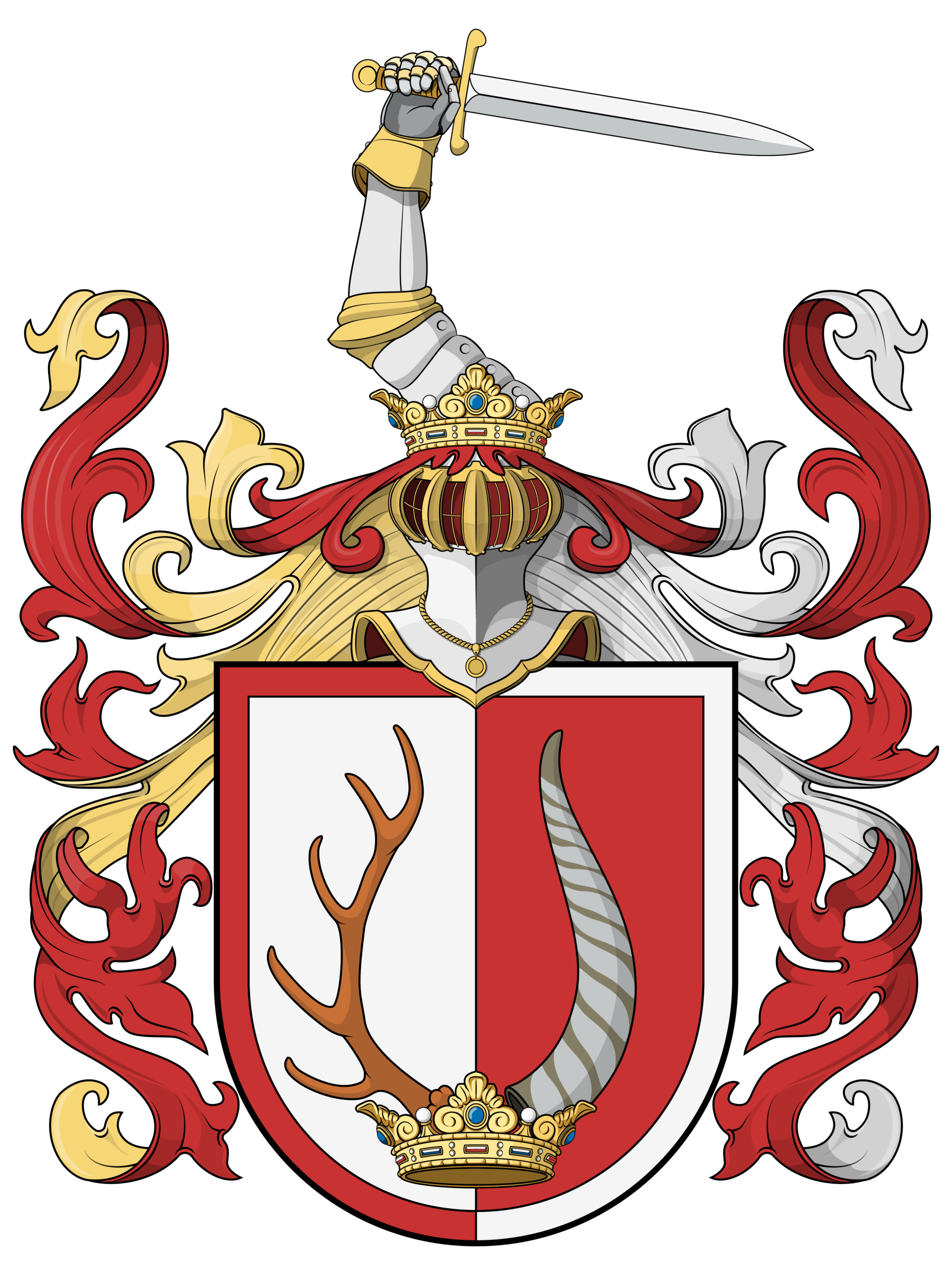
Coat of arms of the Rogala heraldic clan
Location:
Type:
History of the Rogala heraldic clan and coat of arms
The Rogala clan (also known as Rogala, Rogalicz, Rogalita) is one of the most ancient and numerous historical Polish clans (ród), whose members formed the backbone of the Polish nobility (szlachta). The history and heraldic heritage of the clan are closely intertwined with the formation of the Polish state.
Origins and Etymology of the Rogala Name
The name of the clan and its coat of arms clearly derives from the Polish word “róg” (meaning horn or antler). This designation directly refers to the two central motifs visible on the escutcheon, which symbolized the clan’s military might, determination, and hunting traditions during the Middle Ages.
Origin and First Appearance of the Coat of Arms
While family legends and some early genealogists attribute Germanic roots to the basic coat of arms, modern historical science suggests that the motif is a product of local, native Polish development, datable to the late 12th or early 13th century (around 1260).
The earliest verified visual representation of the coat of arms survived not in the Lublin Codex (which is of a much later date), but on seals dating back to 1402, as well as in the famous Gelnhausen Codex and the late 14th-century Bellenville Armorial (Armorial Bellenville), considered a cornerstone of international heraldry. In written form, the clan’s name is first mentioned in a court record from 1404. The prominent historical role of the coat of arms is highlighted by chronicler Jan Długosz, who noted that the Rogala clan fought under their own banner in the decisive Battle of Grunwald in 1410.
Description and Heraldic Variations of the Rogala Coat of Arms
The classic Rogala shield is vertically divided (per pale). According to tradition, this layout dates back to an event in 1110, when Duke Bolesław, during a hunt, granted a buffalo horn and a red deer antler to the clan’s ancestor for his bravery.
Dexter side (heraldic right, viewer’s left): A silver (or white) buffalo horn (bison horn) set in a red field.
Sinister side (heraldic left, viewer’s right): A natural-colored (red or brown), six-tined red deer antler set in a silver or gold field.
The Crest (Sisakdísz): The motifs seen on the shield are repeated in reverse on the helmet (the deer antler on the dexter side, the buffalo horn on the sinister side).
Over the centuries—particularly during the trend of 17th-century Baroque heraldry—numerous variations of the coat of arms emerged. Variations exist where the colors of the fields are inverted, or where figures emerge from the coronet of the crest, adapting to the individual tastes of different family branches.
Geographical Distribution in the Polish-Lithuanian Commonwealth
The estates and ancestral seats of the Rogala clan were initially concentrated in Central Poland, within the Duchy of Masovia, as well as in Greater Poland (Wielkopolska) and Pomerania. With the formation and subsequent eastward expansion of the Polish-Lithuanian Commonwealth, clan members settled in large numbers in the northeastern territories of the historic union: in parts of modern-day Lithuania, Belarus (Podlachia and Black Ruthenia), and Western Ukraine.
Number of Families Belonging to the Clan
A unique feature of Polish heraldry is that multiple noble families—frequently unrelated by blood—could belong to a single coat of arms in a clan-like structure. According to historical sources and the official Polish armorials (Herbarz), more than 150 to 350 different families (including the Lewicki, Krasicki, Rogalski, Bieliński, and Chrzanowski families) were entitled to use the Rogala coat of arms over the centuries. This made Rogala one of the most influential and numerous petty noble (szlachta) clans of the Kingdom of Poland.
Sources: Historical Polish Armorials (Herbarz), medieval judicial records, and international sigillographic rolls.

The visual content of this website may be freely used under the terms of the Creative Commons 4.0 license, provided that the source is clearly indicated and the attribution includes a full, clickable link to https://cimerek.hu or to the exact web address of the specific content.