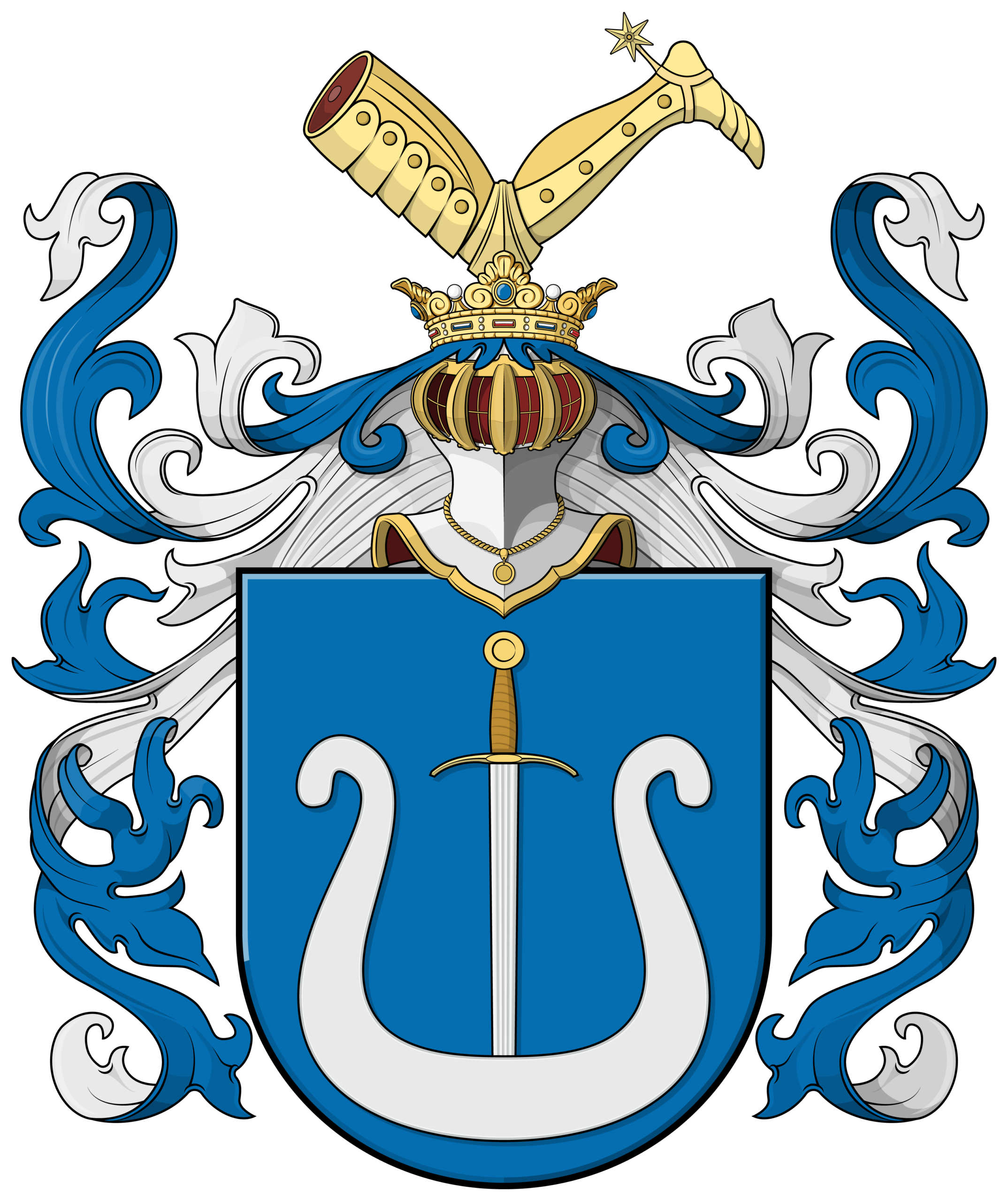
Coat of arms of the Nowina heraldic clan
Lokáció:
Típus:
The Nowina Coat of Arms
One of the oldest Polish coats of arms, it likely dates back to the Early Middle Ages and was first documented on a seal in 1293. It was probably used earlier for branding cattle. It was first mentioned in court records in 1392. The coat of arms became widespread in Greater Poland, as well as in the lands of Kraków, Lublin, Sandomierz, and Sieradz. Following the Union of Horodło in 1413 (often cited in context of the 1414 period), several boyar families were admitted into the ranks of the heraldic clan. The original clan members were represented by Mikołaj von Sepno, while the newcomers were represented by Mikołaj Bejnar.
The Legend of the Nowina Coat of Arms
The coat of arms was officially granted to a Polish knight, though it had been in use prior to his formal appointment. It was awarded because he cut off his own foot to allow his captain, who had been captured alongside him, to escape. This sacrifice enabled the captain to return to the ongoing battle and secure victory with his men. In addition to the coat of arms, the knight received a prosthetic leg made of pure gold from the King. This is why a golden leg is found in the crest of the coat of arms. The legend was first recorded by Wacław Potocki in 1696.

The visual content of this website may be freely used under the terms of the Creative Commons 4.0 license, provided that the source is clearly indicated and the attribution includes a full, clickable link to https://cimerek.hu or to the exact web address of the specific content.