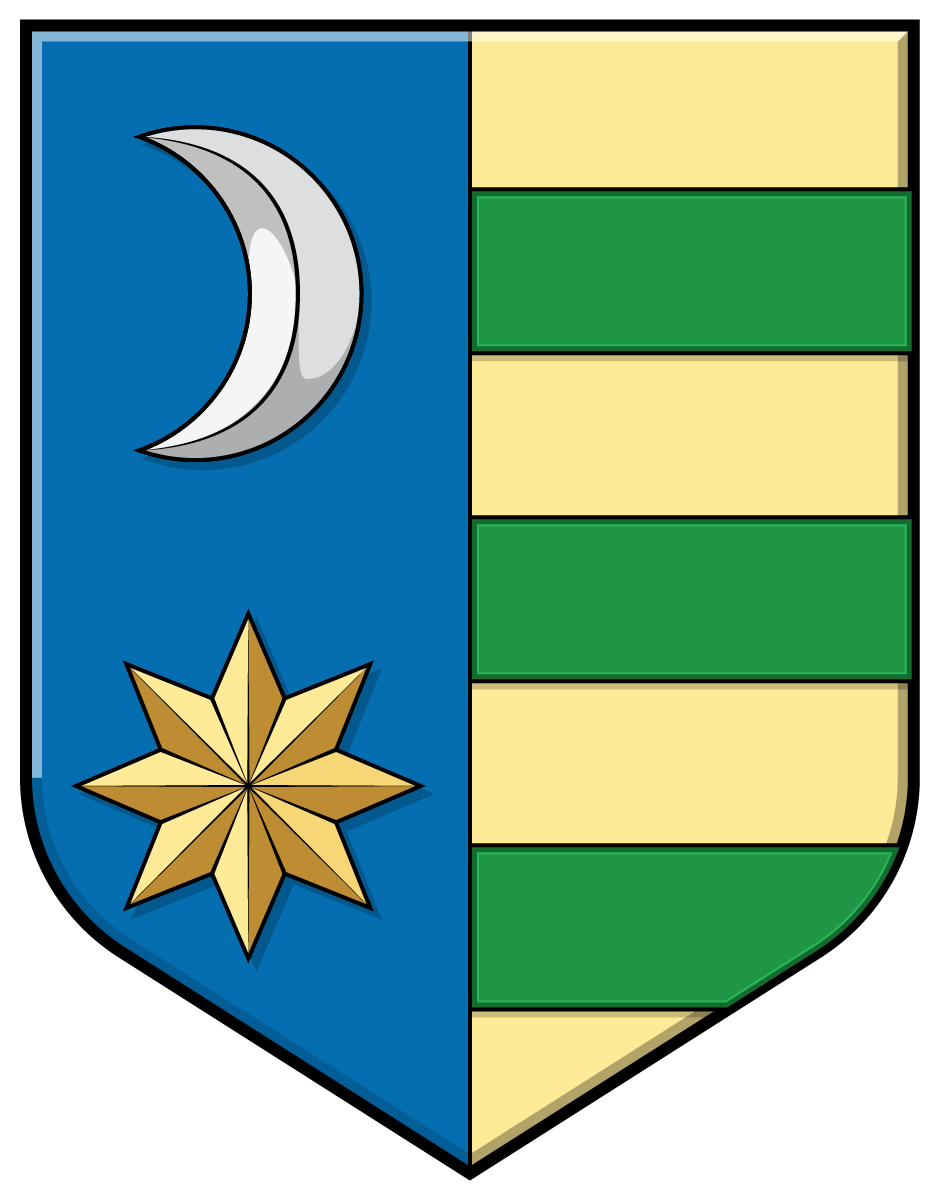
Coat of Arms of the Drăculești Family
Name:
Epithet:
Country:
Title:
Dynasty:
Reign:
The Origins of the House of Drăculești and the Wallachian Throne Struggles
The House of Drăculești was one of the major ruling branches of the House of Basarab, the founding dynasty of the Principality of Wallachia. Members of this lineage played a defining role in the political and military landscape of the Romanian principalities between the 14th and 17th centuries.
In the early 15th century, the House of Basarab split into two fiercely rivaling factions: the Drăculești and the Dănești branches. The subsequent decades of armed conflicts over the throne, intertwined with the shifting alliances of internal boyar factions, heavily shaped the medieval history of the region.
The Historical Etymology of the Drăculești Name
The name of the family is directly attributed to Prince Vlad II of Wallachia. In 1431, Vlad II was knighted in Nuremberg by Sigismund of Luxembourg, King of Hungary (and later Holy Roman Emperor), into the prestigious Order of the Dragon (Societas Draconistarum).
The prince later incorporated the insignia of the order—a dragon clutching itself—into his coinage and official charters as a personal emblem. Derived from the Latin word for dragon (draco), the ruler earned the sobriquét “Dracul” (The Dragon). In the Romanian language, the term Drăculești translates literally to “descendants of Dracul.”
State Symbols and Seals of Wallachia
The rulers of the Drăculești branch utilized the official state symbols of the Principality of Wallachia in their diplomatic correspondence and on their royal seals.
Based on historical records, the following elements can be verified with sigillographic accuracy:
The Wallachian State Coat of Arms: The central element of the princely seals features a bird facing left (referred to as aquila or eagle in Latin documents, and traditionally interpreted as a raven in Romanian lore) holding a cross in its beak. The bird is typically accompanied by a six-pointed star and a crescent moon.
The Princely Coinage: On the coins minted by Vlad II (Vlad Dracul) and his sons, the official state coat of arms was occasionally supplemented by the dragon figure of the Order of the Dragon, alongside other heraldic motifs signaling political alliances with contemporary Hungarian rulers (such as Sigismund of Luxembourg, John Hunyadi, or Matthias Corvinus).
The Reign of Vlad III and the Narrative of Posterity
The most prominent historical figure of the family was Vlad III (Vlad Ţepeş), who held the office of Prince of Wallachia on three separate occasions (1448, 1456–1462, and 1476).
Following his father’s title, he used the name Dracula (Son of the Dragon) in his diplomatic correspondence. The epithet “Ţepeş” (The Impaler) was attributed to him much later by contemporary Ottoman and German chroniclers, referencing the severe methods of execution he applied against foreign enemies and internal political rivals.
Separating Realpolitik from Gothic Literature
Historical documents demonstrate that Vlad III was a pragmatic ruler focused on consolidating centralized princely authority, defending Wallachia’s independence against the expansion of the Ottoman Empire.
His historical persona was later reinterpreted by Bram Stoker in his 1897 novel “Dracula,” launching the name into Gothic literature and modern pop culture. Contrary to fiction, the authentic historical legacy of the House of Drăculești—and their seals preserved in medieval charters—stands as a realistic reflection of 15th-century southeastern European state-building and anti-Ottoman defense.
Sources: Institute of History of the Romanian Academy, medieval Wallachian charters, and sigillographic catalogs.
The visual content of this website may be freely used under the terms of the Creative Commons 4.0 license, provided that the source is clearly indicated and the attribution includes a full, clickable link to https://cimerek.hu or to the exact web address of the specific content.