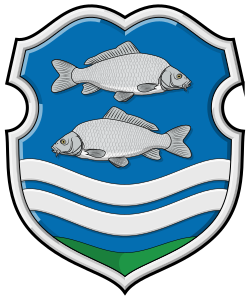
Coat of Arms of Szeghalom
Location:
Type:
Status:
About Szeghalom
The town of Szeghalom is located in the northern part of Békés County, near the Sebes-Körös and Berettyó rivers, in the Kis-Sárrét region. The settlement is a historical and cultural centre of the region, with a history dating back more than a thousand years. Its first written mention dates from 1067, in the founding charter of the Százd Abbey.
Location
Szeghalom lies in the northern part of Békés County, between the Sebes-Körös and Berettyó rivers, in the Kis-Sárrét region. The surrounding landscape is flat and was formerly characterised by extensive areas subject to flooding. The rivers and floodplain environment have played an important role in the history and economic life of the settlement.
The historic centre of the town developed around the mound that gave Szeghalom its name. Numerous archaeological sites are known within the town’s territory, bearing witness to the continuous or recurring settlement of the area since prehistoric times.
History of Szeghalom
The first written mention of Szeghalom dates from 1067, when it appears as Scegholm in the founding charter of the Százd Abbey. Anonymus also mentions the settlement as Zeguholmu in his Gesta Hungarorum, written at the end of the 12th century. In the 13th century, Szeghalom was the seat of an archdeaconry, and from the end of the 15th century it was a market town with the right to collect tolls.
As a result of the Ottoman wars and the destruction that followed, the inhabitants repeatedly fled the settlement. In 1711, the people of Szeghalom permanently resettled at the site of the former village. The settlement subsequently developed rapidly and soon became, after Békés, one of the most populous settlements in the county. The Reformed community restored its church by 1715, and the present Reformed church was built at the end of the 18th century.
In the 19th century, river regulation and flood-control works significantly transformed the Sárrét region and created more favourable conditions for the development of agriculture. The educational and cultural role of the settlement also grew stronger. In 1926, the Péter András Grammar School was opened, becoming one of the region’s important educational institutions.
Szeghalom was granted town status in 1984.
Places of Interest
The most prominent historic building in the centre of Szeghalom is the Reformed Church, whose present form dates from the turn of the 18th and 19th centuries. Its main nave was built in 1780 and was extended with a transept between 1825 and 1827. Its Greek-cross ground plan makes the building distinctive among Reformed churches in Hungary.
Kossuth Square, which developed around the church, forms the historic centre of the town. The square received its present name in 1907, when a statue of Lajos Kossuth was unveiled there.
Other significant cultural landmarks include the building of the Péter András Grammar School and the Nagy Miklós City Library and Sárrét Public Museum Collection. Numerous archaeological sites and historical monuments can also be found within and around the town.
Coat of arms
The present coat of arms of Szeghalom was adopted in 1991. On a blue field are two silver fish swimming towards each other. In the lower part of the shield are two silver bars outlined in black, with the field below them coloured green. The shield is surrounded at the top and sides by a silver border decorated with curved elements and defined by parallel black lines.
The two fish are the most important element of Szeghalom’s heraldic tradition. The motif appeared as the heraldic animal of the Barsa kindred and later in the coat of arms of the Nadányi family, eventually becoming established among the symbols of the settlement. A seal made at the time of the resettlement in 1711 already depicted two fish swimming towards each other.
The two silver bars represent the Sebes-Körös and Berettyó rivers, which flow near Szeghalom, while the green lower part of the shield refers to agriculture. The blue field was inherited from the town’s earlier heraldic tradition. The composition of the coat of arms thus refers simultaneously to the settlement’s history, its geographical environment and its agricultural character.
Source of the coat of arms: https://www.nemzetijelkepek.hu/szeghalom-varos

A webhely képi tartalmai a Creative Commons 4.0 licenc feltételei szerint szabadon felhasználhatók, amennyiben a forrás egyértelműen meg van jelölve, és a hivatkozás egy teljes értékű, kattintható link formájában a https://cimerek.hu oldalra vagy az adott tartalom pontos webcímére mutat.