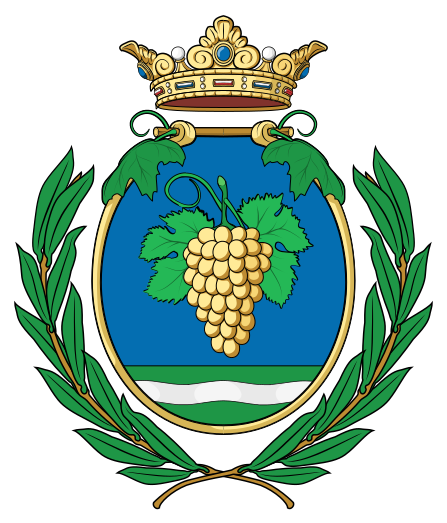
Renewed coat of arms of Sajólászlófalva
Location:
Type:
Status:
Made by:
Sajólászlófalva
Sajólászlófalva is a village in Borsod-Abaúj-Zemplén County, within the Miskolc District. The settlement was named after Saint Ladislaus (St. László), whose cult was particularly strong in the region of Borsod.
The New Official Coat of Arms
The new official coat of arms features an upright, oval, blue military shield. At the base of the shield is a green field charged with a wavy silver fess. Above it floats a golden grape cluster with green leaves. The shield is framed by two willow branches crossing each other by their stems, and above the shield a golden crown is displayed.
The silver fess and the willow branches symbolize the River Sajó, while the grape cluster represents the settlement’s long-standing tradition of viticulture.
Location
Sajólászlófalva lies in the northern part of the Bükk region, within the Tardona Hills, 21 kilometres from Miskolc. It is one of six villages (Varbó, Parasznya, Radostyán, Kondó, Sajólászlófalva and Sajókápolna) situated in the picturesque Pitypalatty Valley, surrounded by wooded hills. These neighbouring settlements are closely connected, providing a home for their inhabitants and offering attractions for visitors to the region.
The directly neighbouring settlements are Sajókápolna to the north, Sajóbábony to the east, Miskolc–Pereces to the south, Radostyán to the southwest, and Kondó to the west.
History of Sajólászlófalva
Chartered records relating to the village can be found from the 14th century onwards, although members of the Lászlófalvai family appear even earlier in references to royal officials. This suggests that the settlement already existed during the Árpád era, under the name Lazlófalua. Over time, its name underwent several changes, appearing in forms such as Laslófalwa, Lászlófalwa, and Lazlo Falwa.
During the period of Ottoman rule, the village paid taxes as part of the occupied territories. The Reformation spread in the area from 1576; Sajólászlófalva first functioned as a filial church and later as an independent parish, rebuilding its church in 1706. In the 17th century, the area was known for its quality wine production. During this period, part of the estate was granted to Gergely Bodó, after which it came into the possession of the Pálóczi, Horvát, and Szirmai families. By the end of the 18th century, the village was owned by the Fáy and Almássy families.
Original image source: https://www.nemzetijelkepek.hu/onkormanyzati-cimerek
Text source: Wikipedia

The visual content of this website may be freely used under the terms of the Creative Commons 4.0 license, provided that the source is clearly indicated and the attribution includes a full, clickable link to https://cimerek.hu or to the exact web address of the specific content.
