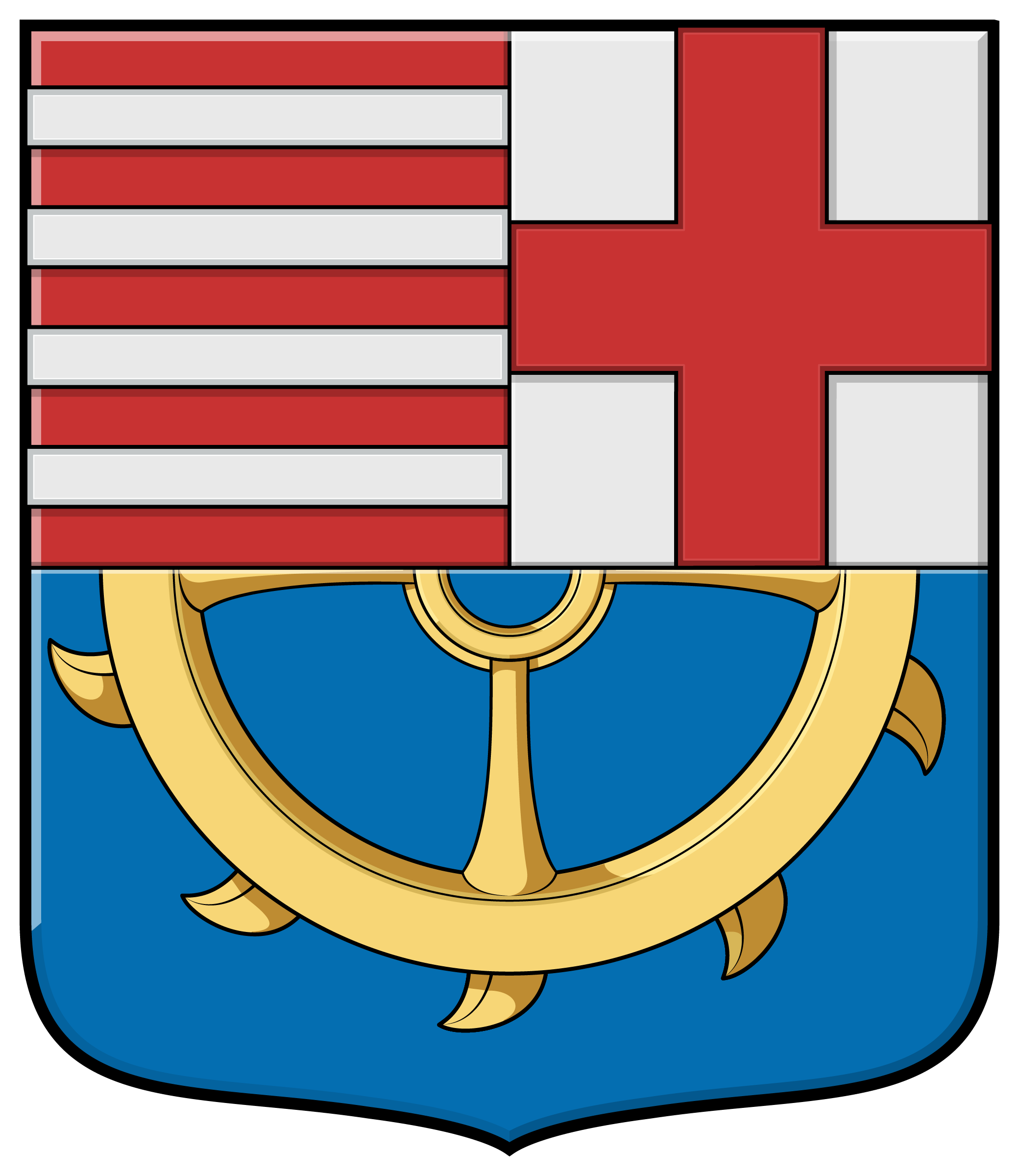
Coat of arms of Örvényes
Location:
Type:
Status:
Örvényes
(in German: Erewin) is a village in Veszprém County, in the Balatonfüred District. Formerly, from the time of Saint Stephen, King of Hungary, until the county reorganization of 1945, it belonged to Zala County.
The shield is upright, divided horizontally and split at the top. In the first (red) field there are four horizontal silver bars. In the second (silver) field appears a red Greek cross; in the lower blue section, rising downward from the dividing line, a gilded mill wheel is depicted with three spokes and five paddles, of which the outermost are only partially visible.
The four stripes of the first field refer to the settlement’s ancient, Árpád-era past. The second motif, the cross, commemorates the resettlement that took place in 1722. In that year, Abbot Grasso invited German-speaking settlers from the present-day German state of Rhineland-Palatinate. The red Greek cross on a silver field is one of the principal heraldic motifs of that region. The third symbol, the mill wheel, refers to the mills that have existed and operated in the village since the 13th century. Of the three former watermills, one is still in operation today as a notable monument of the area.
Location of Örvényes
Örvényes lies on the northern shore of Lake Balaton, near the Tihany Peninsula. The old village is situated slightly away from the lakeshore, on the northern side of the main road and railway line crossing the area. A somewhat separate part of the settlement, Tanítótelep, is located in the eastern part of the built-up area, between the railway and the lakeshore.
It has only four neighboring settlements: Aszófő to the northeast, Tihany to the east–southeast, Balatonudvari to the southwest, and Pécsely to the north–northwest; it narrowly misses bordering Vászoly to the northwest as well.
History of Örvényes
Based on archaeological finds, the settlement and its surroundings have been inhabited since prehistoric times.
Örvényes is an Árpád-era settlement. Its name was already mentioned in 1093 as Ermenes, and later appeared in the forms Eurmenus, Ermenus, Ewrmenes, and Wrmenes. Its original meaning may have been “őrményes,” that is, “place of milling,” referring to watermills.
In 1211 it was mentioned as a possession of the Benedictine Abbey of Tihany.
Under Ottoman rule, it became almost completely depopulated by 1593.
In 1733, Abbot Grasso of Tihany resettled the village with German settlers from the Rhineland-Palatinate region. In memory of this event, a fragment of the provincial coat of arms appears in the coat of arms of Örvényes.
The inhabitants are primarily engaged in viticulture, winemaking, and tourism.
Örvényes is surrounded by the Balaton Uplands National Park, which includes the valley of the Pécsely Stream, the ancient oak grove north of the village above the former mine, and the ruins of Zádor Castle, located three kilometers away.
On the gentle hills surrounding the village, native Balaton grape varieties are cultivated.
Az eredeti kép forrása: Nemzetijelkepek.hu
Szöveg forrása: Wikipedia

The visual content of this website may be freely used under the terms of the Creative Commons 4.0 license, provided that the source is clearly indicated and the attribution includes a full, clickable link to https://cimerek.hu or to the exact web address of the specific content.