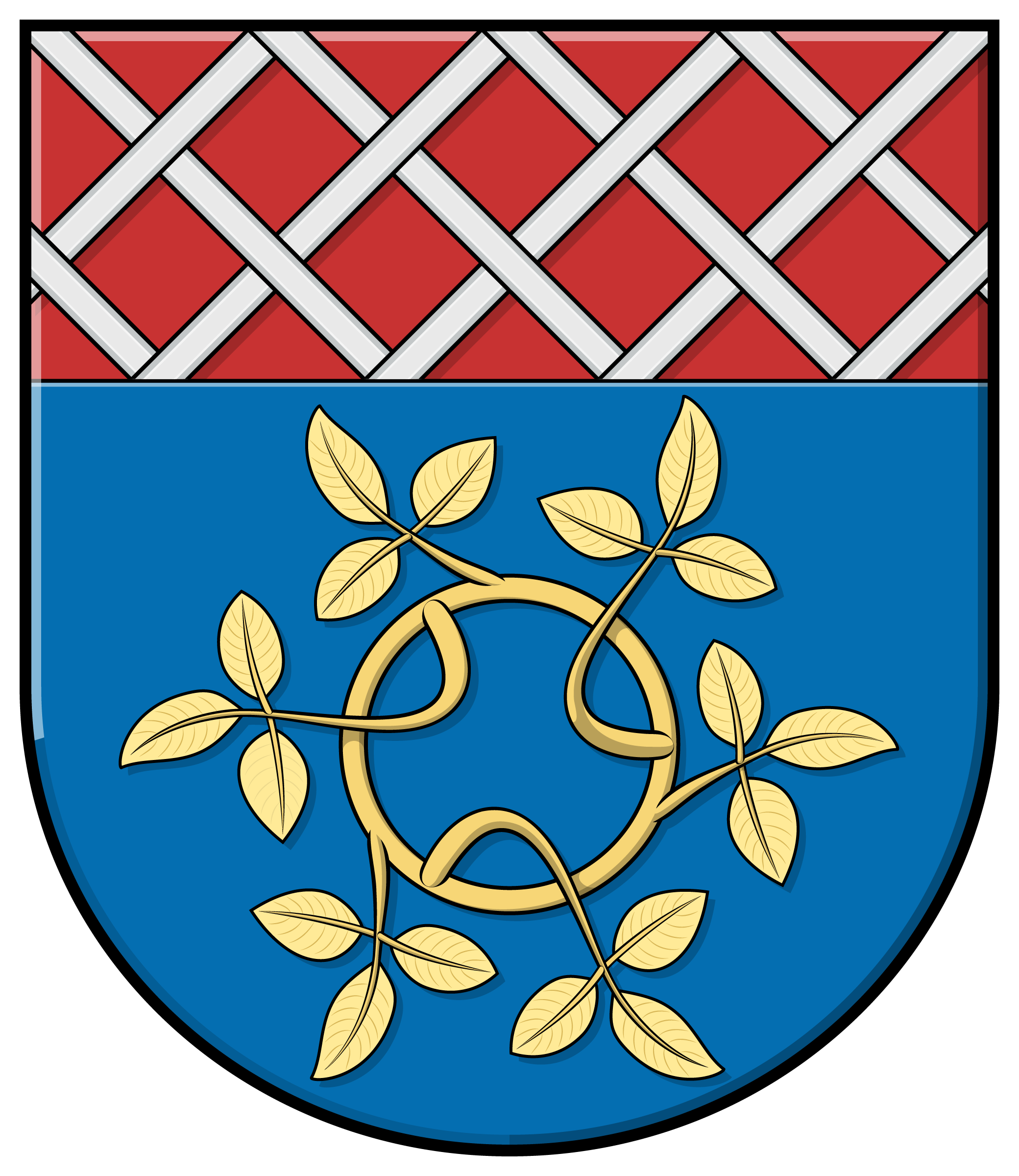
Coat of arms of Nagymányok
Location:
Type:
Status:
Nagymányok – a Town in Tolna County
Nagymányok is a historic settlement in Tolna County, within the Bonyhád District of Hungary. Its German name is Großmanok. Formerly classified as a large village, it was granted town status on July 1, 2009.
Location
Nagymányok lies on the eastern slopes of the Mecsek Hills, in southern Tolna County. The surrounding area is hilly, forested, and rich in vineyards, making it ideal for hiking and nature tourism. The nearest town is Bonyhád (approx. 8 km), and the county seat, Szekszárd, is about 27 km away.
History of Nagymányok
The first written record of the settlement dates back to 1015, when it was mentioned as Manek in a land donation by Prince Damaslaus to the monastery of Pécsvárad.
Over the centuries, the name evolved several times: Manky, Meneke, Manyk, Manyuk, Mányok, and eventually Nagymányok.
Following the Ottoman occupation, the area became depopulated and was later repopulated by German-speaking Catholic settlers. A significant portion of the current population is still of German descent.
Economic and Social Development
The town’s development was closely tied to coal mining:
The construction of the railway in 1873 supported both mining and industrial growth.
Mining activities were particularly significant during the 19th and 20th centuries, shaping the town’s structure (e.g., areas like Bányatelep and Újtelep).
Attractions
St. Michael Roman Catholic Church – Built in Baroque style and consecrated in 1783. It replaced an earlier church destroyed during the Ottoman period.
German Ethnographic House (Tájház) – A traditional Swabian farmhouse showcasing local history and folk culture.
Calvary Hill, monuments, chapels, and wine cellars – The town features several cultural and historical landmarks.
Population
As of January 1, 2025, the population of Nagymányok is approximately 2,100–2,300. The majority are ethnic Hungarians, but the German minority remains a prominent part of the community.
Interesting Facts
The town continues to nurture its German heritage, supported by a local German minority self-government and cultural preservation groups.
The German Ethnographic House has received multiple honors, including the title “Folk House of the Year”.
Coat of Arms of Nagymányok
The coat of arms features a rounded base shield, vertically divided with a chief bearing a central figure. In the light crimson-red chief, a silver interlace appears; below it, on a cobalt-blue field, a six-branched golden wreath is depicted, with three elliptical leaves on each branch. The wreath’s plant motif is inspired by the biblical balsam tree.
The Golden Rain tree, native to Transdanubia and the Mecsek, shares similar branch and leaf structures, symbolically linking the design to the region’s geography.
The wreath represents the village and the preservation of tradition. Its circular, woven shape refers to the town’s renewal after Mongol and Ottoman devastations.
Blue symbolizes freedom,
Gold stands for the ancient past,
Red and blue together are the traditional colors of Tolna County.
The silver interlace in the red chief symbolizes the town’s industrial heritage. The black border of the shield represents the coal mining and briquette industry, which played a crucial role in the settlement’s development until recent times.
The interlace also alludes to the local convent and to the intertwined lives of Hungarians and Germans, symbolizing their mutual reliance and unity.
Az eredeti kép forrása: Nemzetijelkepek.hu
Forrás: ChatGPT

The visual content of this website may be freely used under the terms of the Creative Commons 4.0 license, provided that the source is clearly indicated and the attribution includes a full, clickable link to https://cimerek.hu or to the exact web address of the specific content.