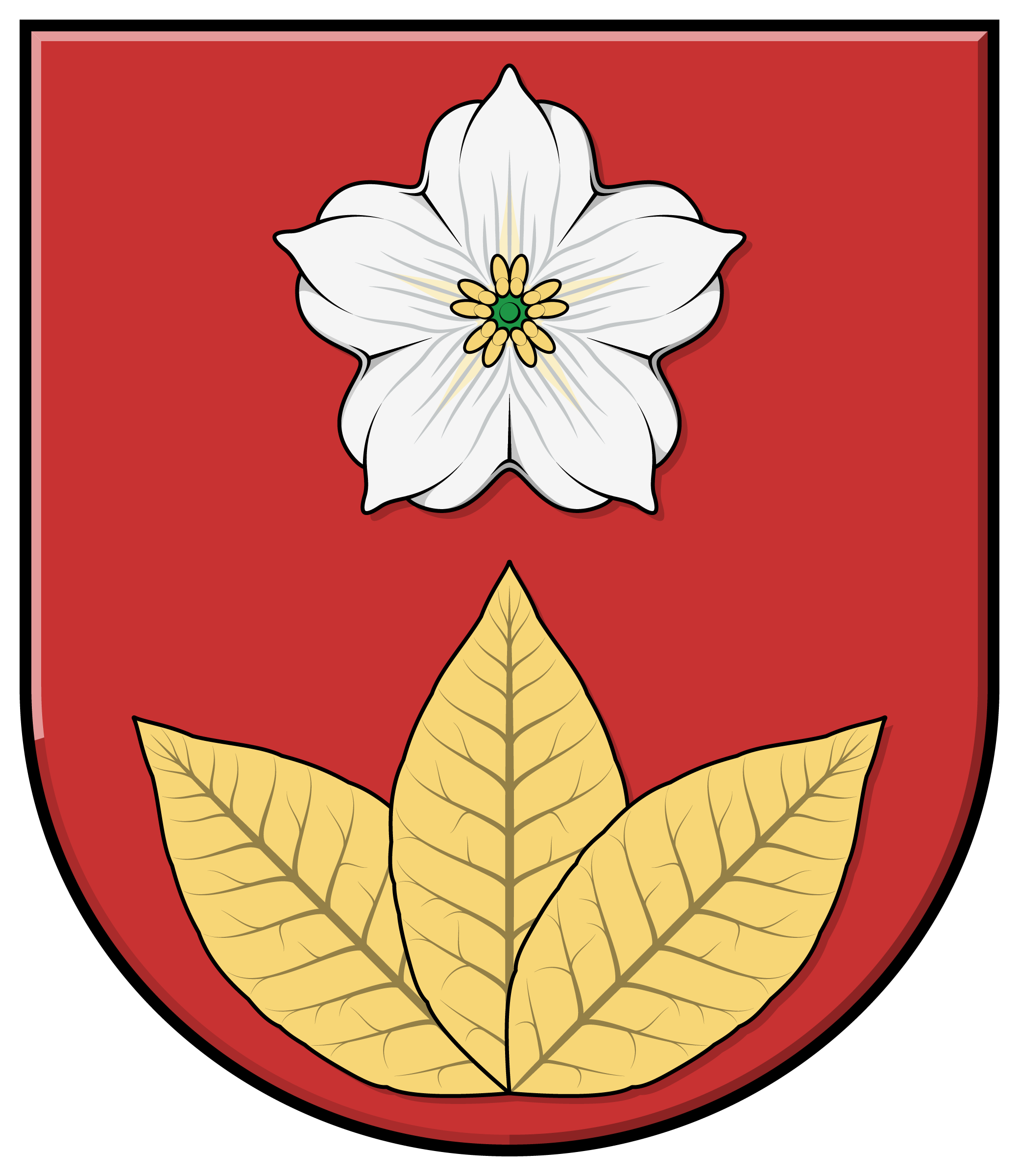
Coat of arms of Mike
Lokáció:
Típus:
Jogállás:
Location of Mike
Mike is a village in Somogy County, approximately 23 kilometres southwest of Kaposvár and west of the town of Kadarkút. The 6616 road, connecting Kaposfő and Lábod, passes through the centre of the settlement, providing access towards Kaposvár, Nagyatád, and the main roads No. 61 and No. 68.
The village is situated in the central part of Somogy County. Its surroundings are characterised by agricultural land, forests and small watercourses, which have influenced local farming and the development of the settlement for centuries.
History of Mike
The area of present-day Mike has been inhabited since prehistoric times. Archaeological finds indicate the presence of Avar, Celtic, Roman and Hungarian Conquest-period communities. The settlement was first mentioned in written records in 1213 under the name Mica. About two centuries later, it became an estate of the Priory of Vrana.
In the Ottoman tax register of 1554, the village appears under the name Miske, with only five households recorded. During the Ottoman wars, the settlement was completely abandoned. In 1745, the estate came into the possession of the Somssich family, who played a decisive role in the later development of the village.
During the 19th century, German settlers were followed by Hungarian families. At that time, Mike held the status of a market town and had already been granted the right to hold six annual fairs in the mid-18th century. The Somssich Mansion, completed in 1821, became one of the settlement’s most important historic buildings. In 1838, the estate owners established a school, which was later expanded, while a kindergarten was opened in 1907.
During the first decades of the 20th century, community life flourished. The village maintained a volunteer fire brigade, a shooting association, an agricultural society, a credit and mutual aid cooperative, and even a local casino. Both World Wars caused considerable losses. After the Second World War, part of the German-speaking population was deported, while Hungarian families resettled from Upper Hungary (present-day Slovakia) were given land and homes in the village.
Following the political changes of 1990, Mike regained its independent local government. Agriculture remains the village’s principal economic activity, with potato cultivation continuing to play a significant role.
Main Landmarks
The village contains four protected historic monuments: the Somssich Mansion, a 19th-century granary, the statue of Saint Wendelin erected in 1898, and the abandoned Somssich Mausoleum located near a lake outside the inhabited area.
Mike is also known in the history of science as the site where the Mike meteorite fell on 3 May 1944, becoming one of Hungary’s notable recorded meteorite falls.
Coat of Arms of Mike
The coat of arms consists of a round-based shield. In its red field, three golden tobacco leaves with black veins are arranged in a fan shape in the base of the shield. Above them is a silver five-petalled potato flower with a green centre and ten golden anthers.
Source of the original image: Nemzetijelkepek.hu

The visual content of this website may be freely used under the terms of the Creative Commons 4.0 license, provided that the source is clearly indicated and the attribution includes a full, clickable link to https://cimerek.hu or to the exact web address of the specific content.