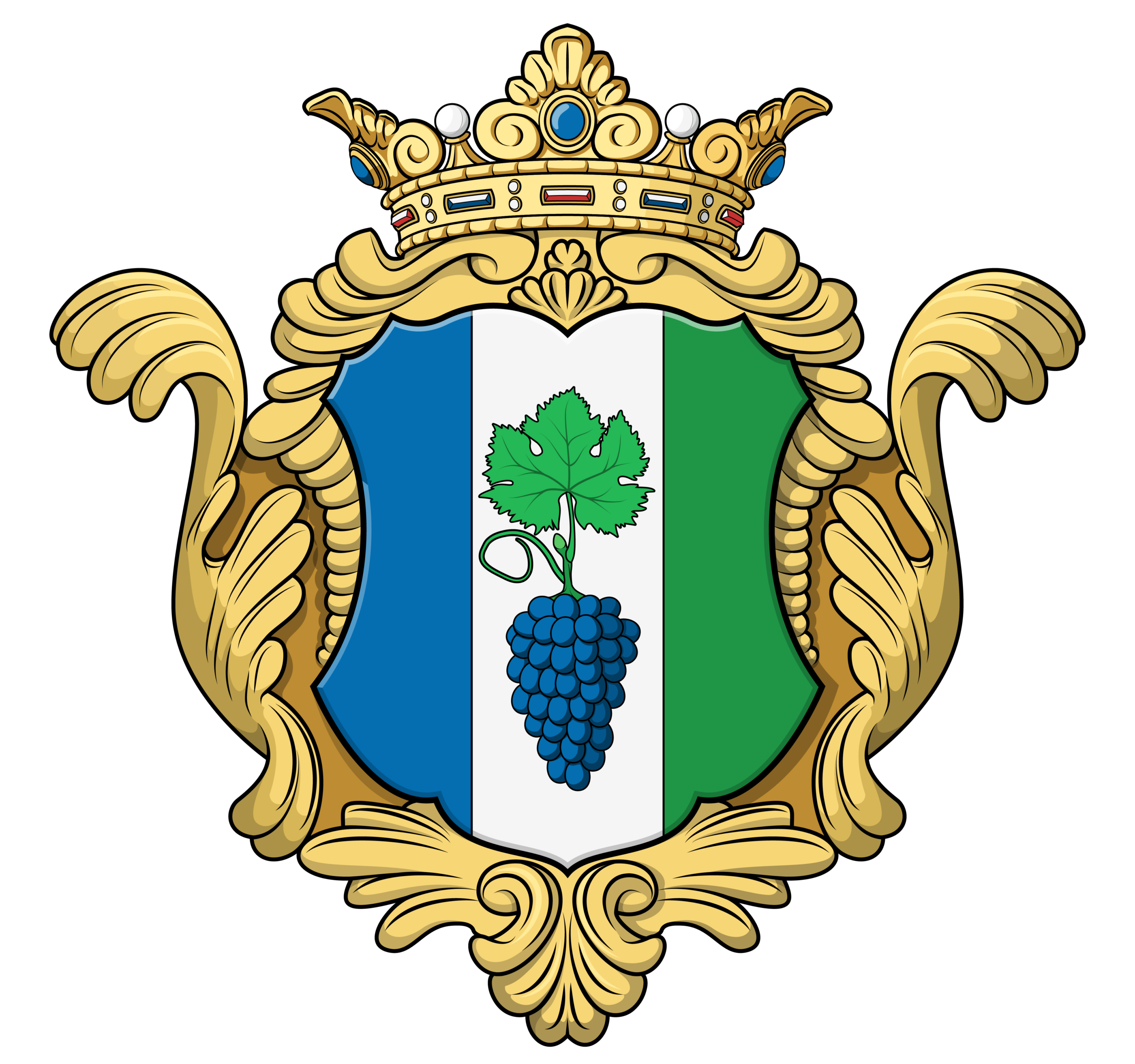
Coat of arms of Kiskunlacháza
Location:
Type:
Status:
Year:
Made by:
Kiskunlacháza
Town in Pest County, in the Ráckeve District.
In the new coat of arms, the former coats of arms of Kiskunlacháza and Pereg were combined, symbolising the unification of the two settlements.
Location
Kiskunlacháza is situated on the Csepel Plain, south of Budapest, on the left bank of the Ráckeve branch of the Danube.
Neighbouring settlements are Áporka to the north, Délegyháza to the northeast, Bugyi to the east, Apaj to the southeast, Dömsöd to the south, Ráckeve to the southwest, and Szigetszentmárton to the northwest. The latter two settlements lie on the opposite bank of the Ráckeve Danube, on Csepel Island. The town’s outlying areas extend far to the north of the centre, where it also borders the otherwise more distant settlement of Majosháza.
History of Kiskunlacháza
The settlement and its surroundings have been inhabited since the time of the Hungarian Conquest. Its earliest known name was Szántó, derived from the royal service people known as rab szántó.
Around 1020, King Stephen I granted Szántó to the Benedictine nunnery of Veszprémvölgy. As recorded in the Greek founding charter and its later Latin renewal, the village of Szántó by the Danube was donated together with 30 plus 20 servile labourers, the Saturday ferry crossing on the Danube with seven ferrymen, the toll from the Saturday market, and twelve Danube fishermen.
Between about 1272 and 1290, King Ladislaus IV granted the Szántó estate belonging to the royal castle lands of Fehérvár, adjacent to the land of Beek, who had died without heirs, to the royal treasury officials and stewards Peter, Abraham, Comes Jacob, and Herboldus (tavarnici et dapiferi), and had its boundaries recorded.
In 1300, Herbordus of “Szigetmellék” and Kulus, ancestors of the Lack and Kolos families of Szántó, appeared with two companions in a land dispute near Taksony. In 1321, part of Szántó belonged to a certain László, whom Kolus had adopted as his brother; after László’s death without heirs, the king initially granted his land to John, son of Botond, then reclaimed it within the same year and instead bestowed it upon the sons of Kolus—brothers Nicholas, Kolus, and Lack—confirming the donation in 1324. In 1326, Nicholas called Tretul, ispán of Pozsony, and Nicholas called Lepes, son of Rorandus, transferred their Szántó estates to the sons of Kolos of Szigetmellék (de iuxta Magna Insula): Master Kulus, Lachk, and Nicholas. In 1329, the Szántó estate of the sons of Herbordus was demarcated from the neighbouring village of Pereg, owned by Imre Becsei.
In 1331–1332, Herbordus’s sons—Beke, Andrew, and Etel—together with Giles, son of Donatus, compensated the masters Teuteus Becsei (Töttös) and Vezzeus, as well as their sister Margaret, wife of Abraham, son of Herbold, with lands at Izsótelk. In 1376, Izsótelk, and in 1420 Herboldháza, were identified as being identical with Szántó.
Szántó later took the name Lackháza after one of its owners, Lack, son of Kolos, and his descendants, the Lackfi family of Szántó.
On 1 September 2021, Kiskunlacháza was granted town status.
Pereg
Pereg is a settlement dating back to the Árpád period and has formed part of Kiskunlacháza since 1950. In the 13th century, Pereg was partly land belonging to Fehérvár and partly a noble estate. Its first known owner was Yginig of Pereg, who had previously owned a Danube island; this was confiscated by King Andrew II, who granted him the castle land of Pereg in compensation.
In 1239, King Béla IV determined that the confiscated island had been significantly larger than the granted castle land and therefore allowed Yginig’s sons, Gregory and Enoc, to retain it. In 1298, Peter, son of Tenkeleu, received three markae as his wife Salch’s daughter’s quarter from the sons of Martin Peregi; the transaction was mediated by Peter, son of Inok, comes and priest of (Sziget-)Szentmiklós, and Benedict, son of Kuch, also a comes.
In 1312, members of the Ürbői family sold a Pereg estate for ten markae to Imre Becsei, next to the land of Peter called Bicch. After the death without heirs of John, son of Peter, son of Inok, King Charles I (Charles Robert) granted their Pereg estate to Comes Imre Becsei. Between 1312 and 1329, Becsei acquired the Pereg lands through purchases. In 1329, his Pereg estate was demarcated from the village of Szántó (Lackháza) lying to the north; the charter notes that a road led from the boundary toward the Church of Saint Emeric. For this reason, the village was also known in the 15th century as Kispereg or Szentimrefalva. Further south lay Nagypereg, owned by Nicholas Treutel.
In 1332, the parish priest of Pereg paid seven garas in papal tithe.
Original image source: https://www.nemzetijelkepek.hu/onkormanyzati-cimerek (website discontinued)
Text source: Wikipedia

The visual content of this website may be freely used under the terms of the Creative Commons 4.0 license, provided that the source is clearly indicated and the attribution includes a full, clickable link to https://cimerek.hu or to the exact web address of the specific content.