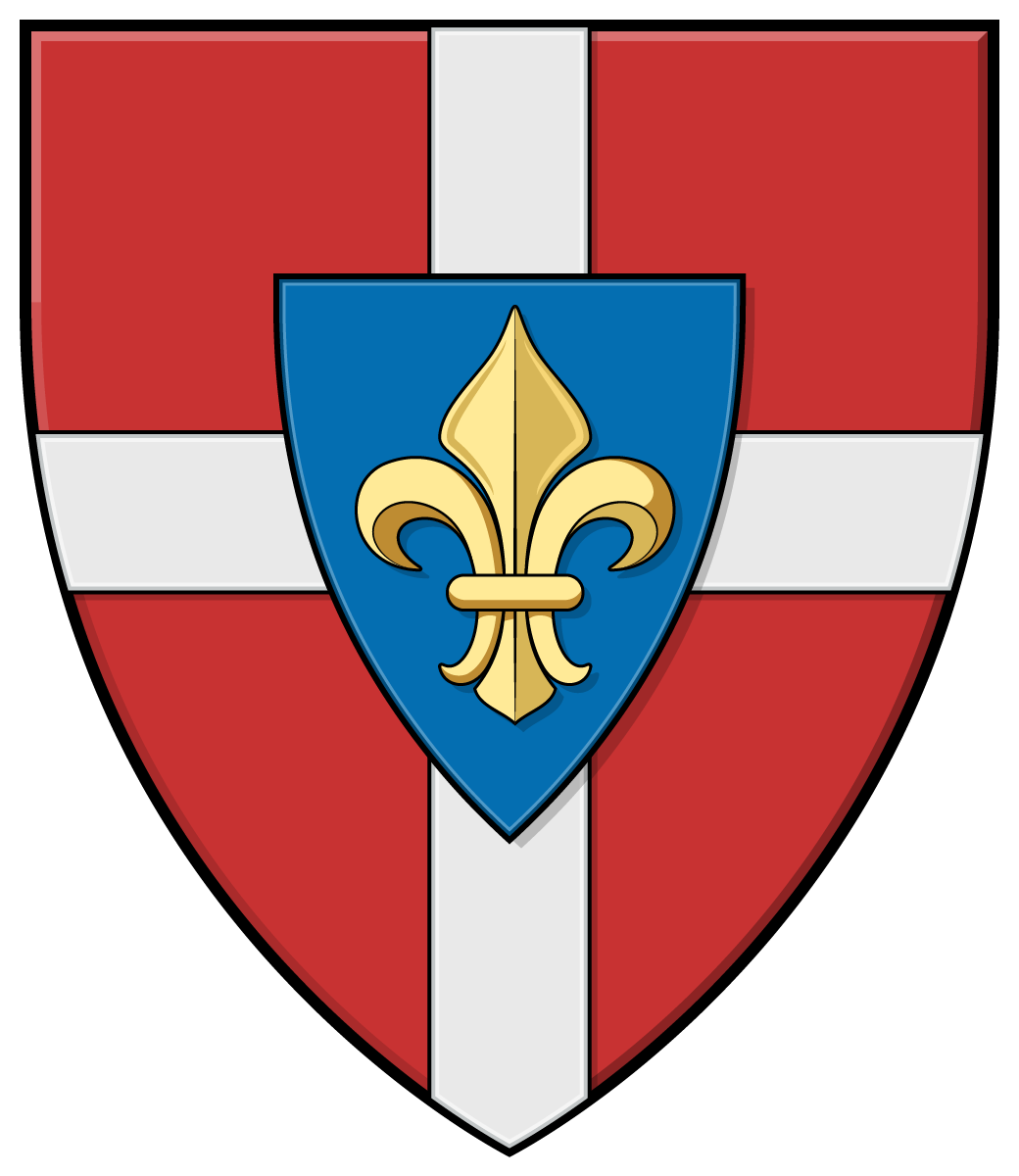
Coat of arms of Kaposszerdahely
Location:
Type:
Status:
Kaposszerdahely
A village in Somogy County, within the Kaposvár District.
Description of the Coat of Arms
A triangular red shield divided into four quarters by a silver pale and a silver fess arranged in the form of a cross. At the center of the shield is a small blue inescutcheon, in which a golden heraldic fleur-de-lis floats.
Location
Kaposszerdahely is situated in Somogy County, south of the county seat Kaposvár, on the edge of the Zselic region. Most of the village houses lie along the main road leading into the Zselic, in the valley of the Berki Stream. Two newer residential areas, Kisszennai and the Saint Stephen Housing Estate, were built on the hills overlooking the valley.
History of Kaposszerdahely
Medieval Period
The history of Kaposszerdahely dates back to 1230, when Tamás, son of Makariás, head (ispán) of the Monoszló kindred, was granted the right to hold a market on Wednesdays beneath Ropoly Castle. In 1245, the settlement—by then already known as Szerdahely—was purchased by the Dersfi family, and by 1332 it had both a church and a parish. At that time, charters mentioned it together with Tókaj.
In 1335, Miklós Dersfi founded a Pauline monastery in honor of Saint Ladislaus. In the same year, the judge royal attempted to survey the boundaries of Tókaj in connection with a legal dispute; however, local inhabitants, led by the deputy ispán of the court servants and Simon, the village judge, drove away the surveyors with arrows. In 1346, the two Dersfi brothers, Miklós and Péter, divided their estates equally, with Szerdahely falling to Miklós. In 1394, Queen Maryherself visited the Szerdahely pilgrimage held on the feast of Saint Lawrence.
In 1408, the village became the property of János Szerdahelyi Koron, and between 1443 and 1453 it belonged to Kaposvár Castle. In 1495, János Berzenczei Bornemissza and his relatives attacked the monastery and stole documents kept there belonging to Orsolya Danch and Veronika Danch. In 1501, Miklós Dersfi, “due to pressing necessity,” mortgaged several of his villages—including Szerdahely—to Imre Enyinghy Therek and his wife, Lady Krisztina.
In 1555, when the Ottomans captured Kaposvár Castle, the monks of the Szerdahely monastery fled, and the population escaped into the surrounding forests to avoid the destruction of the village. According to the Ottoman tax register of 1563, the settlement—then referred to as Városszerdahely—had only two houses. However, as resettlement began, the number of taxable households rose to eight by 1571. For a time, the Ottomans even designated Szerdahely as the center of a nahiye (district). In 1706, when Kaposvár fell into the hands of the Kuruc rebels, the previously settled Serb (Rác)population abandoned the Zselic villages amid looting and arson.
Early Modern Period
In 1726, during the official settlement of property relations, Szerdahely—following the extinction of the Dersfi family—passed into the possession of the Lengyel and Prilej families. They established extensive vineyards, and by that time a noble manor house already stood on the site of the former monastery (its ruins were reportedly still visible in 1812). In 1802, a chapel was built on the site of the destroyed church. The cholera epidemic of 1831 claimed 30 local victims. In 1867, following a county decree ordering the demolition of so-called “outlaw inns,” the Barna Inn of Szerdahely was also torn down.
Modern Period of Kaposszerdahely
In 1895, when civil registration was introduced in Hungary, Szerdahely was assigned to the Szenna registry district. In the final years of the century, indebted medium landowners sold their local estates, while smallholder families settled in the village. In 1904, a school was built, and in 1909 the Minister of the Interior granted the settlement the name Kaposszerdahely (a designation that became final only in 1929).
At the outbreak of World War I, local men were conscripted into the 44th Common Infantry Regiment and the 19th Honvéd Infantry Regiment, both stationed in Kaposvár. Kaposszerdahely was declared an independent small village only in 1922, although administrative affairs continued to be handled in Szenna.
In 1918, the Ropoly economic narrow-gauge railway was opened, connecting Kaposvár with the Ropoly Forest, with one of its stops located at the Szerdahely mill. Forestry work provided a livelihood for many locals, who boarded the railcars daily at 6 a.m. and returned home at 6 p.m., riding atop trains loaded with timber. The narrow-gauge railway ceased operation in 1929. Two years earlier, the village’s World War I memorial was inaugurated, and in 1932 a macadam road was built through the settlement.
Three years later, the church still standing today was completed. During the final years of World War II, which claimed 28 local victims, Kaposszerdahely also received refugees from neighboring settlements. The village was connected to the electric grid in 1949. On 27 May 1950, Tókajpuszta and Kisszenna—the latter previously belonging to Szenna—were annexed to the settlement. In 1951, Kaposszerdahely became a municipality with an independent council and civil registry. The local agricultural cooperative was established in 1961, later merging in 1968 with the Zselic Táj Cooperative of Szenna. In 1969, the independent council was abolished and the administrative center returned to Szenna. Drinking water was introduced in 1984, telephone service in 1990, and natural gas in 1993.
Original image source: https://www.nemzetijelkepek.hu/onkormanyzati-cimerek (website discontinued)
Text source: Wikipedia

The visual content of this website may be freely used under the terms of the Creative Commons 4.0 license, provided that the source is clearly indicated and the attribution includes a full, clickable link to https://cimerek.hu or to the exact web address of the specific content.