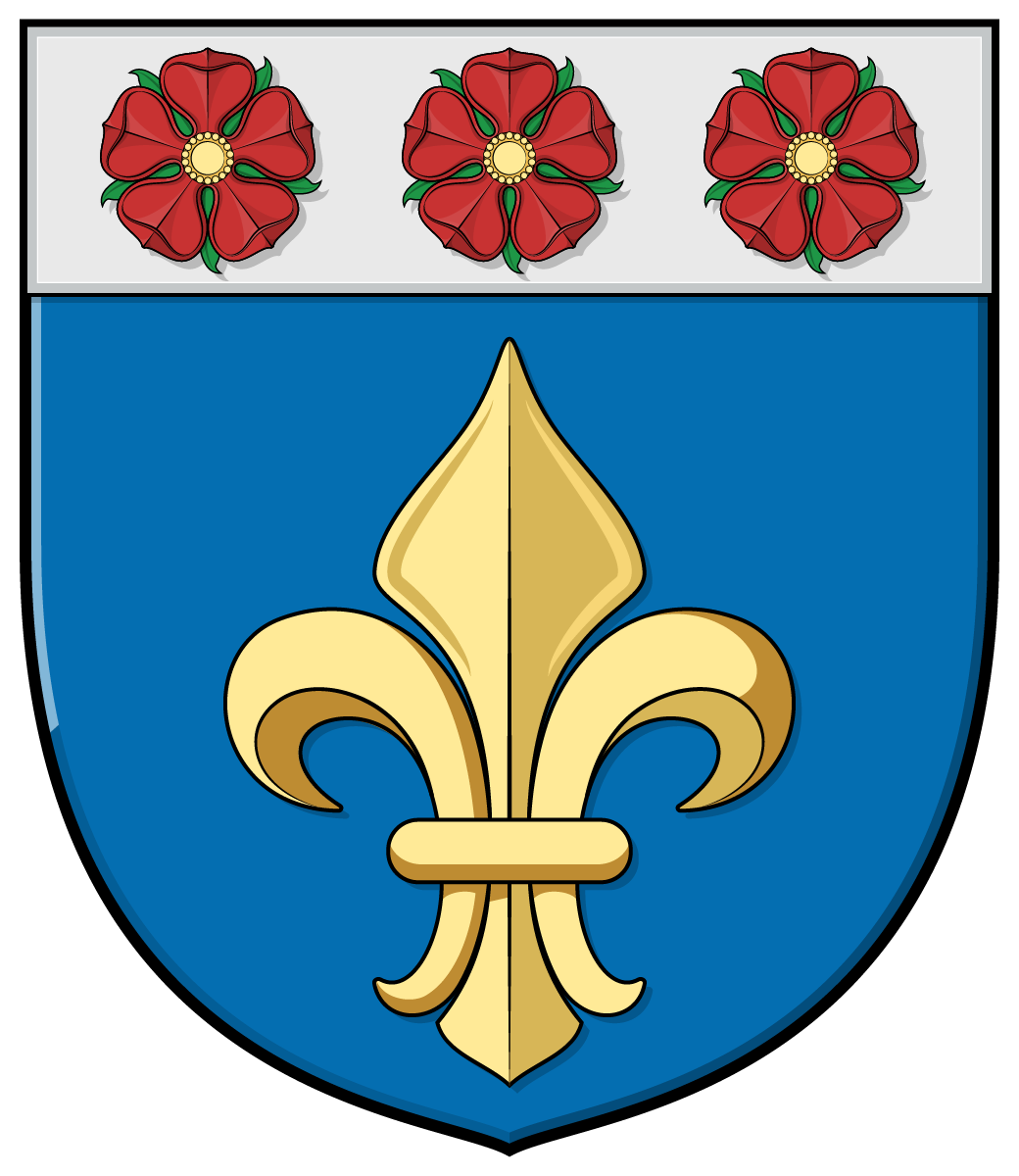
Coat of arms of Kaposgyarmat
Location:
Type:
Status:
Kaposgyarmat
A village in Somogy County, within the Kaposvár District.
Description of the Coat of Arms
The coat of arms consists of two triangular shields with a silver chief. In the blue field appears a golden heraldic fleur-de-lis, taken from the coat of arms of the Győr kindred. In the silver field are three red heraldic roses with golden centers. On the larger shield, the fleur-de-lis refers to the Győr kindred as the earliest known landholders. The three roses placed in the chief symbolize the village’s patron saint, Saint Elizabeth of Hungary (Elizabeth of the Árpád dynasty), and were included in the coat of arms in her honor.
Location
Kaposgyarmat is located 18 kilometers southeast of Kaposvár, in the Zselic region. The 6621 road, connecting the main roads No. 66 and 67 between Sántos and Bőszénfa, passes through its administrative area; the village lies just over 4 kilometers from the Sántos junction of Road 66. The center of the settlement can only be accessed via the 66 157secondary road branching off from this route.
History of Kaposgyarmat
Kaposgyarmat, formerly known as Gyarmat, was first mentioned in 1296, when it was purchased by Ders, son of Ders Iof the Győr kindred. During the familial division of property in 1346, the ancestors of the Szerdahelyi Dersfi family acquired the settlement, and in 1375 the Szerdahelyi Dersfi family was formally installed as its owner.
In 1425, the sons of János Szerdahelyi Csepel, Imre and Dancs, together with Márton Szerdahelyi Dersfi, laid claim to the village in opposition to the Abbey of Zselicszentjakab. In 1454, Pál Dancsfi was also among the landholders, pledging his local estates to Mihály Somi. According to the 1660 tithe redemption register, the owner at that time was Mrs. Farkas Imrefy.
In 1715, the village was owned by Count József Esterházy, and only three households were recorded there. By 1726, it had become part of the Esterházy princely entailed estate.
According to early 20th-century records, the settlement also included Vörösalma-puszta, whose name already appeared in 1375 in the form possessio Veresalma, when it was likewise granted to the Szerdahelyi Dersfi family. In 1454, it belonged to Pál Szerdahelyi Dancs, who mortgaged it to Mihály and Demeter Somi. From 1726 onward, it too formed part of the Esterházy princely entailed estate.
Original image source: https://www.nemzetijelkepek.hu/onkormanyzati-cimerek (website discontinued)
Text source: Wikipedia

The visual content of this website may be freely used under the terms of the Creative Commons 4.0 license, provided that the source is clearly indicated and the attribution includes a full, clickable link to https://cimerek.hu or to the exact web address of the specific content.